Showing posts with label auction. Show all posts

City Hall Review


City Hall board game in play

As a board game enthusiast, occasionally I get to play prototypes of games.  These can be hit or miss, with most of them still needing to be refined.  But, every now and then the prototype is amazing and you want to play it a lot more.  This is how I initially played City Hall.  And, after two years of waiting for it to be published in its final form, I finally have a copy!!

In City Hall, the players are competing to become mayor of New York City.  In order to become mayor, they have to win the most votes - by bringing people into the city, and also making sure they have a high approval rating among the people they bring in.  The game consists of a series of turns, with each turn having all of the players select different roles to be performed.  However, whenever a role is performed, there is an auction of Influence (one of the currencies in the game), and whoever spends the most Influence gets to do the action associated with the role.  And, if the person who selected the role chooses not to perform it himself (chooses not to win the auction), then he gets to keep all of the Influence from the high bid.  These roles allow you to purchase land, build upon your land, run campaigns to increase your approval, bring people into the city, acquire extra Influence or money, and move the turn order.  Whichever roles aren't selected at the end of each turn have an Influence placed on them to incentivize players to select them later.  Play continues turn after turn until a player has maxed out their approval, or until all the players have collectively improved enough land.  Then there is a final turn with all of the roles being activated, one final population check, and then the final vote to see who becomes mayor!  (Note: there is no chance that some guy from Boston that wasn't even playing comes in at the last second and wins the vote - one of the players always wins.  I know, I ruined some of the excitement of the election.  Second Note: that was supposed to be a joke.  I'm pretty sure it failed miserably, though.)

Board Setup for City Hall
The board design is also slick - each role is with what it affects
My first pro for City Hall is that I like how the role selection works with the auctions.  This mechanic really encourages you to sometimes select roles that you don't even want, just to give you a better chance of getting to perform the roles that you need.  For example, if you can't earn very much money from taxes, but all of your opponents can, and you don't have much Influence, it might be better to select the Tax Assessor than a role that you want to perform.  Hopefully your opponents will all want to perform the Tax Assessor, thus letting you collect quite a few Influence in preparation for whatever role you need.  Conversely, if you have a lot of Influence, getting to select the role that you need can be very powerful - as the person selecting the role, you make the final say over who gets to perform it (such as yourself), and if you have enough Influence to match any bid, then you can guarantee to perform it without accidentally bidding more than you need to (or risking getting outbid).

The next pro that I have for City Hall is that I don't feel like there are any bad roles (which is impressive, since there are seven roles).  Now, there are some roles that will be performed more frequently than others.  But the less frequent roles can really make a large impact on the game when they finally are selected.  The roles that I see selected least frequently are the Deputy Mayor (which allows you to move to the top of the turn order), and the Lobbyist (which allows you to collect Influence based on your Approval Rating - and then you can buy or sell Influence).  The benefits of these roles may appear minor, but once you also factor in the number of Influence that might be sitting on them from having not been selected in a few turns, they can really shift the balance of the game.  Selecting Deputy Mayor and suddenly getting first choice of roles each round lets you select more roles that have Influence on them, and lets you avoid overbidding for the role you most want.  And, being the Lobbyist when you have a lot of Influence, and selling that Influence for money can sometimes give you all the money you will need for the rest of the game!

Housing layout example
Queens was popular in this game
The last pro that I will mention is that I appreciate how City Hall encourages you to buy land that is unpopular.  Each time you gain new land, you have three locations to select from.  Whichever two locations aren't selected will have $5 placed on them.  (When buying land, you must pay $20, but at the beginning of the game you get some land for free.)  So, if a certain location is regularly passed on, it may have $20 or more on it!  Then you can choose between getting a free piece of land that might be in a less ideal location, or paying for land in a better location.  And, which decision you make (and how you're able to capitalize on that decision) can really swing the outcome of the game!

Now that I have praised City Hall, there is one con that I need to mention.  Initial placement on the board seems to have a very strong influence on the game.  Whereas I want initial placement to matter, it sometimes feels like it matters too much.  Each type of building you play has a maximum number of stars that can be placed on it.  (Stars are used when determining how many people come into the city - you want a lot of stars.)  Also, each type of building gains or loses stars based on what other buildings are next to it.  So, Housing specifically can be powerful if it is near other Housing.  It has the most stars possible (5), and it gets more stars for being near Housing (2) than any other type of building.  Your buildings also play off of each other player's buildings - which is pretty cool.  But, if two players start with adjacent Housing, and the other players start elsewhere without the ability to get as many stars, then the players with Housing might be able to dominate the population all game without the other players having much ability to catch up.  This is especially the case if either of those players is able to place another Housing next to the existing ones.  I have not played the game enough to say that Housing is overpowered, or that there is a single "right" initial move (and, in fact, I don't think there is, since all of the placement can be affected by what your opponents do), but I do have concerns that an early lead in stars feels almost insurmountable.  (If you're wondering, the initial placement options other than Housing allow you to earn extra money but have less stars.)

Overall, I give City Hall a 9.5/10.  I have loved my playthroughs of this game, and I want to play it more.  Rarely do I find games that I think work incredibly well with each player count, but I've enjoyed City Hall at 2, 3, and 4 players, and I would gladly play again at any of these counts!

If you enjoy City Hall, you might also check out Goa, Notre Dame, and Puerto Rico (one of my very early reviews).

I would like to thank Tasty Minstrel Games for providing me with a review copy of City Hall.

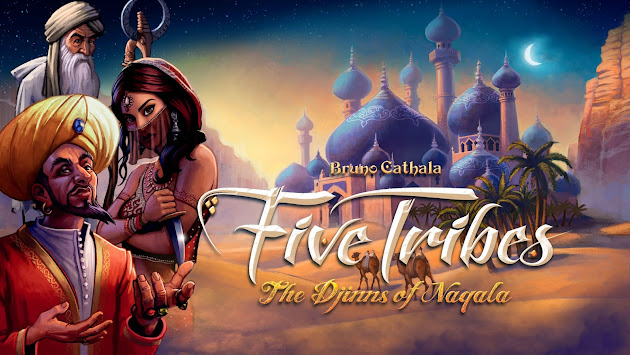
Five Tribes Review


There were a lot of great games released at Gen Con this year. Five Tribes, from Days of Wonder and Bruno Cathala, was one of the most talked about - and hardest to get.

Now that the game has finally hit distribution, does it live up to all that hype?

No "board" but still takes up a lot of space!
Looks good doing it, though.
Five Tribes is a part logistics puzzle, part action selection, part point salad game that pits players against one another, each of them trying to best maneuver the five tribes of the "Land of 1001 Nights" in order to become the next Sultan!

The game board is made up of 30 individual tiles, which are arranged randomly before each game. Meeples of 5 different colors are placed on these tiles, also randomly. Players will take turns picking up a group of meeples from any tile on the board, and dropping one off at a time, mancala-style, until they drop the last meeple they picked up. One important rule when choosing which tile to end up at - there must already be a meeple on the tile the player ends with that matches the color of the meeple she is placing on the tile.

Days of Wonder has included some large, but superb player aids.

Once the player finishes distributing the group of meeples she picked up, she performs two actions. First, she picks up all of the meeples on the tile she ended on that match the color of the meeple she placed there (always at least two because of the rule I mentioned above), and executes that tribe's action. If the player was able to pick up all of the meeples on a tile (because they were all the same color of the meeple she placed there) she gets to place one of her camels on the tile, and will score that tile's depicted points at the end of the game. Then, she also gets to perform the action of the tile she ended on.

The leftmost tile allows a player to
buy 2 goods cards for 6 gold.
The actions of the tribes and the tiles are quite varied and give players the opportunity to score points in a variety of different ways. Some allow players to get money right away, which can be used in game, or exchanged 1:1 at the end of the game for points. Some allow players to acquire powerful Djinns which can grant either in-game or end-game bonuses. And others will allow players to go to the market, and attempt to assemble sets of goods card which can be traded in for large amounts of points/money.

Gameplay continues until either one player places all of her camels or there are no legal moves left (no groups of meeples can be distributed in such a way that the final meeple to be placed will be the same color as one already on the destination tile).

The biggest potential problem for Five Tribes is how many options players are presented with, all at once. Five Tribes is not a game that starts off at a reasonable pace, and then ramps up as the game progresses. For the most part, from when the game begins, the number of choices for the players is gradually decreasing, as more meeples are removed from the board, and more tiles become owned by players. That not only can make the game intimidating and difficult to learn for new players, but it can also lead to a lot of analysis paralysis for experienced players. This can lead to awful amounts of downtime for the rest of the table. This also, however, means that player turns are almost never boring, and each point earned by players really feels like the result of proper planning and execution.


One of the most exciting parts of Five Tribes is something I haven't mentioned yet - bidding for turn order. Before each round, players will bid for turn order. There is a bidding track, like in Amun-Re or Vegas Showdown, where the values are fixed, and in turn order of the previous round, players place their bidding pawns on the amount of money they are willing to pay for turn order. This is interesting in itself and leads to a bit of bluffing and gamesmanship, but keep in mind also that at the end of the game, money is converted into points at a rate of 1:1.

The main mechanism of Five Tribes, the manacala-esque distribution of meeples is so much fun and super satisfying. Players are challenged each turn to both get as many points as they can (hopefully more than they bid for their turn order) as well as keep from setting the other players up to either take ownership or a tile or otherwise have a huge turn.

Five Tribes absolutely lives up to the hype that surrounded it during Gen Con. The game is a solid 9.0 in my book - one of my favorite releases this year.

Hollywood Kickstarter Preview

This post is a preview for a game currently on Kickstarter. I played the game using the print and play files, which are available via the Kickstarter campaign. My copy was assembled by me, and did not include cards which will be included in the final version of the game.

Hollywood was released in Russia by Hobby World almost a year ago. It received some favorable attention, but faded from the limelight quickly due to its limited print run and availability. Hobby World is attempting to fix those limitations with its current Kickstarter campaign.

Hollywood (as one might guess) is a game about making movies (and money) in Tinseltown. It is also a mash-up or sorts. It combines auctions with card drafting - two game mechanisms not usually found in the same game.


Players represent movie studios, and are tasked with putting together higher grossing blockbusters than the rival studios. Making a movie is as simple as assembling a script, director, and an actor. Players will do this by collecting a hand of 9 cards over a series of 3 main gameplay phases.

In the first phase, a player will draw a number of Star Cards (directors, actors, and scripts with better attributes than the basic cards) equal to the number of players, looks at them and distributes them among the players (1 each) as she chooses.

Next, each player is dealt 7 cards from the basic card deck, chooses one to keep, and passes the rest left. This repeats until each player has kept 7 cards.


The final stage of card acquisition is an auction. A number of cards from the basic deck are flipped face up according to the number of players. Then, using their bidding cards, players bid on either one of the cards, or the top card of the basic deck (which remains face down).


After this, each player has 9 cards in hand with which to make movies! As mentioned previously, each movie requires a script, director, and an actor (or actress). There are other cards that can be added, like the producer, the makeup artist, or the editor. Players can have as many of these green cards as they like. After everyone is finished assembling their movies, players receive income for their them.

This movie is worth $26 million. $4 (base) + $2 (for coins) + $16 (for matching heart symbols) + $4 (for having a "Lead Duo")

Each card in a movie adds $1 million to its value, some cards have coins that also add value, and if any of the cards match the genre of the movie (set by the script) they also add extra value. After each player gets her income, the movie with the most awards icons wins the movies of the year award. This player will get to distribute the star cards for the next round and the award itself will give bonus income at the end of the game. Then, the next round begins (unless it is the third round, in which case the game ends). The player with the most money wins!

Hollywood is what many might call a "next-step" game. The type of game that people might play after first being introduced to hobby games. It combines a few different gaming mechanisms, but not in ways that are super confusing. The separate parts are kept pretty separate, while all being used to further each player's simple goal of collecting the best set of 9 cards they can.

The theme is appealing, the game is simple, and - bottom line - playing the game is fun. If you think Hollywood would be a good fit for your collection, Hobby World's Kickstarter has already funded and they are currently pursuing lots of exciting stretch goals! Go grab a copy and help us get those bonuses!

The Scepter of Zavandor Review

The Scepter of Zavandor game in play

A neat auction game with some very nice engine building mechanics is The Scepter Of Zavandor.

In The Scepter of Zavandor, every turn consists of finding ways to improve your income.  This can be done in a few ways.  First, you can buy better "gems."  Each gem produces income for you, so having better gems improves how much money you make (and you can only have a certain number of gems, so you will need to upgrade them).  Second, you can auction artifacts.  The various artifacts can provide you with additional gem slots, give discounts on future items, increase your hand limit (how much money you can carry over from one turn to the next), etc.  Finally, you can improve your "knowledge."  Knowledge allows you to have various bonuses - a temporary boost of gems, unlocking better gems, increasing your base income, and providing you a better price when buying gems.  Ultimately, the game continues with players seeking to maximize their income every turn until a certain number of "sentinels" (super artifacts that are worth a lot of points) are purchased.  Once that happens, players add up points - from gems, artifacts, sentinels, and knowledge.  Whoever has the most victory points (most likely the person with the highest income) is the winner!

So, let's start out the pro/con section for Zavandor with this statement - I like a lot of things about this game.  First, I really like that you get a varied income from gems.  What this means is that each gem does not produce a set amount of money.  For example, you don't get $2 every turn for having an opal.  Instead, each gem provides you a card, and the cards have a range of values, with the better gems obviously having higher values.  This does a couple of things - first, it gives you some turns where you are able to have a "better" turn than you should (though at the cost of probably having turns later that are "worse" than they should be).  Secondly, it prevents your opponents from knowing how much money you have.  And this second element is very important in an auction game.  Now, instead of knowing that they can outbid you at exactly $52, your opponents know that you have somewhere around $40-60; but they don't know any more than that!

artifact cards from the Scepter of Zavandor
Various artifacts to be sold
There is actually a second element to the cards-as-money mechanic that I like.  There is a hand size that is enforced at the end of every round.  And, this hand size is fairly small.  Because of this, it really encourages you to improve your gems.  Since the better gems produce higher value cards, you are able to carry more money from one turn to the next if you have higher level gems!  And, while I'm talking about the cards-as-money mechanic, there is one more great feature.  In case you dislike pulling random cards, once you have enough of a certain type of gem, you get to pull a "concentrated energy" card instead of a normal card.  These cards allow you to get a set price for your gems that is slightly above average - and doesn't count (as much) towards your hand limit!

The next thing that I like about the Scepter of Zavandor is that it is really fun to try to get your financial engine going.  If you really enjoy one decision building on the next, and having one purchase pay off throughout the rest of the game, then Zavandor will have a lot of appeal to you.  I enjoy this kind of system, and so I have enjoyed selling gems in order to get better gems, carefully planning which auctions I need to win versus the ones I can hold back on, and where to improve my knowledge to get the most impact for my money.

The last two pros that I will mention briefly are these: I like the diverse starting position where each player starts with a different piece of knowledge (and thus should have a different initial strategy), and I like that the discounts provided by purchasing artifacts at the beginning of the game encourage you to buy a wide variety of items.

The Scepter of Zavandor player sheet
One of the different player boards
Yet, with all that I like about the Scepter of Zavandor (and, again, I like a lot about this game), there is one glaring con.  This game might have the worst runaway leader problem that I have ever seen.  Remember how I said that each decision builds on all of your previous ones?  So, if I make a few great decisions in the first 2-3 rounds, and they help me to earn some extra income, then guess what: I will have more money with which to buy the next things that come along.  And, that will help me earn more income.  Which, in turn, makes me more income.  There is a mechanic in the game to try to slow down the leader (and help the player in last to catch up).  The top 2 players are forced to pay extra on artifacts, and the bottom two players get discounts on them.  This is not enough.  In the last game that I played (in which I believe everyone had played the game before), the leader defeated the player in last place by about 80 points (the scores were something around 100 to 25, from what I recall).  And, in case you thought one player just played especially poorly, the leader also defeated second place by about 40 points.  Now, I said that I think that everyone had played the game before.  I know that the person in first, second, and last had played the game before - and it was still that uneven.  Whereas I like my decisions to matter in any game that I play, it seems that the decisions made in the first few turns set the course of this game a bit too much (the leader led from approximately 10 points until the end of the game).

The second con that I have for the Scepter of Zavandor emerges because of the previous con - the game is far too long.  Having an engine building game in which early decisions are unforgiving is completely fine.  It encourages you to make good decisions throughout the game!  But, more specifically, they are fine in a 30-45 minute game.  Zavandor is advertised as a 90 minute game, but I think is closer to 120-150 minutes as average.  Yet, the last hour (or more) of the game might not have any real impact on who wins or loses the game.  It can wind up being an extra hour of the player in first pummeling everyone else, while they watch helplessly (and with ever-increasing frustration).

Overall, I give The Scepter of Zavandor a 6.5/10.  As I keep saying - there are many aspects of this game that I think are wonderful, and that I enjoy greatly.  But, with how badly the leader can runaway with the game (and with how long everyone else in the game has to suffer), I just can't justify giving the game a higher score.  (Really, I think it speaks highly for the game that it gets a score this high while having such a frustrating element!)

If you enjoy auction games, you might also want to check out For Sale, Modern Art, and Biblios.

Hollywood Blockbuster (Dream Factory) Review

Hollywood Blockbuster board game in play

Recently I've gotten several opportunities to play a game called Hollywood Blockbuster.  You should know - there are several different versions of this game, and I think that the current one is called "Dream Factory."  However, I'm not entirely sure what (if anything) has changed, so I will go ahead and review based off of my version of the game.

In Hollywood Blockbuster, each player takes on the role of a movie studio trying to have the most successful year.  Success is based on the number of stars on a movie as well as the number of awards the movie earns.  Play is divided over four rounds ("quarters"), and at the end of the year, best movie awards are handed out.  Each quarter consists of a number of auctions and parties.  In each auction, the players are bidding contracts (the currency of Hollywood), on various pieces for their movie - it could be for special effects, sound work, actors, guest stars, directors, or agents (which are wild).  All of the auction tiles are face up from the beginning, so that you know what else is available.  Whenever a player successfully wins and auction, he must immediately place or discard all of the new tiles that he has purchased (generally you win 2-3 tiles).  In addition, once the winning bidder pays for his new tiles, all of the other players get to divide the contracts spent among themselves.    Parties work a little differently.  Once you arrive at a party space, all of the tiles are flipped face up.  Then, starting with the player that has the most actors and guest stars ("star power"), each player gets to select a tile (for free) to add to his board.  As soon as a player completes one of his (up to three) in progress movies, he calculates the score and collects the corresponding scoring tile; then he receives another potential movie from the stack.  If he has completed the first movie of a given genre, then he wins a smaller award.  Plus, at the end of each of the first three quarters, whoever has the overall best movie gets a small award.  At the end of the game, all of the final awards are handed out, and the player with the best total score between awards, completed movies, and leftover contracts wins the game.

Hollywood Blockbuster unstarted movies
Each movie has different needs
So.  I've realized recently that I love auction mechanics.  As I perused my collection for games to take to game night the other day, in addition to Hollywood Blockbuster, I was tempted to bring For Sale, Modern Art, Vegas Showdown, Money, and a bunch of other auction games.  (Eventually I decided I should diversify a bit.)  But, with all of these auction games available, what is different or unique about Hollywood Blockbuster?  There are really two auction mechanics in this game that I think fit well together that I want to discuss - and I'll go ahead and list them as separate pros.  First, I like that whatever you pay is immediately divided among all of the different players.  One of the beautiful things about auction games is that players truly set the value of everything in the game - in one game, things may even go for half as much as in the next.  However, in my experience, this has never been more true than in Hollywood Blockbuster.  Since the contracts are constantly flowing back and forth, your group can really set the value for tiles as high or as low as you want.  I've played games where everything went fairly inexpensively, and I've seen games where almost every time someone bought something, they had to spend all of their contracts.

The second auction element that I think works well is the fact that tiles are grouped together.  There is only one auction per round in which a player buys a single tile - the first auction (which is for a 4-star director).  After that, the auctions will always be for at least two tiles.  I like this because it will cause more bidding wars than if the players were bidding on single tiles.  Sometimes this war will be because one player wants the sound board, and another wants the special effects.  Sometimes it will be because both players are just desperate to fill several empty places on their movie.  Sometimes the only special effects available for the round are paired with the best actor.  But, overall, auctioning several things at a time allows much more tension and excitement to be in the game.

My third pro for Hollywood Blockbuster is about the only other way of gaining tiles - parties.  I like the intrigue that parties present, where you don't know how good they will be.  Because you don't know what will be available, you always hope for the best.  What this indirectly does is increase the value of actors.  In addition to helping you with your movie, if you are able to purchase a lot of actor tiles, then you will get to pick first at the party, thus potentially giving you a nice 3-star tile for free.  And, of course, the downside of not having actors is that your opponents might get to pick a nice 3-star tile for free!  Of course, you might show up to the party, and there is nothing that you want.  I feel like the parties are a perfect element of controlled randomness in the game.

Various awards from Hollywood Blockbuster (Dream Factory)
You don't have to win awards - but you should
The final pro that I will mention for Hollywood Blockbuster is the awards.  First of all, what kind of game about movies would be complete without awards?  So they definitely make sense thematically (well, except for the one that is for "Worst Movie").  However, the awards add an extra layer of strategic decisions.  Suddenly, you're faced with the following questions: Should I complete this now and get best of the quarter?  Should I complete a bad movie in order to be the first one to complete a comedy?  Do I really want to complete this movie now, when a drama will be the next movie, or should I wait, since someone else has already completed an amazing drama?  Should I make this movie awful and try for the Worst Movie award?  And, the awards also allow players to have a second path to victory - instead of simply getting the most stars on movies, getting the most stars on the right movies can also lead to victory.

The last thing that I will mention about Hollywood Blockbuster is more of a "point of note."  My copy of the game doesn't have licenses to any movies or actor names, so they are all spoofs.  You will see things like "Star Battles" instead of Star Wars, "The Prince Groom" instead of The Princess Bride, "Jim Scarry" instead of Jim Carrey, and "Dental Washington" instead of Denzel Washington.  Some people will like this, and will enjoy trying to figure out what all of the spoof names are referring to, whereas other people will probably be annoyed by it.  I know that at least one German version of the game is able to use actual actors and actresses (I'm not sure about movies), but it uses historically famous people - like Marilyn Monroe and Frank Sinatra.  I am unsure of how Dream Factory addresses this issue.  Anyway, if this is something that is important to you, I'd recommend you looking at the different versions to decide which one will fit your tastes.

Overall, I give Hollywood Blockbuster a 9.0/10.  I really enjoy the game, and I intend to keep it in my ever-growing collection of auction games.

If Hollywood Blockbuster sounds interesting, then you might also check out Mice and Mystics, Notre Dame, and Legacy: Gears of Time.

Money Review

Reiner Knizia's Money card game in play

So, the game that causes the most awkward conversations has to be Reiner Knizia's Money.  (Conversations like, "Hey, can I borrow Money?" or "I'd really like you to include Money in the trade.")

Anyway; other than being an awkward conversation starter, Money is also an interesting little auction game.  To start the game, each player starts with a handful of cards that represent money in both different currencies and denominations.  Every turn there are two piles of money, each with four different "bills" (cards).  Players now take cards from their hand and perform a silent auction.  Revealing at the same time, players get to select a pile of money and exchange their bid for if (starting with whoever bid the most).  Interestingly, instead of only purchasing the piles of money in the middle of the table, you can also buy other player's bids (still by exchanging your bid with theirs).  At this point, you might be wondering what the point is in this futile exercise.  Well, the reason that this isn't an exercise in futility is the scoring.  At the end of the game (when the deck runs out), each player scores points based on what they have collected (not necessarily how much).  Each set of all three 20's or 30's of the same currency are worth 100 points.  Additionally, each currency type in which a player has between 100 and 200 "dollars" is worth the total value minus 100.  Next, any currency in which a player has at least 200 "dollars" is worth its full face value.  Finally, there are Chinese 10's - these are always worth 10 points.  Whoever has the most points wins the game!

Example pile in Money card game
A typical pile of cash!
So, my first pro for Money is that I think that there are a few different ways that you can try to maximize your points.  Either you can try to make as much money as you want, and assume that some of it will match (or just make as much as possible early and then make things match), or you can immediately go for matching values.  So, if your goal is to make as much money as possible, then in the early auctions you may bid very low - hoping that everyone else will bid high, and you will profit.  (Since you have last pick, you will probably be collecting another player's bid.)  However, if too many people do this, then you might wind up only "earning" $10, while other players that bid slightly higher are the ones to actually make a decent profit.  So, not only are there different overarching strategies, but you are really forced to adapt your strategy to how your opponents are playing.

The next pro that I have for Money is that "it takes money to make money."  Which means that in any given round you have to bid something.  Which also means that you are probably not going to (immediately) recover whatever you are bidding.  That's often not a problem; but, if you have done a really good job of collecting only cards that are relevant to the currencies that you're collecting, then it might be a huge problem.  If might force you to go ahead and abandon one of the currencies that you were just starting to collect - at least for a time.  (Which, in turn, might make another player very happy, if they had been wondering where the rest of that currency was!)

My final pro for Money is that I really like that you don't simply win by making the most money.  If that were the case, then I think that the game would be fun to play once or twice, but would have its novelty disappear quickly.  Instead, you really must specialize (and adapt your bids to what you are specializing in).  Early in the game, it might be beneficial to simply collect whatever pile has the highest face value.  However, at the end of the game, a single bill might be worth 230 points!  (This could happen if you have $190 in a currency, and you have two of the three 30's in that currency.  The final 30 would be worth 100 points for completing your set of 30's, an additional 100 points for putting you above $200 in that currency, and also worth its face value!)  So, the biggest bills in the game aren't necessarily the "best" ones.

A hand of bills in Reiner Knizia's Money
A typical hand in Money - including a "bluff" card
The main con that I have for Money is that it is very math intensive.  You are constantly calculating and re-calculating things in the game - your score, your bid, which pile is "better" for you, how much an opponent might make off of certain things, etc.  None of these calculations are difficult.  They are all basic addition.  However, when you start making a lot of these calculations, some people will get turned off to the game pretty quickly (and others might start taking a long time to make decisions).

The second con that I have for Money is that the tie-breaker in the silent auctions can be frustrating.  When two players bid the exact same amount of money, the tie breaker goes to the player that bid using the lowest serial number on a "bill".  This generally corresponds to whoever bid using the lower bills (20's have lower serial numbers than 60's), but can wind up just arbitrarily picking someone.  Whereas I realize that there has to be something to break these ties, it can be very frustrating if you lose out on a choice pile of cash simply because your bill's serial number wasn't low enough.

Overall, I give Money a 9.0/10.  Honestly, I only tried the game because they were briefly giving away the iPhone version.  However, I'm quite glad that I did!  I think that Money is a fabulous little auction game that fits nicely into most any collection.

If Money sounds like a game that you would enjoy, you should definitely check out For Sale and Modern Art - as well as Ra.

Keyflower Review

Keyflower board game during play

Sometimes a game's box doesn't immediately attract your attention, but something else causes you to try it out.  For me, Keyflower was a perfect example of this.

In Keyflower, you play a series of four rounds ("seasons").  Each round is a combination of auctioning and worker placement.  Going around the table, each player has the option of placing workers.  These workers can be used to bid (or increase a bid) on a tile, or they can be played on top of a tile to activate its effect.  At the end of each round, players take any tiles that they have won, and they connect them to their village (previously purchased tiles).  That is the crux of the game.  However, one action that can be performed is worth noting - tiles can be upgraded.  By acquiring goods (and moving them (another action) to the correct locations), players can upgrade their existing tiles to make them better - either they will have a stronger effect, they will be worth more points, or both.  At the end of the four rounds, whoever has the most points wins.

So, to be fair, there are a lot more rules than the very trim overview that I just gave.  And one specific rule leads to my first pro.  Each tile can be bid on (and/or activated) by only one color of meeples ("miniature peoples").  What does this mean?  There are three basic colors of meeples - red, blue, and yellow (there are also green meeples, which are harder to get).  Each player will have a varied number of these meeples, and they will use them to bid on tiles.  So, when I bid on a tile, I might bid one yellow meeple.  If someone else wants to overbid me later, they have to bid more yellow meeples than I bid - they can't use green, red, or blue.  This causes a really interesting dynamic in the game.  Sometimes you want to have an even distribution of colors - that would let you bid on anything, and you won't have to worry about what other players bid.  Other times it might be in your best interest to have a whole lot of one color.  This would let you be much more likely to win a tile that you really want - assuming that you're able to set the color on it.

bidding example in Keyflower board game
Bidding in yellow meeples
The next pro is that owning a tile isn't always better than not owning it.  Why?  Because anyone can activate your tiles - not just you.  And, when activating a tile, whoever activates it first selects what color is used for activating it.  So, if I have a lot of red meeples, and you have a tile that I really want to activate several times, then I might choose to activate it with red meeples (each additional activation costs an extra meeple; and each tile can only be activated up to three times per round).  And, since I placed red meeples on your tile, I may have prevented you from being able to use your own tile!  (That is, assuming you don't have any red meeples.)  Now, at the end of the round, you get to keep any meeples that were played on your tiles, which can be wonderful.  But that isn't always better than getting to activate your own tile, specifically on the last round of the game.  So, whereas it is very good to own tiles (you can at the very least control things like when it is upgraded), it is sometimes much better to go first!  (And, of course, you get to go first if you win the auction that determines who goes first.)

My third pro for Keyflower is that the game has a very tense feeling.  What I mean is that often during the game I will want to perform about five actions on each turn.  And, I'm actively waiting on my opponents, hoping that they won't do "that one thing" that I need to do.  Which, inevitably, they will do.  One of the marks of a good game is that you are forced to decide the "better" move between two good moves.  And, in my opinion, Keyflower nails that characteristic.

The final pro that I will mention is how the fourth round ("winter") works.  At the beginning of the game, each player is given a few different winter tiles.  Before the start of winter, each player has to select which of their tiles (at least one) will be available for auction that round.  So, you have some control over what will be worth victory points.  Or, probably more truthfully, you have some control over what will not be worth victory points - by burying the tiles that would be most beneficial to your opponents.  Granted, just because you select a tile doesn't mean that you will actually keep it - you still have to win the auction.  But, I like that the final scoring tiles are determined by player selection instead of random chance.

Another example of Keyflower game in play
Meeples waiting to be collected
Though there are not very many cons that come to mind for Keyflower, I will mention this one: the game can be negatively affected by the random tiles that are used in a given game - especially with a smaller number of players.  Each game you use a different random selection of tiles.  Great - replayability!  However, depending on which tiles appear, certain elements of the game can be neglected.  For example, if no tiles are drawn that allow you to create green meeples, then this very important aspect of the game will be completely missed.  (Granted, this is not a common situation; I did, however, play a game where only one of these tiles was drawn - and that one was drawn in the last possible season.)  Additionally, if the tiles that allow you to collect certain types of resources are not drawn, then you will have a hard time upgrading many of your tiles.  These situations are not common, but with less players (the less players in the game, the less tiles you use), they can definitely happen.

My other (very minor) con for Keyflower is that it is difficult to quickly see what is happening.  Since everyone is bidding with the same thing (colored meeples), and colors are not associated with players, it takes a second to register where you are bidding, what you are winning, and where you might want to play.  (If you're wondering, you bid by placing your meeples on the side of the hexagonal tile that faces you.)  This is a small price to pay for the incredibly well executed auction mechanic, but it is a nuisance nonetheless.

Overall, I give Keyflower a 9.0/10.  It is one of the most pleasant surprises that I've found recently in gaming, and I think it will stay in my collection for quite some time.  (And, hopefully I will get at least decent at it - I never win!)

If Keyflower sounds interesting, you might also check out Kingdom of Solomon, Legacy: Gears of Time, and Power Grid.

I would like to thank Game Salute for providing me with a review copy of Keyflower.

For Sale Review

For Sale card game in play

Sometimes, a "filler" game steals the show.  Recently, this happened to me with For Sale. (In case you're not familiar with the term, a "filler" game refers to a quick game that you play, generally, while waiting on other games to end or more friends to arrive.)

For Sale is the game of the double auction.  Every player starts with a pile of money.  You use this money to buy properties.  To do this, you flip over one property per player and start an auction.  Going around in a circle, each player must increase the bid or pass.  If they pass, they get the lowest valued property and get half of their previous bid back.  This continues until one player is left - they buy the highest valued property at their full bid price.  Once the entire deck of property is auctioned, you sell what you've bought.  Again, you will flip up one card per player, but this time it is from the deck of "checks."  All of the players will select one of their properties and sell it by revealing it at the same time (a silent auction).  The players then get a check corresponding to the relative value of their property - the highest valued property gets the highest check, etc.  Once all of the checks are gone (all the properties you bought will be too), whoever has the most money in checks (and starting money that they didn't spend) is the winner!

I love For Sale.  It is simple, engaging, strategic, easy to teach, and can be enjoyed by everyone.  Is that enough pros for you?  Really, all of those adjectives are precisely what I look for in a "filler" game - especially the easy to teach (and I also look for quick to play).  Yet, I have found For Sale to be engaging enough that I often want to play it more than I want to play the longer game that I actually meet up with people to play.  So, I guess the first official pro for For Sale is that it is fun.  Yes, this is a highly subjective pro - but to me, I really enjoy playing the game.
card from For Sale game
I even like the artwork!

My second pro for For Sale is that I love that you get half of your bid back when you pass.  Normal auctions aren't like that - you normally buy something or you don't.  However, in For Sale, you're going to get a property every time, and so it makes sense that you should have to pay something every time (except if you pass before ever bidding, then you get a (crappy) property for free - that may not make sense thematically, but it's ok).  Often you find yourself in a situation where you are actively trying to not win an auction; but you don't want to lose it either.  You often bid simply to not be last - and sometimes you bid a bit higher to try to force other people to pass!  You can really see that people have no intentions of winning the auction when they start jumping to the next round number.  (For example, if the bid is at $2k and they bid $4k.)  When you get half of your bid back, it rounds against you - so, if you pass later, bidding $3k or $4k costs you the same.  However, if you actually win the bid they cost a different amount.  So, people will bid like this in the hopes that they can pass later and get a better property than is currently the lowest.

My third pro for For Sale is that I love the double auction.  It forces you to balance how much value you place on any given property.  You have to ask yourself whether it's worth an extra $5k to get a property 2 points higher.  Will that new property actually earn you more than $5 over the other property in the next round?  It can if used at the perfect time, and it can cost your opponent a lot of money when he bids his highest property only to lose to yours!  My general strategy in valuing items (both property and checks) in this brilliant little game is to bid higher when there is a large discrepancy.  For example, if the properties available are worth 1, 4, 25, and 30, I will try to stay in the auction - I don't want the 1 or 4!  But I'll pass as soon as the 25 is the lowest.  Likewise, with checks, if the $2k, $4k, $13k and $15k are available, you really want to be in the larger group, so it's worth throwing one of your top properties.  Unless you know that you'll lose, in which case you throw a cruddy property and hope for the best on the next set of checks!

different decks from For Sale game
The property deck is on the left!  Weird, huh?
I can't really think of too many cons with For Sale.  The only one that comes to mind is that I think you might feel "played out" of For Sale fairly quickly.  It plays fast enough that you can play several games of it in an hour, which can quickly rack up the total number of times you have played it.  There's really not that much to the game, so I think you could probably grow tired of it.  I'm not there yet, I still really enjoy playing - so this is just speculation on my part.

Ok, I do have another con that is incredibly nit-picky.  The back of the cards (on my edition) for the properties looks like money - it is green with a fancy money-esque image.  The back of the cards that are checks have a picture of property on it!  What??  I always grab the opposite deck of which one I need.  Always.

Overall, I give For Sale a 9.0/10.  I try not to give 9 or higher unless I can see myself getting a group together just to play a game, and I can see this with For Sale.  I might have to play other games when I have this group together (life's hard, right?), but I enjoy For Sale enough that I would go meet people just to play it 5 times in a row!

For more thoughts on this game, you can check out Games With Two's For Sale Review, or I Slay the Dragon's review of For Sale. And, if you like quick, simple games, you might also want to check out Flash Duel, Poo: The Card Game, and Cookie Fu.

Priests of Ra Mini-Review


Now it's time for a quick rundown of Priests of Ra.

Let me start off by telling you that Priests of Ra is a remake of Ra.  I have already reviewed Ra, so I'm going to assume that you're familiar with that game.  (If not, go check it out - Ra is an awesome game!)  This review will mainly highlight the differences.

Building the pyramid is a different scoring mechanic
Priests of Ra is an auction game like Ra, and all of the bidding, sun tiles, and Ra tiles work in exactly the same way.  The difference is what pieces you are bidding on.  In Priests of Ra, you are bidding on buildings, workers, pyramids, priests, and plagues.  Each of the buildings and workers are double sided, with different images (and colors) on each side.  When a player pulls a tile out of the bag, he gets to select which side is showing.  However, when a player buys a priest, he has the option of flipping over one of his pieces - whether one that he just bought, or one that he already owned.  For scoring, workers score at the end of each epoch, and you get points for having the most workers of a certain color, and another bonus for having at least three types of workers (this bonus is an "ankh" and scores after the third epoch); then they are discarded.  With buildings, you score points for every "complete" building (a pair of buildings of the same color), with a bonus if you have three or more types of "complete" buildings; you keep buildings from one epoch to the next.  Priests are worth two points each, and are then discarded.  Pyramid pieces only score at the end of the third epoch, and are worth points based on how tall your step pyramid is.  Plagues are scored after each epoch, and you lose points based on how many you have, with the penalty per plague growing as your number of plagues grows.  At the end of the third epoch, whoever has the most points wins.

So, yes, Priests of Ra is basically the same game as Ra, but slightly different.  One of the most impactful differences (that I actually like) is that, in Priests of Ra, plagues stay from one epoch to the next.  In Ra, you can get plagues that don't hurt you (if you don't have the tile that is being plagued), but in Priests of Ra, plagues always hurt you, and if you collect too many of them, can hurt you really, really badly.  Yet, they aren't so bad that a single plague is really all that damaging - after all, if you can buy a large collection of tiles inexpensively because there is a plague, that might be worth doing.  However, just because one plague doesn't hurt you doesn't mean that you should not be careful.  If you get enough plagues, you can lose 20 points - after each epoch!

It even has the same Ra piece
The next thing to mention about Priests of Ra is the tile flipping.  Instead of the "god" tiles in Ra (that let you steal a tile from the currently available tiles, Priests of Ra has priests.  Priests aren't as strong as gods, since you can't take what you need from the center, but they are still quite helpful since they can both flip tiles and get rid of plagues (if you have three priests during an epoch scoring, you can discard a plague tile - this is the only way to get rid of plagues).  Like gods, priests can be useful or useless based on when they come up, and what tiles come with them.  In Ra, a god tile is worthless (ok, it's action is worthless, the tile is worth 2 points) if you purchase it with your last sun - you are out of the round, so you can't steal any tiles.  However, in Priests of Ra, priests that are purchased with your first sun tile are also fairly useless, since you really won't care which side most of your tiles are facing at that point.  They can at least still be used to cancel a plague later.  Again, not really better or worse than Ra - just different.

That's really about all I have to say about Priests of Ra - if you feel like my review should be longer, go read the Ra review again, and pretend that everything I'm saying there is about this game.  Then you should feel better!

Overall, I give Priests of Ra a 9.0/10.  It's a good game, and I actually enjoy it quite a bit - however, I'm dropping it a bit from Ra, simply because it's not innovative.  It's a remake.  And, whereas that is not a bad thing, I don't feel the need to own both games, so I will probably be parting with this one.

Modern Art Review

Modern Art game in play


Occasionally a game surprises you. The game that has done this to me most recently is Modern Art (sorry, no Amazon link - I think this version might be out of print).

Modern Art is an auction game where you are trying to make money by buying and selling pieces of modern art.  To start the game, you will have a hand full of modern art pieces by different artists.  On each of your turns, you will select one of these pieces to be auctioned off.  Depending on the card, there are different kinds of auctions.  When auctioning a piece from your hand, you are welcome to participate, but if you buy your own piece, then you pay the money to the bank - if someone else buys your piece, they pay you.  However, at some point the market will become saturated.  Once a fifth piece by the same artist is played, the round immediately ends.  Then, based on the number of pieces sold by each artist, you determine how much each of these pieces is worth (you want your artist to have sold the most pieces).  Plus, each artist's value is cumulative from one round to another, as long as they are in the top three (of five) artists.  At the end of each round, you must sell all of the pieces you have bought.  Next, each person gets new cards and a new round is started.  You play through five rounds, and whoever has the most money at the end is the winner.

Modern Art Karl Gitter card - he works wonders
"Karl Gitter - his stuff is hot this year!"
The first pro that I have for Modern Art is that it is fun.  This is the part that surprised me.  I picked up a copy of the game because I saw it cheap at a convention, and I knew it was ranked well on Board Game Geek.  However, reading through the rules, I thought, "ok, well, it seems like the game will work," but I missed where it would be very enjoyable.  Once we started playing it, and we were trying to convince each other of the value of the paintings we were selling ("Karl Gitter is hot this year - you definitely want this..."), I found where the enjoyment was hiding.  We had a blast playing the game.  Since most of the auctioning is done aloud, whoever is selling the piece will regularly be doing his best salesman pitch to try to convince the other players why they should pay tons of money for the piece - after all, you keep the money from the pieces you sell.

Which leads to my second pro - I like that you keep the money from the pieces that you sell to other players.  It is definitely important to make money by selling pieces of art at the end of the round.  However, you can make significantly more money by selling works to the other players.  After all, if a piece is going to be worth at least $90,000, why shouldn't they buy it from you for $80,000?  They'll make $10,000 that they couldn't make otherwise!  (Of course, you will be making $80,000!!!)  This mechanic forces you to drive up the prices as much as you can while selling - but, if you drive them up a bit too high, you might wind up buying the piece from yourself and having to pay the bank.  Suddenly, you are only making the $10,000 instead of the $80,000.  The fact that you are making the money from the other players, I think, also leads to one of the main strategies of the game - you have to determine which artist you can make incredibly valuable at the end of the game.  Since you are dealt a lot of extra art in the first round, you can do some planning about which pieces to sell now to build up value for an artist, so that you can sell more of them (for a lot more money!) at the end of the game.

Third, I like that there are different kinds of auctions.  Specifically, there are open auctions (everyone yells out prices), silent auctions (everyone shows their bid at the same time), fixed price (the seller says what it will cost, and each person has the option to buy it or pass until it is sold - with the seller being forced to buy it if nobody else does), once around auctions (each person gets one chance to make a bid), and double auctions (it gets sold with another piece by the same artist).  This keeps the game from feeling monotonous.  Honestly, the game would be essentially the same if it was played entirely with open auctions.  But, though it would have the same strategies and such, it would be much more dull, as you would be doing the same thing over and over.  With the different auction formats, the game stays fresh (and you have to figure out what your salesman speech should be with each of the different auction formats to make sure that you milk your opponents for as much as you can).

Toko card from Modern Art card game
"Yoko has been doing really well"
Now, with all that I love about Modern Art, there are a couple of minor cons.  First, there is (in my opinion - and I get to write the blog, so I get to share my opinion) a definite ideal number of players.  The game can be played with 3-5 players, but I really think that it works better with more players (so, 5 is ideal).  After all, since the entire game is built around auctioning things off amongst yourselves, if you are able to sell your art in a bidding war between 4 people, it will be much more exciting than a bidding war between 2.

Next, the double auction card is incredibly powerful, and so there is a bit of luck involved in what you draw in the game.  Since the double auction lets you sell of two pieces at the same time, you are increasing the likelihood of that artist being one of the artists that is worth money at the end of the round (and also increasing the chances that their work is worth more money at the end of the round).  You are also, simply, selling off twice as many works of art, so it should (theoretically) be worth twice as much!  Now, I still think that strategy is heavily involved, even with these cards (do you want to use them early on in the game, or save them until the last round and hope that the artist has been valuable to that point), but the double auctions definitely seem outright better than the other auctions (of course if you only get double auctions, then you won't have the second work that you need, and so you'll have to share money with someone else who can provide that piece).

Overall, I give Modern Art a 9.0/10.  I love the game - I was very pleasantly surprised with it.  I think that it is one of the more fun games that I have played in recent memory!

If you like financial games, you might also want to check out Power Grid, Acquire, and Chicago Express. Or, for a second opinion on this game, check out this review of Modern Art at Play Board Games.

Goa Review


A game that sat in my "to play" pile for far too long because of timing issues (and not play issues) is Goa.

In Goa, each player takes on the role of a spice merchant attempting to gain the most prestige by discovering plantations, selling spices, and upgrading their shipping infrastructure.  The game consists of two phases, each consisting of four rounds.  To start each round, the first player will place a flag (the first player marker) along with an auction indicator next to any of the tiles in the center of the board.  In turn order, each of the other players will place an auction indicator on one of the tiles adjacent to the previous one, followed by the first player placing a second auction indicator.  After this has occurred, each of the tiles will be auctioned in order - with tiles representing colonsits, ships, plantations, victory points, and more.  After the auction, players take turns performing actions until each player has performed three.  After the third action, players with extra action cards may perform bonus actions (or carry one bonus action into the next round).  Actions consist of gaining ships, replenishing spices on your plantations, collecting income, drawing expedition cards, and attempting to establish colonies.  Finally, a player may also take an action to spend spices and ships to upgrade any of the previous actions.  At the end of the game, players will get victory points for how much they have upgraded each of these sections of their board, how many colonies they have established, what cards are in their hand, and from tiles that they have purchased.  Whoever has the most points wins (yes, yes, this sentence is normally a given, and maybe I should stop bothering to type it)!

Auctions are ready to begin
The first pro that I have for Goa is that I think that the auction system is very interesting.  Specifically, I like that where you place your auction indicator affects where the next one can be placed.  So, as the first player, you want to start off by placing near the tiles that you need.  Yet, each other player is going to attempt to place their tile on the one that they need (or think they can make the most money from), so the tile the first player still might not be auctioned.  In addition to the creativity of this initial placement, the money changing within the auction is another important aspect of the game (and so should also fall in the "pro" category).  Specifically - when you buy a tile, you pay the person that has put the tile up for auction (or, they have the option of purchasing the tile for one less than the highest bid).  The only use for money in Goa is buying tiles (though the person with the most money at the end also gets victory points).  This means that a player that collects far more in taxes than the other players will have his pick of whichever tiles he wants to purchase - and will do so, since there's no other use for all that tax money.  Yet, since he has to pay that money to another player, if he is not careful, he may enable one of his opponents to have enough money to outbid him on the next tile!

The second thing that I like about Goa is that everything feels vitally important.  You always feel like you're doing poorly in the game, because one of the other players will inevitably be doing well in whatever area you need at any given moment.  Do you have all the ships and spices you need?  Well, then you probably had to neglect taxes in order to upgrade those things.  So, during the auction, you're going to feel like you're getting obliterated.  Have plenty of money?  You're going to feel like you can't colonize.  Do you feel like you have a little bit of everything?  Then you're not earning many points in any area!  (You score 0, 1, 3, 6 or 10 points depending on how many times you've upgraded each section.)  Yet, this feeling of doing poorly isn't depressing, but just makes each decision that you make feel very important.  And, you want to do everything now, dangit!  But, unfortunately you only have three actions per round.  Which then makes buying extra actions feel critically important!  A side effect of how many different difficult choices exist in Goa is that you are able to win with a large variety of strategies.  You can win by dominating the auction, upgrading better than other players, getting a lot of expedition cards, etc.  I appreciate games that allow for varied strategies to all be successful, and Goa definitely falls into that category while providing a very tense, satisfying game experience.

What is most important to you?
With all of the brilliance of my pros, there are a couple of nitpicky things that I should mention as cons.  First, I don't really like how expedition cards score points.  Each expedition card has a symbol in the bottom right-hand corner.  This symbol means absolutely nothing in gameplay terms.  However, at the end of the game, you get points based on how many symbols you were able to match (again using the 1, 3, 6, 10 scale).  This makes absolutely no sense to me, though I realize that if this weren't in place, then the expedition cards would quickly become unbalanced.  If you scored simply based on how many you had (with the escalating scale), then they would be far too valuable; and if you made them not worth any points, they wouldn't be valuable enough.  Yet, this forces you to make strange decisions about which cards to play, and allows the "luck of the draw" (drawing matching symbols) to swing the game by a few victory points in a game where less than ten points may separate first from last.

My other con is even more trivial.  It is simply that a player with a lot of money will probably maintain the first player flag for much of the game.  Now, this really depends on your play group and how much they allow this to happen.  However, if one player collects four more dollars in taxes than all other players, then an extra action is worth four more dollars to him than all other players - after all, he can easily just use the action to collect income.  (Yes, I realize that it doesn't break down quite this way if you think of it in terms of potential victory points, but if you look at it strictly from a "what I spend versus what I can receive" perspective, then my statement is true.)  The only way to prevent this from happening is to spend enough money that the cost of keeping the first player marker is not worth the value gained for this rich player.  Yet, the money that you spend to take it away goes to the former first player (the rich guy), and so you actually may be helping him more by buying it from him!  However, being the first player (and getting the extra action) in no way guarantees the win, so this ultimately isn't a huge deal.  As I said - it's a minor complaint.

Overall, I give Goa a 9.0/10.  I enjoy the game quite a bit, and I think that it is a perfect example of an incredibly well balanced game with many strategies that can be victorious.  And, since those are two things that I look for in games, it should come as no surprise that Goa scores very highly in my opinion.

If Goa sounds interesting to you, then you might also want to check out Alien Frontiers, Princes of Florence, and China.

I would like to thank Z-Man Games for providing me with a review copy of Goa.

Biblios Review

Biblios card game in play


When asking for games with depth that can be played in 30-45 minutes, someone recommended that I check out Biblios. So.... I did.

In Biblios, the goal is to get the most victory points by having the highest score in (enough of) the five different categories.  To start the game, each category is worth three points.  On a player's turn, he will draw a number of cards equal to the number of players plus one.  After looking at each card, he must decide if he will keep it (one per turn), put it in the auction pile (one per turn), or put it face up in the middle (all the others).  After he has gone through all of his cards, the other players get to take the cards that he placed in the middle - thus each player gains a card every turn.  Any time one of the players gets a "church" card, they immediately adjust the value on one or two of the dice (and thus a category's value).  After the deck has been exhausted, the auction phase begins.  One at a time, all of the cards that were placed in the auction pile are auctioned off to players - who use cards to buy gold cards, and use gold cards to buy everything else.  After the last auction, players compare scores in each category and the highest total in each gets the scoring die.  Whoever has the most points from scoring dice is the winner!

Very ironically, I received my copy of Biblios at approximately the same time as I received a copy of Pax - and both games seem to have a similar core mechanic of "draw X cards, one at a time, and put them in different places."  I listed this as a pro in Pax, and it is also a pro for Biblios - this mechanic forces the players to make meaningful, simple, and yet difficult decisions.  If you make a mistake in the first round and accidentally give your opponents a powerful card, you're not going to instantly lose - but if you regularly give your opponents better cards than you keep, then you don't really stand a good chance of winning.  And, with more players, these choices get tougher.  You get to look at more cards with more players, and so you will have a much harder time deciding what to do with a mid-value card that you draw early.  Should you take the safe bet and keep it?  What if something better is drawn?  But, you also don't want your opponent to have it!

Biblios scoring dice
Scoring dice - what each category is worth
The next pro that I have for Biblios is that I think the auction works well.  I have played this game with two and three players, and the auction works well with both (and I would imagine works at least as well with four).  It's tough to find a two-player auction game that actually works, but for some reason this one does.  I think that there are a couple of factors with this - first, you know that any card you don't win counts directly against you.  With three and four players, you might be able to spread out cards in a category so that you can still ultimately have the highest score, even if you don't have a majority.  With two players, every card that you don't take goes to the same opponent.  Also, the game is built where you must buy things in the auction to win.  You put as many cards in the auction pile as you put in your own pile at the beginning of the game, so the chances of you winning any category without auctioning are very slim - the odds of you winning several categories without the auction are basically zero.

The third aspect of Biblios that I like is that not all of the cards are in the deck in each game (the number of random cards pulled out is different based on number of players).  Because of the rule that you have to have the most points in a category to score, you are often trying to get the majority in that area (at least I was).  The inner cover tells you the card breakdown, and so you can know when you have the majority.  But!  Not all of the cards are in the deck - and so you might have a majority without knowing it.  And, a player that is better at figuring out when they have "enough" cards, without wasting extra card draws and money on getting a guaranteed majority will probably win over a player that always guarantees their majority.
card from Biblios game
Church cards adjust scoring dice

The final pro that I will mention is that I like the church cards.  Now, with that said, I don't like being the one to get stuck with the church cards - I would rather increase my score in one of the categories.  However, the church cards are a good way to mitigate the fact that you know an opponent is going to beat you in certain categories.  They are also useful for improving the value of your majorities.  But, there is a touch of a bluffing element here, because if you are always increasing the value of the same category, your opponents will realize that you have a lot of points there, and they will focus on lowering it.  But, at least in the auction phase, you can prevent them from doing so, by buying all of the church cards - but that will get expensive really, really quickly.

I don't really have any "cons" for Biblios.  I found the game to be very fun, and I could play it repeatedly.  I think that it is a great filler game or lunch game, but I don't know that I would go to a gaming session explicitly to play Biblios (though I'd consider it), which is the only thing that keeps it's score out of the upper echelon.  And, with that said....

Overall, I give Biblios an 8.5/10.  I think that it is a brilliant, light game, that can be enjoyed by gamers and non-gamers alike.  If you have the opportunity to play it - do so!

If you are looking for games that can be played over lunch, you might also check out 1955: The War of Espionage, China, and Ra.