Showing posts with label preview. Show all posts

FlickFleet Preview


Well.  Let's see if I can remember how to do this.  It's been two years since I've written anything here, but when Jackson Pope, the nice designer of FlickFleet reached out to the wider community asking for reviewers that like dexterity games, my name came up.  (Apparently I haven't done a good enough job convincing everyone else in the world, and thus new reviewers, that dexterity games are truly the greatest kind of game there is.  (Well.  I mean, I guess if you consider sports to be dexterity games, then I'm in the vast majority of the population as a whole in thinking that dexterity games are the best.))  And then I started hearing things like "new dexterity game" and "flick pieces for movement" and all of the normal things that immediately gather my attention.  So here I am.  Wow, that was a long winded way to say, "Hi, I'm back for now, but don't expect this to be a regular thing."

So, what is FlickFleet?  It's a game.  There's flicking and stuff.  The end.  Free game acquired.  Obligation fulfilled.  *Boom*

.
.
.
.
.
.
.
.
.
.
.
.
.
.
.
.
.
.
.

A tricked out Destroyer lives up to its name
Ok, fine.  FlickFleet is a new dexterity game about sci-fi spaceship combat.  There are several kinds of ships, but they basically take 2 forms - the ones that have a board where you have to track stuff on the side, and the ones that don't.  The ones that don't have a board associated with them are called fighters, and they start off with three pieces that fit together, and you track everything about them based on how many pieces remain.  When they get to activate, you can move them by flicking them, and then you can attack by setting a die on top of them and flicking it towards your opponent's ships.  You get to shoot once per remaining section, and one type rolls a ten-sided die, the other rolls a six-sided die.  The second kind of ship is a capital ship, and there are a few different types of them.  Each of them has a board to track actions, and they can fire (some of them can do this in two ways and thus can use two actions for it), some can launch fighters, they can repair hull damage and/or shields, and they can move.  They also don't always get hit when you hit them with a die, because what face the die ends up on determines if they're hit.  A six-sided die always hits, but the ten-sided one only hits on 1-6 (unless you had shields, in which case you're also hit on 7-10, because apparently shields are easier to hit).  Players alternate taking turns activating ships until all of them have activated, then they start over.  And they keep doing this until everyone dies.  Wait, that's not right.  Only your opponent has to die.  If you died too, then you played too long.  Sometimes there's a different ending based on the scenario, but for the most part, it's a 'til death kind of situation.

Okay, so I've said there's flicking of ships and dice.  Is there anything different about this one, or is it basically just a clone of all the other flicking games?  Well, there are a few differences that I can point out compared to your standard flicking game.  First, there is the dice flicking element.  The only other game I know of that has dice flicking is Tumblin Dice, but that one is (at least pretends to be) a bit more strategic about it.  In FlickFleet, the dice flicking is meant to be a bit more random; basically, it's meant to be a combination of flicking and die rolling in a single element, where the die roll affects the outcome of the attack.  (That's at least my opinion on it.)  Another difference between FlickFleet and other dexterity games is that there is a strategic component to it in action selection for your (capital) ships.  Deploying fighters at the right time, and balancing when to move, attack, and heal can affect the outcome of the game (though this element isn't as crucial as being good at the dexterity element of it, as you probably would have assumed).

A heated battle in the works.
There are a couple other things I also want to point out before I get into the "who would enjoy it" part of the post.  First, you actually have to have some control with your flicking in this game, which I find as a pleasant added challenge.  Specifically, if you flick your ship off the edge of the board, it just flat out dies.  So, don't do that.  But, when you are flicking a die at a ship, if the die goes off the edge of the board, then it's a "wild shot" and misses completely.  So, you shouldn't just blast it as hard as you can, like you might be tempted to do in some other games like PitchCar or Catacombs.  Second, FlickFleet has a handful of scenarios (four in the prototype that was sent to me, but I think they're planning to expand that online after launch).  The scenarios let you have a little bit of variety in how you play.  They don't really change the crux of the game, but they add enough variance that it doesn't feel like you're doing the exact same thing each time, and they can also affect how you approach the strategic element of the game, which is nice.

So, for the part you actually care about.  Who would enjoy FlickFleet?
  • Flicking fans that want to add a random factor into the game.  Specifically, if you enjoy dexterity, but want the ability to blame the game if you lose, then this game gives you that scapegoat option by blaming the die flicks.  ("Well, if I hadn't kept hitting you with 9's, I would have clearly won!")
  • Dexterity fans that like to be able to customize their game from play to play.  You can customize the setup with scenarios and with building custom fleets (there is a costing system provided for figuring out how to balance the number of ships in each fleet).
  • People who want decision flexibility in their turns beyond only moving and/or attacking.  (I've played a game where I decided to never spend an action on movement, because I just fired my weapons the entire game.  And I won.  Take that however you would like.  For added clarity, it was during a scenario where there was a black hole pulling the ships towards the center of the board after each turn, so I was slowly moving - just not using actions for it.)
  • Dexterity fans in general.  Let's be honest.  This is who the game is meant for.
Getting ready to shoot.  This "should" be an easy shot.
Who should avoid it?
  • People who hate dexterity games.  But, if you hate dexterity games (the best genre of games as we've discussed earlier), did you really get this far in the post?
  • People who want instant setup of their dexterity games.  This one takes a couple minutes to find the pieces and get the fleets prepared.  That's the cost of the customizability.  (Basically, the setup is more like Catacombs, where you have to grab all the pieces you'll need for the scenario you're playing, and not like Crokinole, where you put the board on the table and immediately start playing.)
  • People who want the person who is better at dexterity games to win every time.  If you are just plain better at flicking than your opponent, then yeah, you'll win most of your games of FlickFleet.  But if you hit them with a 7-10 every time you flick the die, you'll lose.  
  • People who believe "when it's dead, it's dead" about destroying their opponent.  Since I only briefly mentioned this earlier, I should elaborate now.  The capital ships have shields.  One of the actions you can take with them is to repair your shields.  This can lead to situations where a ship keeps healing all of it's damage, and their opponent feels like they can't finish it off.  More specifically, it can also lead to situations where their opponent can't finish it off (if they are only firing a single shot each round; just concede, my friend).  Not everyone will love the ability to repair the shields.  Though, frankly, its easy enough to create a scenario where there's some kind of "spatial anomaly" that prevents shields from being repaired, if you really hate shields coming back.
Overall, I enjoyed my plays of FlickFleet.  That shouldn't surprise anyone.  If I find a lot of dexterity gamers in my gaming group, then I could see it continuing to hit the table, but for people that aren't partial to dexterity games, I typically go with goofier ones like Coconuts when I occasionally convince them to dip their toe in the beautiful waters of dexterity.  So my continued play of it will depend pretty heavily on who I am playing with.

If FlickFleet sounds like something you'd like, then check it out on Kickstarter.

I would like to thank Jackson Pope of Eurydice Games for sending me a preview copy of FlickFleet.

Good Cop Bad Cop: Bombers and Traitors Preview

This post is not a review, but a preview for a game currently seeking funding on Kickstarter. Final art, components, and rules are all subject to change.

Good Cop Bad Cop is a social deduction game that pits straight officers against crooked cops in a battle of bluffing and wits.


To begin the game, each player is given 3 Integrity Cards. These cards will be one of 4 things:
  1. An Honest cop
  2. A Crooked cop
  3. The Agent
  4. The Kingpin


If you have a leader card (either the Agent or the Kingpin), you are automatically a member of that faction. If you don't have a leader, then you are a member of the faction that you have two or more of.

Once the Integrity cards have been distributed, the game can begin. One a player's turn, they have a few options.

They can Investigate, by peeking at any one face-down Integrity card.

They can Equip by drawing an Equipment card and also turning one of their own Integrity cards face-up.

They can Arm, by picking up one of the available Gun cards and also flipping one of their Integrity cards face-up.

The last option a player has on her turn is to fire a Gun card she is holding.

Then, after a player takes one of the preceding actions, she can aim her Gun card at another player if she has one.


If a player is shot and she is not the Agent or the Kingpin, they must flip up all of their Integrity cards and they are eliminated from the game. The first time an Agent or Kingpin is shot, they must take a wounded token and draw an equipment card. If an Agent or Kingpin has a Wounded token and are shot, the game ends and the opposing team wins.

Those are the rules for the base game. Good Cop Bad Cop is an eminently simple game, that is one of the best conduits for emergent game play and story telling I have ever seen. The framework is so simple, that it simultaneously stays out of the players' way while also facilitating a supremely fun game experience.


What the Traitors and Bombers expansion adds to the game are...Traitors and Bombers. In the corner of many of the cop cards are either knife icons, bomb icons, or both. If a player ever has a hand made up of all 3 bombs or all 3 knives, they are either a bomber or a traitor, respectively.
'
Bombers will win if they either get shot or shoot either the Agent or the Kingpin, while Traitors will win if they survive the death of either the Agent or Kingpin.

The Bombers and Traitors expansion definitely keeps with the base game's philosophy "less is more," and is a fantastic addition to the game.

I strongly recommend backing this campaign, as it is a great way to not only support a small publisher, but also to get your hands on a great game that has been harder to get a hold of!


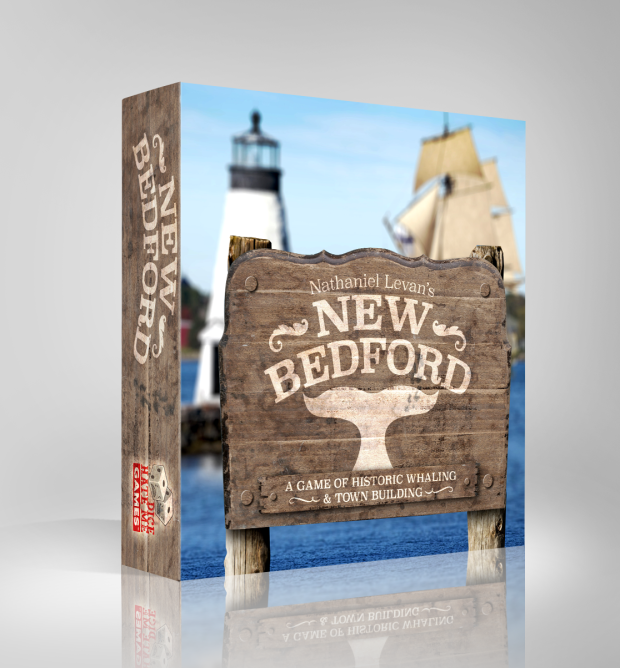
New Bedford Kickstarter Preview

NewBedfordBoxFirstLook
This post is not a review, but a preview for a game that is currently seeking funding on Kickstarter. Final art, components, and rules are subject to change.

Dice Hate Me Games was one of the first board game publishers to get their start on Kickstarter. They have done quite well for themselves and have a very strong reputation as a great company that puts out consistently great games.

Five of the Town action spaces
Next up from Chris and company is New Bedford. Designed by Nathaniel Levan at Oakleaf Games, New Bedford is a worker placement game set in the titular Massachusetts city during the time of whaling. Players will use their workers to collect resources, build buildings, and go on whaling expeditions.

Play takes place in phases. The first is the Action Phase, where players will take turns placing workers onto the seven starting action spaces, as well as any built buildings, and resolving their effects immediately. Town spaces are not blocked once workers are placed on them, but the player who places on each space first will get a bonus.

Light colored buildings can be used for actions,
while dark colored buildings are worth points at the end of the game.

Players will also be able to build their own buildings. Unlike Town spaces, buildings can only be used once per round. Additionally, the player who builds a building owns it, and can use it on future turns for free, while other players who use the building will have to pay the owner $1. There are also buildings which cannot be used as action spaces, but rather score the owning player points at the end of the game

After all players have place their workers, the Movement Phase will begin. All ships at sea will move 1 space up the whaling track towards the Return space. Then, the Whaling phase begins. Whaling tokens are drawn from the bag equal to the number of ships on the board. These tokens are then drafted by the players, with players who have ship farther out to sea choosing first. Whale tokens chosen this way are placed on the player's board, next to the corresponding ship. Any whale or open sea tokens that are leftover will be returned to the bag at the start of next round's whaling phase.

When a player's ship returns to port during the Movement phase, players will have to pay a "lay." Each whale token paid for, will earn the player points indicated on the token. Players can also choose to (or they may have to if they can't afford lays for all their whales) sell any whales tokens that return to port. When a player sells a whale token, she receives half of the cost of each sold token from the bank. Then, moving in clockwise order from the seller, each player will have the opportunity to purchase the sold tokens for the full cost. Any amount paid goes to the bank, and if a player cannot or chooses not to purchase whale tokens, the next player clockwise will have the opportunity, and so on.


The game continues in this way for 12 rounds. At the end of the game, players receive points for any whale tokens in their possession, any buildings which score points, and for leftover money ($5=1 point).

That's New Bedford! It is a very enjoyable game, with a refreshing mix of familiar mechanisms. The worker placement aspect is fun, since it both removes the tension of being locked out of spots, but retains the tension of having to prioritize placement because the bonuses for being first at a Town space are pretty good. The whaling mechanism is always very exciting, especially as the game goes on and the bag really only has a few whales mingling with a mess of worthless open sea tiles. I especially like the choice of having to either pay for your whales or sell a few for some much needed money. Should I sell for some quick cash, but then risk giving my opponent's the opportunity to score points? And once you've gone through that decision, the next time you're at sea you'll think twice before automatically taking the big 4 point whale (which costs $8 to bring back)! Or maybe you'll spend most of your time in Town, building up a bustling economy, and then waiting at the docks to buy the leftover whales from your overeager opponents with too many whales!

New Bedford does a lot of things right - but the best thing about the game is that it is one of those games that is easy to both learn and teach, but will surprise you with its depth after you dive in for subsequent plays.

If you think New Bedford sounds great, go pledge your support for the game on Kickstarter today!

Peptide Kickstarter Preview

This post is not a review, but a preview of a game currently seeking funding on Kickstarter.

Genius Games is an independent publisher that had recent Kickstarter success with their first title, Linkage. That game was about DNA transcription. The game currently on Kickstarter, Peptide, is about using RNA to build proteins. Sensing a theme here?

Peptide is a set collection card game that also combines elements of card drafting and action selection in interesting ways.

There are 3 main types of cards in the game. Organelle cards are drafted by players and used to take actions. RNA cards are collected by players through the use of Organelle cards, and are used in order to create the Amino Acid cards (which are worth points). 

The meat of the game is in the Organelle cards. To start each round, 2 cards per each player is flipped face up in the middle of the table. Then, to start, each player will select one card from the middle of the table for themselves. This will continue until each player has taken 2 cards. 

After the draft, players will resolve the actions of their chosen Organelle cards. These actions include things like drawing Amino Acid cards, gaining ATP energy tokens, drawing RNA cards, matching RNA cards to an Amino Acid card, scoring completed Amino Acid cards and flipping it over and adding it to the player's Peptide chain.

That is pretty much it for gameplay. The game is very simple and flows very well. It has opportunities for some great choices and definitely has educational value! I really like how the different Organelles do different things, and the way the cards are laid out on the table are a great (rough) visual representation of what goes on during this process.

Right now, Genius Games reminds me of Academy Games. Their two games are lighter than Academy Games' stuff, but Peptide, just like Linkage, is one of those rare games that is fun, but also sneaks actual learning in as well. 

If you think Peptide would make a good addition to your collection - or your classroom - go ahead and back it now!!

Super Show Preview

SuperShow game packaging
The prototype came in a Chinese food takeout box

As an avid wrestling fan, when I saw The SuperShow on Kickstarter, I was immediately curious!  (Disclaimers: I own several hundred professional wrestling DVDs, and have played several games about pro wrestling, including Wrasslin', WWE Topps Attax, the WCW Nitro card game, and a few others.  I am almost undoubtedly the target audience for this game.)

Now that I've gotten the disclaimers out of the way, let's get into the game itself, and try to figure out who would enjoy it.  I think that when considering this game, the first question you should ask yourself is, "Do I enjoy professional wrestling?"  Followed by the second question, "Do the friends that I play games with also enjoy professional wrestling?"  If you answered a resounding no to either of these questions, then this probably isn't the game for you.  However, if you answered, "of course!," then you should definitely keep reading.

The game is rather straightforward - in order to defeat your opponent, you must perform your finishing move, and then pin him for the 1-2-3.  (This is modern day pro wrestling - we're not letting you win with a cheap roll-up.)  In SuperShow, there are three types of cards - leads, follow ups, and finishers.  On your turn you draw a card, and then you can play a single card.  There is no requirement to play a lead, but to play a follow up, you must have a lead in play, and to play a finisher, you must have a follow up in play.  ("In play" means you've already hit this move.)  Each of your cards has additional text to go along with the type - some of these let you draw cards or fish them out of your discard pile (these are both really helpful since you'll only have 3 finishers in your deck).  Other cards, however, can be played out of turn as "Stops" - if your opponent tries to hit specific types of moves, then you can Stop them to prevent that move from landing.

Now that you know the basic flow of playing cards, there is another concept in the game - where you roll against your opponent.  At the start of the round, both players roll a die to see which stat they compare - and the person with the higher stat starts the round.  (There is a six-sided die that correlates to the six stats on your card.  If you roll "Power," and your Power is 6, then you compare that to what I rolled - say, "Technique," where my Technique might be a 7; and so I would go first.)  This rolling mechanic also occurs after you hit your finishing move.  If I land a finisher, then I roll a die to see how well I executed it (some finishers give you bonuses to certain stats so that this roll will be higher).  Then the person who is pinned (because you pin people after you hit finishers - in the game just like in real life) gets three rolls to equal or exceed the number that their opponent rolled.  If they successfully roll high enough, then they kick out - the board gets cleared, and the "Crowd Meter" goes up by 1 (this number is added to the finisher roll so that as the game progresses, each finisher is more likely to avoid getting kicked out of).  If they don't kick out, then they lost the match!

Since this game is still in what I consider prototype form (I don't have the final version, since it is still on Kickstarter), my goal in this preview is to help you understand the gameplay so that you can figure out if you will like it, and also clarify who I think will and will not enjoy it.  Now that we've covered the gameplay, here's some other stuff you should know.

SuperShow wrestlers with finishing moves
The two wrestlers that came in my 2-player box
First, what's in the box!  This is a bit tricky, as there are several backer levels (and I did not get the standard level for this preview.)  However, I believe this is what you receive in a basic 2-player game (the $25 level):

  • Two wrestlers - a wrestler consists of 4 unique cards - the wrestler itself, and three unique finishers that get shuffled into your deck.
  • Two standard 27 card decks - each of these decks is the same from what I can tell (at least for now - they have teased that they might change this with the expansion, which is available at another level).  I also think that if the designers are smart, they will make rules that allow you to customize these decks or, in the future, give each wrestler a slightly different deck so that they feel a bit more unique.
  • Two custom dice - these dice have the six different stats depicted on them for the rolls that I described earlier.
  • Six Crowd Meter cards - these allow you to track how many finishers have been hit (and kicked out of).
  • Two Kickstarter promo wrestlers - consisting of 4 unique cards like with your normal wrestlers.


Now, the crux of this preview - is the SuperShow something that you might enjoy?

People that will enjoy the SuperShow:
SuperShow cards
Each of the cards has the move drawn correctly, which is nice!

  • Wrestling fans - especially indie wrestling fans, as the wrestlers in the game have much more of an indie feel, and the game isn't licensed.  However, if you are a wrestling fan, you will probably really appreciate the artwork - I think that this game may have the best art of any of the wrestling games that I've played.  (Aside from possibly Raw Deal, which used images from actual WWE programming.)
  • Players who are looking for quick, fairly random games - games I have played have occasionally ended in three turns (lead, follow up, finisher - and they didn't kick out), and have sometimes lasted quite a long time, as 2-3 finishers have been kicked out of.  
  • People who enjoy playing in tournaments for fun without worrying as much about whether they win (the randomness will cause you to lose sometimes, even if you are "better at the game" than your opponent).  I can see game store owners that enjoy wrestling having old wrestling matches playing in the background as they have a SuperShow tournament running, with the winner getting the "championship belt." (Yes, I believe that they have promotional championship belt cards that you can acquire somehow.  Or, if you're super dedicated, you can buy actual replica championship belts.)
People that will not enjoy the SuperShow:
  • People that ask, "You watch wrestling?  Really?  You know that it's fake, right?"
  • People that are looking for a deep strategy game.  I have reviewed a lot of those on this site - but the SuperShow is much more similar to Lunch Money (without having to memorize all of the cards), than it is to Viticulture.
Overall, I have enjoyed my games of the SuperShow, and I have some friends that I think would enjoy it with me, but the people I played with (non-wrestling fans) haven't shared my excitement for the game.  Overall, I am curious to see what they do with the game going forward.  I have hopes that they expand the game to give it a bit more variety - hopefully allowing you to customize the starting decks, and play to each wrestler's "strengths."  (For example, right now if you have a 10 in Grapple, it doesn't mean that you have extra Grapple cards in your deck - which I think it should.)  There are also areas about each wrestler that I think they could continue customizing as each wrestler comes out.  (The wrestlers I've seen all have the same stats, but in a different arrangement.  I think that they could make some wrestlers have worse stats but better special powers, as an example of how to add more variety.)

If you think that the SuperShow sounds like something you would enjoy, make sure to check it out on Kickstarter.  As I write this, it is over halfway funded, and has about 3 weeks to go!

I would like to thank Steve Resk for providing me with a copy of the SuperShow.

Slaughterball Kickstarter Preview

Nemesis athlete figure 3d renders
This post is not a review, but a preview for a game currently seeking funding on Kickstarter.

Slaughterball is a board game simulating a future blood-filled sport where 2-4 teams battle it out in a pit. In Slaughterball, teams score points not only by scoring goals, but also by attacking and injuring opponents - that and the name Slaughterball, should tell you pretty much all you need to know about this game!

Athletes in Slaughterball have stats like accuracy, agility, brawling, speed, and toughness. These stats tell how many dice the athlete will roll when testing certain skills. The interesting thing about this is that there are four different types of athletes, who can each perform any of the available actions, but each of them have specialized stats so they are much better at doing certain things. 

On a turn, each player will go through Draw, Onslaught, and Cleanup phases. During the Draw phase, players can discard as many cards as they would like, and draw the same number back into their hand.

The Onslaught phase is the main phase of a turn. Players will activate a number of their athletes one at a time in order to take actions such as Chop, Move, Pass, and Shoot. 

The Cleanup phase is where players may be able to return athletes who have previously been sent to either the Penalty Box or the Slaughter Box. 

Prototype athletes and boardThe game ends after 6 rounds, and the team with the most points wins! Players can score points being the first to move onto the central Meat Grinder spaces with the ball, by scoring goals, or by knocking down or injuring opposing athletes. 

Slaughterball certainly invites comparisons to the other big sport-combat game this year, Kaosball. I've played both now, and I have to say that Slaughterball blows Kaosball out of the water. Slaughterball is much more streamlined and intuitive, and more successfully combines the aspects of sports and combat that I think both games aspire to achieve. 

All Hands on Deck! Kickstarter Preview

This post is not a review, but a preview of a game currently seeking funding on Kickstarter.

All Hands on Deck! is a family set collection game with a fun, cartoony pirate theme. The game consists of 108 cards made up of 3 different bands of pirates (colored suits) as well as a variety of actions cards. 


A Deckful of Pirate BootyThe goal of the game is to assemble a team of winning pirates - either 7 consecutive pirates from one crew, or 3 consecutive pirates from all 3 crews. Players go about this by participating in auctions and through clever play of their action cards.

Each round, there will be a card from the deck put up for auction. All players will put up cards from their hand into the blind bid auction. All pirate cards values are added up, and the highest bid wins. Any actions cards that are included in the bid are also resolved in turn order.

Once someone assembled a winning hand, the game ends!

The 'Pirate King' Action CardThat it pretty much it! The game is great for families - it is easy to understand, has fantastic artwork, and a fun theme. Decisions in the game - like knowing which cards to give up in your bids and which to hold onto as sets (as well as which type of set to shoot for) are simple, but also not so easy as to make the game uninteresting. All Hands on Deck definitely has enough gameplay to be enjoyable for everyone, and definitely doesn't outstay its welcome!

If you think All Hands on Deck will be a good fit for you, go check it out on Kickstarter!

Knee Jerk Kickstarter Preview

This post is not a review, but a preview of a game currently seeking funding on Kickstarter. Final art, rules, and components are subject to change.

I don't think there's anything I love more than sitting around with my friends and family and laughing. That is why I love games like Taboo and Balderdash. They don't is not much to those games, but they produce such hilarious and memorable moments that I simply can't get enough of them. 

Knee Jerk is a game similar to those two in a way. Players need only a deck of cards and about 10 seconds of rules explanation in order to play. 

The game is dead simple - the active player (host) deals 2 cards to the table, and 3 to her hand. She chooses one from her hand, and lines it up with the other 2 so that the green arrow of the first card points to the blue arrow of the second card, which points to the orange block of the third card (the one she chose from her hand). This orientation of the cards will create a randomized story prompt. 


After the host player reads the story prompt, the rest of the players begin offering up their versions of how the scene ends. The host then awards the player who answered first a point - in the form of the left-most card on the table. Play then continues with the host placing another card to the right. 

Knee Jerk is so simple, but so much fun. The crux of the game, however, relies on the players you've gathered together. I think that the rules are simple enough that anyone thinking about bringing this out with a group would already have a pretty good idea of whether or not it would go over well. But because the rules are so simple, it is also fairly easy to implement variants.

The game rules also suggest playing where the host awards the point for a story to the first answer given. While this rule certainly fosters a wide range of hilarious answers shouted out without thinking, I also think that having the host choose her favorite story for each round is also a lot of fun. The last game of Knee Jerk I played with a kind of a blend of the two, where the host of the round chose which rule variant she wanted to use. 

Knee Jerk is one of those party games that I love - it brings out a special kind of silliness in people that is just so much fun to be involved in. And just like the best party games, it is not only a blast to play, but it can also create discussions about where some of these ridiculous stories come from - either real or created. Knee Jerk is great party game - and an absolute steal at $10.


Pack O Game Kickstarter Preview


Final art, components, and rules are subject to change.

Chris Handy is a designer I wish had more published work. I greatly enjoyed his 2009 release Long Shot, and absolutely fell in love with Cinque Terre, which came out last year.

So when I heard that he was designing a bunch of small card games with plans of releasing them all in a single Kickstarter campaign, I was very interested. I had also heard that the games were to be released in boxes the size of a pack of gum. When I heard that, I thought that either Chris was talking about huge packs of gum or that I was somehow misunderstanding him. But when the prototypes arrived, I saw that each of the games were, indeed, the size of a pack of Wrigley's. All of the games in this Pack O Games line is the same size, as are, obviously, the cards.

Chris was kind enough to send me 5 of his upcoming games - following are short descriptions and my thoughts on each.


First up - the dexterity game, FLY. In FLY, a game "board" is created by laying most of the cards in the box out in a grid. When the card are laying out this way, they resemble a picnic table - except it is covered in flies. Players take turns dropping a fly swatter card onto the grid. If they successfully cover (completely) any flies while doing this, they take those cards. Each fly in the game has a colored shape on it and players are trying to assemble sets of flies. At the end of the game, each fly that is a part of at least a set of 3 will be worth 1 point.

FLY is not the best dexterity game I've ever played, but it looks great on a table, and is a good time! It is super easy to explain and play - I had a good time playing it with my niece and nephew.


TKO is a boxing game of simultaneous action selection. Each player assembles a boxer made out of a couple cards, and takes an action selection card. Each round, players will secretly place their thumbs on their action selection card choosing either to punch their opponent's head or torso, or block their own head or torso. Both players will reveal simultaneously and resolve their actions. Points are scored for successful punches or blocks, and a player will win a round once she scores 5 points.

TKO is another super simple game, that is definitely more fun than I thought it would be at first glance. Once thing that really adds to the gameplay is that each boxer has a slight advantage in one category. So the decision to either go straight ahead and be a bit more obvious and push that advantage or to try to throw off your opponent and take another path is quite interesting - especially in a simultaneous action game.


HUE is the colorful game of, well - colors! All of the cards in HUE are made up of regions of colors. Players will be placing cards from their hands in order to manipulate the size of the color regions on the board. Each player will be given 6 cards to start each game, but the game will end once each player has played 5 cards. The card remaining in each player's hand will determine which colors will score for that player. Players will look at the 3 colors on their last cards, and will score a number of points equal to the biggest continuous regions of that color on the board.

The twist of having to score a card of colors that you don't get to actually play is really interesting enough, and makes for a great game. Chris did add one more wrinkle to the gameplay, though. At the beginning of each game, players are also given a card with 3 colors on it, (like the rest of the cards), but this one has a skull on the middle color. When this card is played, whatever matching region the skull touches is not counted when looking for the biggest region of a color. HUE is great. It is colorful, simple, cutthroat, and just great to play. It gives the players some control, but still keeps things random enough to prevent players from overthinking. Games are quick, nasty, and fun.

TAJ is another colorful game - this one involves voting and light negotiation. In it, each player is given a card which indicates which color carpets will score positively - as well as which colors will score negatively. The additional wrinkle here is that each carpet is made up of 3 colors - a 3 point color, a 2 point color, and a 1 point color. The rugs cards are all lined up, and a scoring card is placed above the line, over 3 of the rug cards. Each round, a player will propose switching one of the cards under the scoring card with another rug card, not under the scoring card. Players will vote on this switch, executing it if it passes, and removing one of the rugs from the game (and not making the switch) if it does not pass. Once the game ends, the players reveal their scoring cards, and add up their positive and negative points!

TAJ, just like a few of the other games I've gotten to try in this line, is a very subtle game. With its bright colors, small box, and few components, it seems like there can't be much there - but TAJ will surprise you in how strategies will emerge after a couple plays. Despite having a fair amount of think, TAJ also had my friends and I standing up and screaming at each other (all in good fun) after a few of the votes. In my book, that is the mark of a great game.


Anyone who knows me knows that I like to save the best for last. GEM is my favorite game of the Pack O Games that I've had the pleasure of playing. It is a game of auctions, bluffing, and borrowing that is so simple, yet so clever. In it, players use coin cards to bid on gem cards. Sounds simple enough, right? First, the auctions are "once around" so once you bid, you're done, and the last person to bid basically has the choice of either giving the card up to the current highest bid, or buying the card for one more than the highest bid (assuming she has enough money). This makes each auction really intense - especially since money is so tight in this game already. Second, during each bidding round, players aren't necessarily bidding on any particular gem - they're really bidding on the opportunity to choose one of the gems still available for themselves - so the winning bidder will pay, and then choose any of the gems still available for themselves. Lastly, each gem card has two sides: leveraged and invested. I thought of these states as similar to mortgaged and mortgaged properties in Monopoly, but it isn't really the same. Once players win some gems, they can use them to pay for future auctions. However, gems won are flipped to the leveraged side, and in order to spend the value of a gem, the value of a gem's leveraged side must be paid, to first flip it to its invested side. Sounds confusing, but trust me - it isn't.

If the auction round was over, this player could spend her coins to flip either of the two gems cards she has to the invested side. These could then be used for future auctions, or would be counted in final scoring (if the game was over).

At the end of the game, players will score points for each invested gem they have won, with big bonus points going to those who have the most of each type of gem. GEM is easily my favorite game of the ones I've played. It is just as small as the other games in the line, but really has the feel of a full game. The decisions of which gems to go for, when to deny the other player's, and what you can afford to reinvest are all sooo difficult and all soo much fun.

If these games sound like ones you  might enjoy, go back Chris' Pack O Games Kickstarter now!! He also has 3 minute how-to-play videos up on the page!

Each game is only $6 including shipping to the US - and there's a special Early Bird level that is only good for the rest of today!

Tymor Kickstarter Preview

[This post is not a review, but a preview of a game currently seeking funding on Kickstarter. Final rules, art, or components are subject to change.]

Tymor is set in a land where players are struggling to rebuild their kingdoms after the world suffered an ancient calamity that has unhinged the natural rhythm of the seasons.

This interesting storyline is reflected in game by a season track. To start off each round, the active player will roll the season die to determine which way the season counter will move. 2 out of 3 times it will move forward normally, but there is always a chance that the calamity's effects will be felt, and the season could remain the same, or even regress to the previous season.

Depending on the season, players will receive income, and will then have to pay upkeep for the units on the board - suffering a penalty for each gold they are unable to pay.

On a player's turn, she gets to activate all of the units she has on the board. There are types of units (not including buildings). These units can all perform a "basic move" which is just moving from one hex to another, as long as there are no opponent's units in the destination hex.

The game looks great on the table. And this is just the prototype!

The Merchant's special move allows him to move into hexes occupied by enemy forces. The Priest can, instead of moving, spend gold in order to build a new settlement, or upgrade an existing one. Soldiers have the ability to start combat. They can declare an attack as their action, moving into a hex with opposing units and beginning a battle.

One of the most interesting parts of Tymor is that each of these types of unit's has a unique was of scoring the player points. The Merchant scores points by being on a hex with a opponent's settlement during the income phase of the game. Not only will this Merchant give the owning player some extra cash, they will also move up the Trade Points track on the score board. Priests score points by building up the player's Empire, and Soldiers score points by eliminating the enemy in battle.

How beautiful is that artwork?

This gameplay I have outlined above would definitely work, and make a decent game. But the cards in the game add whole new layers of strategy, tactics, and bluffing to the game. These cards come in 3 varieties that match the three types of units and scoring in the game. They have abilities like allowing units to act as other units, providing boosts to the normal actions, and just gaining the player resources.

Tymor is a lot of fun to play. It is that rare game that I am always on the lookout for - great theme, euro mechanisms, with a healthy dose of dice. I really like how there are 3 different score tracks that focus on the 3 different types of units. It makes the overall structure and goal of the game very easy to grasp. A game with similar weight and complexity without this simple differentiation/structure could easily be seen as overly complex for some people - I think the designer has done a great job in this respect.

Keep away from my stuff!!

One thing I don't care for in the game is the fact that since all 3 of the different ways of scoring are almost mandatory, combat is inevitable. Now I enjoy combat games - check my review of BattleLore Second Edition if you don't believe me! But what I don't really care for is combat in games where at least part of the goal of the game is to build stuff up. I just hate the feeling I get when something that I put effort into building up comes crumbling down.

One of my favorite parts of Tymor is the way that scoring works. I've already talked about how I like the segmented scoring system in Tymor, which is great. But another aspect of scoring in Tymor is that each of the separate scoring categories works a bit like a race. The most points a player can get in any of the categories in 10 points - the top space on each track. However, at the end of each round, players check to see if anyone has made it to the top of any of the tracks. If they have, that track is considered "closed" and while other players can still score points on that track, no one else may enter the top space. And since the players' positions on these tracks are very much public, this dynamic can create some very interesting interactions and motivations for the players on the board. Additionally, the tracks also act as a timer - since the game will end once all 3 tracks have been closed.

Tymor is a wonderful little game. It takes a few mechanisms we've seen before, throws in some really interesting new ideas, and is good solid fun. It isn't too complex, but it's also far from a filler. If you think you'd like a get a copy of Tymor for yourself, go check out the Kickstarter going on right now! The campaign is almost half way funded with plenty of time to go!


Athlas Kickstarter Preview

[This post is not a review, but a preview for a game currently seeking funding on Kickstarter. Game rules, components, and art are all subject to change from the prototype version I was sent.]

Athlas is a game that I was very excited to try out from the moment I saw the art. The more I read about the game, the more I thought it was the kind of game for me.


In Athlas: Duel for Divinity, players face off against each other as they use different custom built avatars, or Alphas, to fight to obtain relics and prove they are worthy of godhood.

One of the most interesting parts of Athlas is the character creation. After players agree on a Summoning Point total, they each take their deck of 170 cards, and create 3 "Alphas." These Alphas are essentially templates - copies of which will be summoned onto the battlefield to attempt to be the first to open the portal to Athlas.


Each player has 9 genus cards - which are the basic building block cards for the Alphas. These come with a few innate abilities, but the fun really begins once players start customizing and building their Alphas. Most of each player's 170 cards are equipment, abilities, or spells which can be assigned to Alphas. These can be things like weapons, superpowers, or magic abilities that will help each Alpha achieve the player's goal of victory.

The Alpha genus cards as well as any equipment, ability, or spell cards assigned to it come with a summoning cost, however. So that each time a player brings a new copy of the Alpha onto the battlefield, she will be getting closer and closer to the summoning point limit players agreed upon before beginning the game. So players really have to decide what kind of game they want to play. Should they load up their Alphas with lots of powerful abilities and weapons, knowing they won't be able to summon to many to the battlefield? Do they go with a swarm approach and build smaller Alphas with less power, but who cost less and can be summoned multiple times per game? Does a single minded Alpha team stand a chance? Is a more balanced team not min/maxed enough? Should the Alphas be fast, nimble, slow, powerful, ranged, melee? All of these decisions need to be dealt with by players as they go through their decks of cards to create their Alphas.


A few of the Divine Intervention cards available in the game.

Players also build a deck of 4 Divine Intervention cards. These cards can be played at almost any time, and can have a powerful effect on the course of the game. The catch with these cards is that they must be played in the order the player chose to put them in at the start of the game. If a player finds she really wants to play her third card, but hasn't played her first card yet, she can do so, but the first two cards will have to be discarded with no effect. So again, careful planning in how players build their decks is important.

My super Spell Binder had extra health, health regen, and a bunch of awesome spells...and "only" cost fourty-four points to summon!

Once the construction phase of the game is complete, players will summon copies of their Alphas to the battlefield and activate them in order to acquire and hold 2 of 3 relics that are on the board. Combat in the game is diceless and, in fact, not randomized in any way. When a combatant uses an action to attack another combatant, stats and bonuses are compared and damage is assigned. Combat itself is fairly straightforward, but with all of those awesome power card in play, keeping everything your and your opponent's Alphas can do is where the challenge lies.

The game ends when one of the players controls 2 relics at the beginning of her turn. The player wins!

Athlas is a very engaging game with beautiful artwork and a lot of interesting decisions and customization options to play around with. I am someone who loves video game RPGs, and Athlas definitely gave me the feeling of getting to "level" up my characters as much as I wanted - without any grinding. A lot of the fun of this game is in being able to create your 3 fighters the way that you want, and then getting to see if the strategy you planned for when you were spec'ing out your troops does what you thought, or crashes and burns.

The best thing I can say about Athlas is that it reminded me of a slightly heavier, much less random version of Summoner Wars. If that description sounds appealing to you, I think you should absolutely go back this game! It has already funded, but only has 3 days left, so don't wait!


Ophir Kickstarter Preview

[This post is not a review, but a preview of a game currently seeking funding on Kickstarter (https://www.kickstarter.com/projects/justinschaffer/ophir?ref=card). Components, art, or rules may change between when Jim played the game and the final release of the game.]

Ophir is the latest game from Terra Nova games (http://www.terranovagames.com/) seeking funding on Kickstarter. Their previous game, Guile, was successfully funded on Kickstarter about a year ago, and is a light, very interesting, card game all about bluffing and deduction.


Comparatively, Ophir is much more complicated than Guile, but it does still very much fall in the "family" category of games. In Ophir, players assume the roles of different government, trade, and religious dignitaries who are all sailing around the region of Ophir with a singular goal - building the Temple.


A lot about the setup of Ophir is modular and randomized, which adds a lot to the replayability of the game. Even players who have played previously will have to take a good look at the board state after everything has been set up and reevaluate whether their strategies will be effective for this game.

The locations of all the goods and the Temple and Market are random, as are the two barriers (which block player movement), as well as the order of the market cards (somewhat - there is an A and a B deck, which are shuffled separately and then combined, A on top of B). Players also draft the special roles in the game, with the first player having her choice from among 1 more than the number of players.


Players will be sailing around to the different islands, picking up goods, and delivering them to either the Market or the Temple and receiving rewards like money, favor, or victory points. The main way to score points in the game, though, is by contributing gold or silver towards the construction of the Temple. Players can purchase gold or silver by paying either coins or favor, and can then deliver the gold or silver to the Temple site in return for victory points.

Moving around the board is interesting too, because each player will have an influence die on their ship. If a player wants to sail into a space which already contains another player's ship, she has to either spend a valuable favor point, or risk rolling her influence die in the hopes of rolling a value that is equal to or higher than the highest influence die on the space she is trying to move to. If the roll is unsuccessful, her action is wasted and her ship stays where it is, but if it is successful, she is able to move into that space, and the value she rolled is the new value of her influence die - which could be bad news for the other players who might want to move into her space.

How awesome does that look? And this is only a prototype!

In fact, one of the big draws of Ophir is the really phenomenal looking 3-D Temple that gets constructed throughout the game. As each level is completed by the players, another level is added, which has art corresponding to the Temple getting closer and closer to completion.

The game will end when either the Temple is completed, or when there are not enough market cards left to fully replenish the market. At this point, players will get extra victory points for any gold or silver they happen to be carrying at the time, and the player with the most victory points wins!

While there is a lot of randomization in Ophir, the gameplay is very simple, which makes this a great game for more experienced gamers to play with friends or family members who may not be as engaged in the hobby. The art and components will absolutely help those "non-gamers" feel more comfortable and more drawn to the game as well. The pick up and deliver mechanisms are also very intuitive and will be very easy to explain to new players as well. I feel that Ophir is a great gateway game for people interested in the beautiful art or in a easy to learn pickup and deliver game.

If you think Ophir would make a good addition to you game collection, go pledge now! (https://www.kickstarter.com/projects/justinschaffer/ophir?ref=card)