Harry's Grand Slam Baseball Review

Harry's Grand Slam Baseball card game in play

For my wife, there are two seasons - baseball season and the off-season.  And, since she's busy watching baseball during baseball season, the off-season is a good time to try to get her to play games - like Harry's Grand Slam Baseball.

In Harry's Grand Slam Baseball, two players play a very fast paced game of baseball.  Just like in baseball, the game consists of nine innings of players alternating who is at bat, and the person with the most runs at the end of the game is the winner.  In any given inning, whichever player is "at bat" will get to play the first card.  Cards represent possible outcomes of an at bat - they can be an out (of various kinds), a double play, a single, double, triple, or home run.  They can also be something that occurs during an at bat - such as a balk, a stolen base, or a wild pitch.  As each player plays a card, it affects the runners on base, and sometimes causes some of them to score runs.  But, once there are three outs, the inning is over - all runners are cleared, and the next player starts their turn "at bat."  And, to mix things up, after the third and sixth innings, the entire deck is reshuffled (along with both players' hands), and everyone gets new cards.  After nine innings, whoever has the most runs wins!

The first pro that I found for Harry's Grand Slam Baseball is that it gives you a taste of baseball, but is very fast paced.  The game doesn't attempt to be a simulation, which is obvious by the fact that an at bat consists of a single card - you don't have to worry about pitch counts, or anything else complicated.  You simply play a card to determine the outcome of the play.

cards from Harry's Grand Slam Baseball board game
Pinch Hitters - ready to be played
The next pro that I have for Harry's Grand Slam Baseball are the "Pinch Hitter" cards.  These cards represent putting in a new hitter (or pitcher), in place of the ones in your hand.  Whenever you draw a Pinch Hitter, you must immediately play it in front of you, and you draw a card from the top of the deck and put it face down with the Pinch Hitter card.  (You also get to re-draw your hand back up to three cards).  At any time later in the game, if you don't like the cards in your hand, you have the option of playing your Pinch Hitter instead.  Simply flip the facedown card over, and this is your new result - it may be better than what you had in your hand, but it might also be a homerun for the other team!     

The last pro that I will mention for Harry's Grand Slam Baseball is that you can easily play it with kids.  As long as both players have a basic understanding of baseball (runners advancing, played over nine innings, three outs, etc), you can play with anyone.  There's not especially much text in the game, so I'd imagine that you could even play with children as young as 3-4 if they were interested in baseball.  It might push their attention span slightly, but the game only lasts about 15 minutes, so they could probably handle a full game with no problems.

However, the speed and simplicity of Harry's Grand Slam Baseball also has a negative side - the game really isn't deep.  There are a few strategic decisions, such as whether you should try to get runners on base before playing your homerun, and when you should play a Pinch Hitter.  But, for the most part, the game is very luck based.  If I am at bat and my opponent happens to not be able to draw any out cards, then I'm likely to have a high scoring inning.  But, if I'm at bat and all I can draw are outs, then I'm going to do very poorly. 

Overall, I give Harry's Grand Slam Baseball a 7.0/10.  I can appreciate the game, and I can see why people enjoy it, but for me there isn't enough decision making to really get me to keep playing the game.

If you Harry's Grand Slam Baseball sounds like something you would enjoy, you might also check out Gubs, Jab: Real Time Boxing, and Tsuro.

Timeline Review

Timeline card game in play

A deceptively simple game that I've been playing recently is Timeline.

The premise of Timeline is very simple - you are supposed to place events (or inventions, discoveries, etc, based on which set you are using) in their correct order in the timeline.  To start the game, each player is dealt a handful of cards, which they place in front of them on the table.  One other card is dealt into the center of the table, date showing, to seed the timeline.  (These cards each represent something that happened at a specific point in time.  One side of the card depicts the event, and the other side depicts the event and also has a year on it.)  Each turn, the active player attempts to play a card by placing it somewhere in the timeline and then flipping it over.  If they have placed the event in the proper location, then their turn is over; otherwise, they must draw a new card.  The first person to run out of cards is the winner.

different Timeline games by Asmodee
The currently available versions of Timeline
Timeline is a bit of an enigma to me.  The game doesn't really sound very exciting.  And yet, my first pro for the game is that it is fun to play.  I am not typically a person that enjoys trivia games and, though it plays a bit differently than a "normal" trivia game, Timeline is still a trivia game at its core.  It's really amazing how something so simply can create an enjoyable experience.  And, as an added positive - Timeline is simple enough that you can teach it to anyone.  It could easily be taught to any of your friends, regardless of previous gaming experience, and they could pick it up quickly and enjoy it with you.

The next pro for Timeline is that there is, surprisingly, strategy about playing the game.  With a normal hand, you will generally have some cards that you know pretty well, some that you have a decent idea about, and some that you have no clue about.  But, with those, when should you play each card?  Should you play the ones that you have no idea about first, and hope that you're able to successfully play them since your odds are better of guessing correctly when the timeline is small?  If you do that, then the ones that you only have a vague idea about will become much harder to play later - after all, if you know that something happened in the 1800's, and there are several cards already played in the 1800's, then suddenly your card is much harder to play.  What's more - you know what cards your opponents have.  So, should you play some of your cards that happened around the same time as theirs in order to make their cards harder to play?  Like I said, the game itself is very simple, but forming a strategy about the order of playing your cards adds some depth to the game.

cards from the game Timeline
Is this where the Can Opener goes??
Yet, Timeline still has a few drawbacks.  First is that I think it lacks in replayability.  When I love a game, I really want to play it over and over again.  However, if you do this with Timeline, you're going to wind up learning the dates of the various events.  And, whereas learning is generally considered a good thing, and may help you feel better about yourself, it will also break the game of Timeline if one player knows when everything happened.  This issue can be mitigated in a couple of ways - first, there are four different Timeline sets that you can purchase (separately, of course), and this allows you to play the game with different cards.  And, secondly, if you are careful to leave a few weeks between your plays of Timeline, then you will likely not remember when everything happened.  Regardless, Timeline isn't something that you're going to be able to sit down and play all night.

The second con is that the enjoyment of the game is going to be highly dependent on the equality of the players.  Since Timeline is a trivia game (and not a game of highly obscure trivia game like Wits and Wagers), some people will know more answers than others.  And those people will win the most.  So, the ideal group for Timeline will be a group of people that have an approximately equal knowledge of history.

The last con that I have for Timeline is that the cards drawn can sometimes highly favor one player.  Why?  Because there are some cards that are really obvious about where they go in the timeline.  Cards like "The Earth is Formed."  Well, I may not know an exact date for that, and regardless of what you believe about creation versus evolution, you still are going to know that this card goes earlier than anything else on the timeline.  As long as a lot of these obvious cards aren't drawn, everything should be alright - but I had a game where I drew "The Earth is Formed," "Dinosaurs Appear," and "Dinosaurs Become Extinct" in my opening hand.  These three cards were all especially easy to play, and, un-surprisingly, I won that game.

Overall, I give Timeline an 8.0/10.  I'm glad to have it in my collection, and I intend to continue playing it for a long time, but the amount of time that I have to wait between plays keeps it from being one of my upper echelon games.

If Timeline sounds interesting, you might also check out Wits and Wagers, Biblios, and Code 777.

Jambo Review

Jambo card game in play

When looking for two-player games to play, one title comes up fairly regularly - Jambo.

In Jambo, the players take on the role of competing merchants attempting to gain money by buying and selling wares.  Each turn, the active player has five actions.  For an action, you may draw a card.  After drawing, you may either keep this card or discard it and draw another one (as another action).  You can do thus up to five times, but you can only keep one card - and it must always be the last one you drew.  After drawing (or choosing not to), you may play cards from your hand and use utility cards that are in play.  Cards from your hand can attack your opponent, buy or sell wares, build an extra market, and several other things.  Similarly, utility cards go into play in front of you (you can have three in play at any given time), and they do similar things, but at a cost - pay a gold to draw a card, take a ware from your opponent but then give them one of yours, discard cards from your hand to collect gold, etc.  If you end your turn with two or more actions remaining, then you earn an extra gold.  Play continues back and forth until one player has more than 60 gold.  At that point, the other player has one final turn to try to out-earn them, with the player having more gold winning!  (Or, if they're tied, then the second player - the one not triggering the end of game wins.  This is odd to me.)

card from Jambo game
The crux of the game is buying and selling wares
The first pro that I have for Jambo is that the game is deeper than it initially seems.  When you first start playing the game, you are basically just attempting to buy goods and immediately sell them (which, when this does happen, is very nice).  However, there are a lot of cards that will allow you to acquire the combinations you need more quickly.  The interesting balance is when to use these, and when the cost is too great.  One of the utility cards allows you to collect any ware that you want for 2 gold.  This can be very good to fill in a missing good, but costs more per ware than using ware cards.  So, it is less effective for filling in all of the goods for a given ware card.  Yet, it is still more valuable than not completing a ware card (unless you could have drawn a ware card that you were closer to completing).  There are also cards that let you sell wares without completing ware cards; but when you do this you only get 2 gold per ware, instead of the 3-4 that you get when you complete a ware card.

The next pro for Jambo is that everything in the game has a price.  In fact, doing well at Jambo requires a player to carefully balance these prices.  But, this pricing is balanced well enough to allow for neat combinations (and tough choices).  For example, one utility card allows you to spend 1 gold to draw a card; another lets you discard a card from your hand for 2 gold.  If you start doing this every turn, you will start making 1 gold per turn.  Yet, you gain 1 gold per turn whenever you end your turn with 2 or more actions - and this combination costs 2 actions!  So, there are many costs that you must balance in the game, including opportunity costs.  Another example of an opportunity cost is in the draw - you can draw up to five times in the hopes of getting a card that you need; but every extra draw prevents you from being able to play as many cards in the next phase.

utility card for game of Jambo
An example utility card
One quick point of note about Jambo before moving on to the cons.  The game has a direct conflict feel, to me, because of the animal cards.  The animal cards are essentially attacks - the Hyena lets you steal a card from your opponent's hand (but then return one from your hand), the Crocodile lets you discard one of your opponent's utility cards, and so on.  Some people love direct conflict in games, and some prefer to avoid it entirely.  So, whereas a game like Jaipur allows you to affect your opponent by performing actions before they can, in Jambo you affect your opponent by attacking them.  There are also "Guard" cards that can cancel an animal attack, but there are not enough of these to cancel all of the attacks, if you find yourself in a very conflict-intensive game.

My first con for Jambo is that, like with many card driven games, luck of the draw can play a major factor.  One example of this is the small market.  There is a rule that if you fill your large market (your starting card, which can hold six wares), then you must spend 2 gold (heavily cutting into future profits).  The small market card can allow you to hold 3 additional goods - which is helpful in itself, because you have extra room to hold combinations of goods.  But, the small market also allows you to avoid paying the two extra gold for filling your large market.  If one player draws a small market in his opening hand and the other player never sees one, the player with the extra market seems to have an advantage.  Yet, other good drawing can defeat this advantage.  There are multiple copies of any given ware card in the deck (I think that there are two of each).  One example of a "lucky draw" is a player that draws both copies of a certain ware card into their hand - poof, use one card to buy the wares and immediately sell them with the other card and make around 7 gold at the cost of 2 actions!  There is not a more effective play in the game!!

My other con for Jambo is that sometimes you feel like you're doing as well by skipping actions as you are by the actions you actually perform.  Remember the rule that you earn an extra gold if you end your turn with 2 or more actions?  Some of the games that I have played I have felt like half of the money I earned was by ending my turns with actions left!  Now, I realize that as you play the game, you will get better, but I think that this feeling can still persist even after your first couple of games.  If you're simply not drawing cards that work well together, a large percentage of your profits can be earned simply by passing. 

Overall, I give Jambo an 8.0/10.  It is one of the better two player games that I have played, but because of the direct conflict, I probably won't play it repeatedly (direct conflict games don't work well between me and my wife - and if you're married, that's probably who you're intending to play most (non-war) two-player games with).

If you are looking for good two player games, you might also check out Hive, Jaipur, and Babel.

Kingsburg Review

Kingsburg board game in play

A game that I've wanted to try out for quite a while is Kingsburg.

In Kingsburg, each player is attempting to help rebuild the kingdom, and fight off invading minions, in order to gain the King's favor.  In order to do this, the game is played over a series of five "years" with each "year" having three productive seasons and then an invasion.  The core of the game is the productive seasons.  In each productive season, all of the players roll their three dice.  Then, starting with whoever rolled the lowest, players take turns placing a group of dice on the board.  Legal placement is determined by the die rolls - for example, if you've rolled a 3, 5 and 6, then you can place a die on the 3, 5, or 6, or you can place a group of dice on the 8, 9, 11, or 14.  However, you cannot place dice on a spot that has already been claimed.  After everyone has placed their dice, then players collect bonuses (generally resources) for the places ("advisers") where they have placed dice ("influenced").  Once these resources have been collected, everyone has the option of building one building - these buildings can help defend against invaders, provide you flexibility in the placement of your dice, or give you victory points.  After the third productive season, each of the players has the opportunity to buy extra troops (they may have hired some during the productive seasons).  Next, the first player rolls a die - this number is added to each player's number of troops, and each player compares their total to the strength of the invading armies.  If you win, then you get a bonus.  If you lose, then they destroy one of your buildings.  Finally, you move everyone's number of armies back to zero, and start the next year - and, at the end of the fifth year, whoever has the most victory points wins!

The first pro that I have for Kingsburg is that I like the fact that your dice drive your placement.  I think that it forces players to make the most of what they roll, and is a very interesting and rarely-utilized dynamic (yes, I realize that Alien Frontiers and To Court the King also do similar things, but I believe Kingsburg came out before Alien Frontiers).  Plus, there are mechanisms within the game that let you alter your roll.  This enables you to do a combination of adapting to your die roll to your strategy and making your strategy adapt to your dice at the same time.  Specifically, there are some "+2" markers (that you earn in various ways) that you can play along with a group of dice to increase their value by exactly two.  Also, there is a building that allows you to place one group of dice per productive season on an adviser that is adjacent to the one that is equal to your dice value.  Other buildings can give you more dice, or let you re-roll some of your dice if you roll especially poorly.  These factors work together to make the game fun.
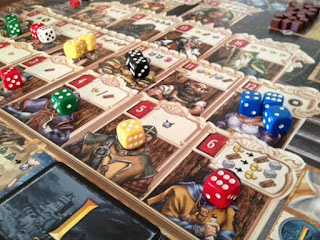
dice on board while playing Kingsburg
Using dice to influence advisors
Another element of Kingsburg that I like is that you have to pay attention to the invading horde.  But, what I like more about this is that there are a couple of advisers on the board that allow you to look at the strength of the invading horde.  So, as the round is being played, you are able to better plan for how big your army needs to be (and which buildings will give you bonuses).  This is especially important if you intend to build one of the most expensive buildings, as they are the ones that will be destroyed by the invading army - so, you want to make sure that you're going to be able to protect it, if you choose to build one of these buildings.  However, you never truly know how large your army needs to be, since you add a die roll to your troops.  This leads me to my first con.

Kingsburg is a bit too random for me.  All of the die rolling is what makes the game fun, but at the same time, it can becoming frustrating quickly when some of these random factors work heavily against you.  One example is in fighting off the invading horde.  When fighting off the horde, there are two approaches you can take - you can either try to get enough armies that you are guaranteed to win (assume that the die will be rolled a one), or you can rely on the die to help you win the battle.  The problem is, whichever of these choices you make is only the "ideal" choice if the die rolls as you anticipated.  If you build a giant army, and the die rolls a one, then you feel like you made the right choice spending all of your resources and influence towards building an army.  However, if it rolls a five or a six, then you realize how much time you wasted building this army that now gets reset back to zero (aside from strength that comes from buildings).  So, the invading horde is basically a press your luck element.  And, though I'm fine with games that are based around pressing your luck, I find that it can be very frustrating in a more strategic game.

King and Queen of Kingsburg
The royal family - you have to roll high to influence them
The other element that is a bit too random can be worded this way, "Bad rolling prevents good strategy."  What I mean by this is that there are some rolls that are just awful.  The more I've played the game, the more impressed that I have been that rolling higher doesn't mean that you are guaranteed to gather more resources than your opponents.  Ultimately, the higher spots generally get you around as many resources per die as lower spots do.  That is, unless you roll very low.  For example, if you roll all 1's.  This roll is awful.  It allows you to claim a single resource on your turn (or, if you are lucky, a resource and a victory point).  Generally, you gain approximately one resource per die - some spots allow you to get a bit more than this, or give you flexibility on what resource you select in place of getting as high of a quantity.  But, a normal productive season will net about three resources.  So, getting one resource, puts you at a major disadvantage - and had nothing to do with what your strategy was in the game.  Now, rolling all 1's isn't common (though I've seen it), but in general, rolling all low dice is bad, because, though I said you average about one resource per die, when you have to put dice together to form a "die" (for example, putting a two and a three to make a "five"), then you are getting less resources per die.

Overall, I give Kingsburg an 8.0/10.  I really enjoyed my first few plays of the game, but I think that it will grow stale for me pretty quickly.  The invading horde provides both a very neat strategic element to the game, but a very frustrating situation where your strategy's merit is determined by a die roll.

If Kingsburg sounds interesting, you might also check out Alien Frontiers, Kingdom of Solomon, and Bootleggers.