Showing posts with label dice rolling. Show all posts

Escape: The Curse of the Temple Review

Escape The Curse of the Temple board game in play

One of my biggest surprises in gaming recently has been Escape: The Curse of the Temple.

In Escape (I will probably be too lazy to add "The Curse of the Temple" throughout this post), you are a treasure seeker that is in a doomed temple.  The temple is collapsing, or exploding, or something like that, and you have to take magic gems and roll fancy combinations of dice in order to place the magic gems onto various enhanced tiles.  Or something.  I don't always pay attention to theme.  (Does it show?)  So, what this means in gameplay terms is that you and your friends win if you escape the temple.  In order to escape the temple, you have to find the exit and then roll a number of "keys" on your dice greater than the number of remaining gems.  To start the game, you have five dice and lots of gems - oh, and the exit also isn't exposed.  So, you will need to find the exit and also get rid of gems.  How do you do this?  By rolling dice.  Escape is real time (there is a soundtrack that plays while you are playing the game), and so you frantically roll dice and use them for different things.  To go to another room, you need a combination of dice; to explore, you need a combination of dice.  Certain rooms allow you to get rid of gems if you roll a certain combination of dice.  (And any time that you use a die for one of these things, it must be re-rolled before it can be used again.)  During the course of the game, there will be two times that you will have to return to your start spot within 30 seconds (indicated by a gong and a slamming door), or you will lose one of your dice.  If you successfully find the exit and every player escapes before time runs out, then you all win the game!  If time runs out and anyone is still in the temple, then you all lose.  (Cue sad music.)

So.  That sounds easy, right?  After all, I can roll the dice as many times as I want - where's the challenge?  My first pro is that one of the die faces is evil.  I don't know the term for it - but it is definitely evil.  Because, if you roll it, then your die is "locked" and cannot be rerolled.  Fortunately, there is another face of the die that allows you to unlock two "locked" dice.  And, if you are in the same room as another explorer, then you can unlock two of their dice.  So, a lot of the challenge of this game is ensuring that you roll the correct combination without locking yourself out.  (There is also an option to add a gem to the pile in order to unlock everyone's dice - this prevents you from losing because everyone just happened to roll poorly.  You can only do this twice per game, though.)

Escape: The Curse of the Temple board game meeples
Unlocking magic gems and heading for the door!
Now you may be asking, "but Josh - you like strategy games!  Where is the strategy??"  Well, though Escape is definitely on the lighter side of strategy, there are some crucial decisions that you have to make that will affect your outcome.  You have to decide how you are going to explore - are you going to explore as many rooms as you can as quickly as you can?  This will help find the exit, but it will make it very difficult to get back to the start tile when the gong sounds.  Also, when you explore, are you going to stay with other players?  Splitting up helps you cover ground, but staying together increases the total number of dice you can use when you reach a room that can absorb a magic gem.  Also, when you roll a lot of unlock faces, should you keep any of them?  Keeping them provides a nice "safety net" where you know that you won't get too many dice locked - but it is at the cost of using one less die (which functionally is very similar to that die being locked).  Whereas none of these are hard decisions, having to make them instantaneously adds to the challenge.

Finally, for pros, I will say this about Escape - it is a lot of fun!  Between throwing the dice frantically, yelling at each other to get help unlocking dice (only to realize that you're not in the same room and they can't unlock your dice anyway), desperately trying to get back to the start tile before the door slams, and hunting down the die that inevitably rolls off the table, Escape is incredibly engaging.  (It's also exhausting.)  You may leave a game of Escape deciding that the game isn't for you, and that you don't ever need to play it again - but I'd be impressed if while playing you weren't completely engrossed in attempting to make your way out of the temple before meeting your doom.

Escape Curse of the Temple curse tiles
Beware the curses from the included expansion
For my last two "final" pros, I will just say this - I also like the fact that I can teach Escape to just about anybody, and I am glad that there is an expansion that comes with the game (thus adding more replayability (also known as "difficulty")).

Though I really enjoy Escape, there is one major con that I have found with the game - it is very hard for my undiscerning ears to hear the different audio cues in the soundtrack.  The soundtrack provides a lot of ambient noise in order for you to really feel like you're trying to escape from a temple.  (Well, at least as much as you can feel that way while you have dice in your hands.)  Unfortunately, all of this ambient noise blends too well with the actual cues that you're supposed to hear.  I've had at least one time where I've just taught the game and, midway through playing, someone asked, "is that the gong?"  To which I had to reply, "I have no idea - but I think we all just lost a die."  Fortunately, there is a "quiet" soundtrack that only has the audio cues that you need to listen for.  Unfortunately, it is not included in the game itself (though you can find it here - I believe it is Soundtrack 3).  I have been told that if you use the quiet soundtrack often enough, then you will learn to pick up the cues and can switch back to the original soundtracks.  I have not bothered to try the originals again yet, but I may do so at some point.

Overall, I give Escape: The Curse of the Temple a 9.0/10.  I think that it is a really enjoyable game.  I don't know that I will play it all the time, but I think that it is a great addition to my collection that I will be able to bring out and play with a wide variety of friends.

If Escape sounds interesting, you might also check out Space Alert, Jab: Real Time Boxing, and Liar's Dice.

Anachronism Review

Anachronism History Channel card game in play

Are you looking for an awful game that you can buy to get free shipping?  Well, then lucky for you, I'm going to talk to you about Anachronism!  (To be fair, I bought this game at full price when it came out originally, and then I bought it again a few months ago because it was $1 and I needed another couple bucks in order to get free shipping.)

In Anachronism, each of the players takes on the role of one of history's most famous warriors - someone like William Wallace, Ramses II, or Spartacus.  Each warrior also comes with various forms of equipment, which can be mixed and matched between sets.  To start the game, however, you take four "support cards" (equipment and special stuff), and you lay them out in front of you.  To start each round, both players will flip over their next support card.  The initiative of these cards will determine who goes first (and the card will also give you a bonus of some sort).  Each player gets to perform a number of actions based on their character (Joan of Arc and William Wallace as two examples, both get three actions).  These actions can be to move, attack, or use an ability.  Moving is fairly straightforward, and abilities are explained on their corresponding cards.  However, in order to attack, your character has various attack zones that they can target (and weapons may have different zones in order to expand your range).  To attack your opponent, you position yourself so that your opponent ("target") is in one of your corresponding zones, and then you roll the dice and apply the modifier for that zone.  Your opponent also rolls the dice - and if you rolled higher (after applying the modifier) than your opponent, then you hit them for damage as indicated on your character or weapon (generally one).  Play continues like this until one character dies or until you have played five rounds (the last round doesn't get a support card).  At the end of the last round, whoever has the most health remaining is the winner!

cards fighting in Anachronism game
Joan of Arc and William Wallace positioned to strike!
The pros for Anachronism are simple - the concepts are amazing.  I really like the idea of historical warriors fighting it out in an arena.  That idea is so appealing that I've bought this game twice for it!  Also, the attack zones are a pretty cool concept, and really makes quite a bit of sense - depending on who you are and what kinds of weapons you are using, it makes sense that you would be able to attack in different areas around you with different amounts of success.  And, in fact, the execution of the attack zones in the game is decent - it encourages you to move around in order to get your opponent in one of your zones.  However, since the ultimate outcome of the attack is determined by a die roll, a slight modifier really isn't worth spending an extra action to get your character in their ideal position.  And thus, the modifiers become fairly unimportant strategically.

Now that I've covered my pro for Anachronism, let's expand upon the con that I started hinting at.  The attack zones, though neat conceptually, don't actually affect your decisions as much as they should.  Each attack is determined by both players rolling dice and the attacking player applying a modifier.  Joan of Arc has three basic attack zones - two of them provide a +0 modifier, and the other one provides a -1.  However, in order to move her from being able to attack with the -1 to attacking with the +0, you must spend one of her three actions for the round.  Instead of moving, you could simply attack an extra time.  And, though your odds aren't quite as good with any of these attacks, making more attacks significantly increases your odds of hitting your opponent with at least one attack, while giving you the chance of hitting them with an extra attack.  So, there's no incentive to position your character.  This could be slightly changed if you thought that you might be able to move your character to a position where your opponent wouldn't be able to easily counterstrike you - but your opponent will probably get as many actions as you do, and so they will simply be able to make similar movements and attack you - with the ultimate affect being that you have less overall attacks.  And so, you don't hit each other as often.

Joan of Arc cards from Anachronism by the History Channel
A full set of Support cards
Speaking of not attacking terribly often, Anachronism's next con is that it is too short.  You only play five rounds.  And, each character generally has seven or more hit points, and deals only one damage (though, to be fair, you may be able to attack several times in a round, and if you roll doubles, the attack deals double damage).  And, chances are that you aren't going to hit your opponent on all of your attacks.  So, this game winds up being much more of a fight to the somewhat injured instead of a fight to the death.  Which really ruins much of the theme of the game, as I can't see Genghis Khan fighting an opponent and then going, "oh wait, sorry, I need to leave - I have a professional wrestling match here in a few minutes."

With all of those cons, though, I think that my ultimate con might be that the game just simply isn't very strategic.  There are some strategic choices in the game - how do you want to lay out your support cards, how would you like to position your character, but the ultimate decision maker is the dice.  Whoever rolls the dice better will win the game.  The board isn't large enough to strategically position especially well.  You simply can't get out of range, especially if your opponent's character is in the middle of the board.  So, you will be fighting every turn.  Roll well and you will win.  I don't really know how to express this any better than to share this - the lack of strategic choices made the game so dull that, even with as short as the game is, we were still bored with it before the game ended.

Overall, I give Anachronism a 5.0/10.  The concepts of the game are really intriguing, and I wish that another designer would pick up this theme and run with it.  It could be amazing!  But, unfortunately, the History Channel may not have been the best publisher for this kind of game.

If you want to read about a better skirmish game, you might check out Summoner Wars, BattleCON, or Dungeon Command.

Kingsburg Review

Kingsburg board game in play

A game that I've wanted to try out for quite a while is Kingsburg.

In Kingsburg, each player is attempting to help rebuild the kingdom, and fight off invading minions, in order to gain the King's favor.  In order to do this, the game is played over a series of five "years" with each "year" having three productive seasons and then an invasion.  The core of the game is the productive seasons.  In each productive season, all of the players roll their three dice.  Then, starting with whoever rolled the lowest, players take turns placing a group of dice on the board.  Legal placement is determined by the die rolls - for example, if you've rolled a 3, 5 and 6, then you can place a die on the 3, 5, or 6, or you can place a group of dice on the 8, 9, 11, or 14.  However, you cannot place dice on a spot that has already been claimed.  After everyone has placed their dice, then players collect bonuses (generally resources) for the places ("advisers") where they have placed dice ("influenced").  Once these resources have been collected, everyone has the option of building one building - these buildings can help defend against invaders, provide you flexibility in the placement of your dice, or give you victory points.  After the third productive season, each of the players has the opportunity to buy extra troops (they may have hired some during the productive seasons).  Next, the first player rolls a die - this number is added to each player's number of troops, and each player compares their total to the strength of the invading armies.  If you win, then you get a bonus.  If you lose, then they destroy one of your buildings.  Finally, you move everyone's number of armies back to zero, and start the next year - and, at the end of the fifth year, whoever has the most victory points wins!

The first pro that I have for Kingsburg is that I like the fact that your dice drive your placement.  I think that it forces players to make the most of what they roll, and is a very interesting and rarely-utilized dynamic (yes, I realize that Alien Frontiers and To Court the King also do similar things, but I believe Kingsburg came out before Alien Frontiers).  Plus, there are mechanisms within the game that let you alter your roll.  This enables you to do a combination of adapting to your die roll to your strategy and making your strategy adapt to your dice at the same time.  Specifically, there are some "+2" markers (that you earn in various ways) that you can play along with a group of dice to increase their value by exactly two.  Also, there is a building that allows you to place one group of dice per productive season on an adviser that is adjacent to the one that is equal to your dice value.  Other buildings can give you more dice, or let you re-roll some of your dice if you roll especially poorly.  These factors work together to make the game fun.

dice on board while playing Kingsburg
Using dice to influence advisors
Another element of Kingsburg that I like is that you have to pay attention to the invading horde.  But, what I like more about this is that there are a couple of advisers on the board that allow you to look at the strength of the invading horde.  So, as the round is being played, you are able to better plan for how big your army needs to be (and which buildings will give you bonuses).  This is especially important if you intend to build one of the most expensive buildings, as they are the ones that will be destroyed by the invading army - so, you want to make sure that you're going to be able to protect it, if you choose to build one of these buildings.  However, you never truly know how large your army needs to be, since you add a die roll to your troops.  This leads me to my first con.

Kingsburg is a bit too random for me.  All of the die rolling is what makes the game fun, but at the same time, it can becoming frustrating quickly when some of these random factors work heavily against you.  One example is in fighting off the invading horde.  When fighting off the horde, there are two approaches you can take - you can either try to get enough armies that you are guaranteed to win (assume that the die will be rolled a one), or you can rely on the die to help you win the battle.  The problem is, whichever of these choices you make is only the "ideal" choice if the die rolls as you anticipated.  If you build a giant army, and the die rolls a one, then you feel like you made the right choice spending all of your resources and influence towards building an army.  However, if it rolls a five or a six, then you realize how much time you wasted building this army that now gets reset back to zero (aside from strength that comes from buildings).  So, the invading horde is basically a press your luck element.  And, though I'm fine with games that are based around pressing your luck, I find that it can be very frustrating in a more strategic game.

King and Queen of Kingsburg
The royal family - you have to roll high to influence them
The other element that is a bit too random can be worded this way, "Bad rolling prevents good strategy."  What I mean by this is that there are some rolls that are just awful.  The more I've played the game, the more impressed that I have been that rolling higher doesn't mean that you are guaranteed to gather more resources than your opponents.  Ultimately, the higher spots generally get you around as many resources per die as lower spots do.  That is, unless you roll very low.  For example, if you roll all 1's.  This roll is awful.  It allows you to claim a single resource on your turn (or, if you are lucky, a resource and a victory point).  Generally, you gain approximately one resource per die - some spots allow you to get a bit more than this, or give you flexibility on what resource you select in place of getting as high of a quantity.  But, a normal productive season will net about three resources.  So, getting one resource, puts you at a major disadvantage - and had nothing to do with what your strategy was in the game.  Now, rolling all 1's isn't common (though I've seen it), but in general, rolling all low dice is bad, because, though I said you average about one resource per die, when you have to put dice together to form a "die" (for example, putting a two and a three to make a "five"), then you are getting less resources per die.

Overall, I give Kingsburg an 8.0/10.  I really enjoyed my first few plays of the game, but I think that it will grow stale for me pretty quickly.  The invading horde provides both a very neat strategic element to the game, but a very frustrating situation where your strategy's merit is determined by a die roll.

If Kingsburg sounds interesting, you might also check out Alien Frontiers, Kingdom of Solomon, and Bootleggers.

Dungeon Roll Preview


Today's post will be about a dice rolling game that Tasty Minstrel Games currently is running a Kickstarter campaign for - Dungeon Roll.  They have provided me with a prototype of this game, which obviously means that it does not include the final components.  Though I'm pretty confident that the core game won't be changing, I would guess that some minor things like character balance and treasure token breakdown may change, so I'm going to classify this as a "preview" instead of a full fledged review.

Dungeon Roll is a simple press your luck dice game in the same vein as Martian Dice or Zombie Dice.  Each turn, you get to take the seven party dice and roll them.  Then, you (or your opponent, depending on if you're playing solo) will roll a number of dungeon dice equal to the current dungeon level (to start each turn this is level one), but with a minimum of three dice.  Now, you must use (discard) your party dice to kill any monsters that were rolled.  Each of your dice can defeat any number of the corresponding monsters, or one of a different monster.  (For example, if you rolled a "Fighter", which is the green face of the die in my prototype, he can defeat any number of Goblins - which are also green.  Or, he can defeat a single Ooze (blue) or Skeleton (grey).)  Any dragons that are rolled are set aside until after you have dealt with the other monsters.  Once all the sissy little monsters are defeated, you check to see if you have awakened the dragon - if there are at least three dice with a dragon face, then you must fight the dragon.  The dragon requires you to use three different types of party members to defeat him (which makes him tough - that and the fact that his skin is made out of diamonds, and he breathes fire!  Though they forgot to mention those last two things in the rules.)  If you successfully defeat the dragon, then you get a treasure!  Yay!  After you have defeated all of the piddly minions and either skirted around or defeated the dragon, you can finally use any potions that were rolled and open any treasures (these two faces are on the dungeon dice, not the party dice).  Drinking a potion lets you take one of your previously discarded party dice, roll it, and add it back to your party.  To open treasure chests, you can either use (discard) a single thief or champion die to open all of them, or you can use (discard) any other party member for each single treasure chest you choose to open.  Finally, you decide if you want to go to the next level of the dungeon, or escape with your life.  If you continue in the dungeon, though, you don't re-roll all of your dice.  You must continue with what you have left.  And, if you don't successfully complete your chosen level, then you get no experience points.  If you run, then you get experience points equal to the last completed level.  At the end of the game (three rounds), whoever has the most experience points wins!  And, unused treasure gives you extra experience points.

The key to going far - a favorable dungeon!
Whew - that was long winded.  But, since you might not be able to find the rules online, and since you're probably trying to decide whether this unpublished game is worth your money, I figured it's ok.

There are three questions that I feel need to be answered in this post.  First, what does Dungeon Roll add to this genre?  Well, it adds a couple of things in my opinion (which is the one that you're payin' the big bucks for right now).  First, it does the press your luck aspect of the game in a different way.  Instead of always rolling your dice and simply calculating odds, you actually have some knowledge.  Each time you decide whether you want to continue in the dungeon, you get to see your remaining party members.  If you only have two party members, then it might be time to retire - whereas if you still have six dice sitting in front of you, then it's probably a good decision to press forward.  The second thing that it adds to the genre is a "polymorph wand."  This is one of the faces of the party dice.  You may spend a polymorph wand to re-roll any number of dice in your party and/or in the dungeon (aside from dragons).  So, determining when you spend this, and which dice to re-roll is another interesting element.  Finally, there is treasure!  Treasure does two things - first, it increases your score (so there are two ways of scoring in Dungeon Roll: advancing safely in the dungeon, and looting treasure).  Secondly, it bails you out of sticky situations.  For example, one treasure lets you immediately leave the dungeon.  Many of the others can be used like a party member, and some are only for scoring.

The second (and probably most important) question is  - who would like Dungeon Roll?  To me, that's a really easy question - the same people that like Martian Dice and Zombie Dice would love Dungeon Roll.  At its core, the game is very similar - how many times are you going to roll the dice before you keep the score that you have, with almost every roll increasingly the likelihood that you "bust".  Now, whereas Martian and Zombie Dice really have very few other elements, Dungeon Roll has a few more strategic choices than that.  You must make decisions such as - should I use my treasure token, or keep it for a victory point at the end of the game?  Should I open the treasure chest, or keep my party full so that I can defeat the next level of the dungeon?  When should I use my party leader ability?  (You get a twice per game "party leader" ability that you can use - also, each "party leader" gives you an ongoing ability like allowing you to take potions earlier in the turn, or allowing a certain die face to be better.) 

A sample party - you choose how to use them.
The last question is probably equally important as the others - who won't like this game?  That answer is also easy.  If you are looking for a strategic game where the person that makes the best strategic decisions wins 75% of the time (or more), then Dungeon Roll is not what you are looking for.  As with any game that is based on rolling dice, Dungeon Roll has an incredibly high luck factor in it.  I've played the game and gotten a score of 40.  Then, I've turned around and played it again, only to get a score of a 14.  Was this because I used brilliant strategies the first time, but those strategies failed me the second time?  No!  It's because I rolled a lot of treasure chests and potions the first time, and rolled a lot of enemies the second time.  (Though, also, the first time allowed me a "party leader" ability which let me convert a goblin to my team - thus allowing me to reduce the total number of dungeon dice.  That helped, too.)  The other group of people that won't like this game are players looking for highly interactive games.  There are really only two forms of interaction while playing Dungeon Roll multiplayer: your opponent will roll the dungeon dice for you, and if you go before another player and score well, then it will force him to make potentially poor decisions in order to attempt to catch your score.

With all that said, what do I think about Dungeon Roll?  Overall, I think that it is a solid game, and that it excels at what it sets out to do.  It sets out to give you a die rolling experience with a little bit of dungeon crawling theme.  I think that it succeeds in this regard.  And, just like I feel that Yahtzee has a place in the world of gaming, I feel like Dungeon Roll fills a similar niche - but for someone that wants a bit more going on than Yahtzee provides.

If Dungeon Roll sounds interesting, and you're too impatient for Kickstarter, you might also check out Perudo (or "Liar's Dice"), Martian Dice, and Zombie Dice.

I would like to thank Tasty Minstrel Games for providing me with a prototype copy of Dungeon Roll in order to bring you this preview, and if you're interested in backing to on Kickstarter, here is a handy link.

Mice and Mystics Review

Mice and Mystics game in play

One of the hottest games lately has been Mice and Mystics.

In Mice and Mystics, you are a group of mice (that used to be humans) attempting to save your kingdom from an evil overlord that is seducing your father, the King.  Also, the evil overlord controls lots of rats, which is horribly inconvenient.  The game is scenario driven, and in each scenario, the players are working together to accomplish a certain goal - whether that is escaping the castle, defeating the house cat, sending a message via a crow, or something else entirely.  To do this, the players alternate taking turns with their mice.  On each turn, you are allowed to move and take an action.  The different actions include attacking, searching, exploring, and recovering.  As free actions, you are also allowed to level up, equip your mouse, or share equipment with other mice on the same space.  Most of the actions are fairly straightforward.  When attacking, you roll dice and compare the number of hits against the number of blocks - and if there are more hits than blocks, then damage is assigned (and if cheese is rolled, then the side that rolled it gets to collect cheese tokens).  Searching lets you find new items, exploring lets you move to the next tile (or flip the current tile), and recovering allows you to attempt to remove status affects.  Among the mice's turns, the minions that are on the board will also get to take turns; their turns work similarly to the mice turns, but they will almost always attack.  If the mice are able to successfully accomplish their goal before time runs out, then they succeed!  If all of the mice are captured at the same time, or time runs out, then they were stopped without being able to accomplish their mission - thus dooming the kingdom!  (There are various things that "advance the timer," like having mice captured and having the minions collect too much cheese.)

At its core, Mice and Mystics is a very lightweight role playing game.  It includes leveling up, an ongoing campaign, characters that you should embrace, and an overarching story.  In fact, the game comes with both a rulebook and a quest book.  And, that quest book contains 11 different quests.  So, honestly, my first pro for Mice and Mystics is that it is a wonderful choice if you are looking for a way to have a laid back role playing experience that can easily include non-gamers and younger kids (probably as young as 8-12).  I think that the campaign is put together well, and I truly appreciate two specific elements.  First, I like that each scenario doesn't have the same victory condition, and second that there are decisions (side quests) that you have to make during the campaign that will affect what happens later.  And, I especially appreciate that, if you play like I do, then you must make these decisions from an uninformed perspective - which does a good job of representing the vantage point of your characters.  Should I go try to get the cook's attention?  Well, I don't know - do I actually need her attention?  What advantage is there in that?  Well, it seems like a good idea - let's do it!

Mice and Mystics player setup
Equip your characters and help them to level up!
The next pro for Mice and Mystics is the world and the story that you find yourself thrown into.  Suddenly, your father has taken ill, and this evil woman has far too much control over your kingdom.  So, what do you do?  You have the castle mystic turn you all into mice, obviously.  Now, as mice, everything is gargantuan!  In fact, even the rats are larger than you.  Both the setting and the enemies in the game do a good job of helping you invest in this theme.  I also like that, as you experience different things, you get to learn more about the story of what is happening around you.  In fact, there are story segments both before and after each adventure, along with an opening prologue and final epilogue for the quest book itself.  And, for the most part the story is interesting - though there are occasionally lines that make me cringe.  (My least favorite line in the book is, "and to make sure Collin didn't dawdle, Nez said, 'Now don't ya dawdle, boy!'"  I really wish they had someone read through that and realize that the word dawdle sounds awkward when used twice in the same sentence.  A thesaurus would have truly helped this line.)  There are also some minor logic problems, in my opinion, but if I go into detail, I'm concerned that I might spoil part of the story for you.  And, as I said before, the story is one of the best parts of the game!

Yet, though I thought that the campaign was well done, there were some definite cons that I had for Mice and Mystics.  The most immediate con that I had for Mice and Mystics was that I felt like I was constantly running into rule ambiguities.  Now, I will confess - I learned this game from a tutorial video.  However, this video was on Plaid Hat Games' site, and was referenced on the front of the rules ("If you want us to teach you how to play, you can visit...") so I was hoping that watching it would be all I needed in order to start playing the game.  Unfortunately, after watching it, I still didn't feel like I understood the game very well, and even after reading the rulebook and referencing it during the game, we often found ourselves guessing at how certain things worked.  One example is with the "Fishhook and Thread" object.  This object is found in the water on the first scenario.  When moving out of water, the rulebook specifies that you must roll a die, and if you roll a "star", then you successfully move out of the water.  The Fishhook and Thread allows you to connect two spaces on the tile and move between the spaces "as if they were normal adjacent spaces."  Now, does "normal" mean non-water, or does it mean that you are able to move between them as if the spaces in between didn't exist?  Do you roll a die, or not?  This is just one example of a multitude of times that I found myself scratching my head trying to decide what exactly the game intended for me to do.  I'm hoping that in the future the FAQ for the game starts addressing more of these issues, but when I referenced it, it still felt like it was in its infancy stage.

beautiful minis from Mice and Mystics
Epic battles on miniature scales
The next con that I had was that I felt like the actions were too prescribed.  Now, if you recall, there were several different things that a mouse could do on his turn.  That sounds exciting, right?  Unfortunately, in order to actually explore (move to the next tile), your current tile had to be cleared of minions.  Why the mice decide they need to fight every household pest is beyond me (ok, ok, they are "heroic" mice - sure), but I really didn't understand why they weren't willing to ever run away.  Regardless, the net effect of this rule is that most turns amount to charging at opponents and attacking.  You will occasionally search, and you will occasionally explore (well, at least if you hope to advance the game), but when you should do each thing is pretty obvious, and so there's not a lot of strategy behind when to fight and when to do other things.

My final con for Mice and Mystics was that I felt the dice played too much of a factor in determining the outcome of the game.  Now, random elements in games are good - they help each play experience to be different.  This is a great thing!  However, in Mice and Mystics, you roll the dice so often that it feels like the entire game depends on how those rolls land.  Did the minions attack you and get some of your cheese?  Did they also roll a lot of cheese when they were attacking and defending?  Then there's a good chance that you aren't going to have a chance to complete your quest, since time will run out well before you are able to actually advance in the game - after all, you hear a roach scurrying around the corner, and you can't resist engaging in an epic battle of one inch warriors! 

Overall, I give Mice and Mystics a 7.0/10.  I think that the campaign nature of the game is well done, but I found the actual gameplay grew stale for me too quickly, so I will probably move away from the game without bothering to complete the campaign.  However, the story was interesting enough for me to cheat and read it, without taking the time to play the chapters.

If Mice and Mystics sounds interesting, you might also check out Runebound, Talisman, and Flash Point: Fire Rescue.

Risk Legacy Review

Risk Legacy game


I have drooled over Risk: Legacy since I first saw that it was coming out. So, when I moved to Philadelphia and was offered a spot with a group just starting a campaign of it, I jumped at the chance to join them! Now, let me tell you that we have played 5 of the 15 games so far - so, I have a good feel for how the game is played, but have not opened every pack. However, I am also intending to write this review without spoilers: so if you're looking for spoilers, this may not be for you, but if you're looking for a good feel on how the game is played, you don't have to worry about me ruining anything - everything I tell you should be found in the rulebook or was at least known to us before we started playing our first game. (Note: I had a pretty picture of the board that we're using, but I realized that if you looked too closely, you might see a spoiler, so I removed it - I have checked all of the other pictures, and they are safe.  The Enclave of the Bear pictures shows only a starting power - which you select before your first game.) With that said, let's dig into Risk: Legacy!
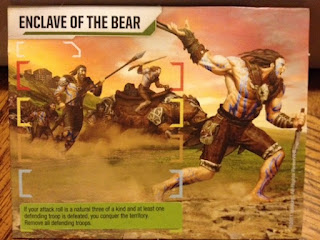
new Risk Legacy Game faction
Select your faction - with a starting power
Risk: Legacy is Risk; but with extra stuff. In Legacy, each player starts with a headquarters and a handful of troops; all of which are on the headquarters. He also starts with a faction from the game. The first time that you play, each player selects a faction, but also gets to select which of two abilities that faction will be able to use - and that faction (not necessarily that player) will use it the rest of the time that you play Legacy. Your goal is to capture four "stars." If a player has never won a game, then he starts the game with a star. Each headquarters is a star, and you can also turn in four "resource" cards to gain a star. When playing the game, you basically play with standard Risk rules. You add up your number of territories (and add population based on cities that you own - this part is new), and divide by three, rounding down. This is the number of armies that you collect each turn (minimum of three). You also get extra armies for each continent you control. From here, you can attack as many territories as you want. The attacker can roll with up to three dice, the defender with two, and the defender wins ties. If you take a contested territory on your turn (ie, you kill somebody else to do it), then at the end of the turn you get a card - when selecting a card, you can either select a card of a territory you control (territory cards can be worth anywhere from one to six resources), or you receive a standard resource card if you do not control any of the available countries. On future turns, you can trade in four cards for a star, or you can trade in cards for additional armies - if trading for armies, then the number of resources on the cards is added to determine how many you receive (with a bonus for having larger numbers). The only in-game change that I haven't mentioned are that you each will start the game with one "scar" card. These cards specify when they can be played, and to play them, you peel the sticker off of the card, place it on the appropriate territory, and then this affects that territory the rest of the time you play this copy of Risk: Legacy! Gameplay continues like this until one person has collected four stars. Then, they win the game, and sign the board (meaning they will get a "missile" instead of a star to start the next game; missiles let you change a single die roll to be a 6). After signing the board, they have the option of naming a continent (giving them a permanent one army bonus whenever they control that continent), place a major city (a city with a population of two that only they can start in), destroy a resource card (rip it in half and never use it again), or a few other things. Anyone that was still alive can either place a minor city (population of one, but nobody can start there), or add a resource icon to a territory.

Ok, that was one of my longer introductions, but now it's time to get to the pros and cons. The first pro is that Risk: Legacy is the most innovative game that I believe I have ever played. I was incredibly hesitant when I first heard that you write on the board, destroy cards, and generally make your game vastly different than when you bought it. However, this part of the game works incredibly well. You truly feel like you are in a campaign throughout the game, and in later games, you will remember what happened in the earlier ones. This will also affect how you play - for example, we had one time when a player had named Australia. He refused to play any negative scars in Australia, because he knew that it would negatively affect him if he controlled Australia in future games. This ever-changing game is an amazing concept, and I am really hoping that more games do something similar.  And, when I think about it from a financial perspective, if I pay $60 for a copy of Risk: Legacy, and I play it and enjoy it for the 15 games of the campaign, then I'm paying $4 per play - I have paid a lot more than that per play for many of my games!

Risk Legacy Do Not Open Ever
I'm ready to open this!
Next, I think that it is awesome that not each game has the same cards. When I was first reading about the game, I thought to myself, "ok, that'll be neat, but once I've played it 15 times, I'll have to move on." I now realize that I was wrong. First of all, for those of you that really enjoy the basic game of Risk, there's no real need to stop playing the game after 15 games - just because the world is no longer changing does not mean that the game itself is no longer playable. You can continue to play the game, and it will really feel like it is "your" version of Risk; because you and your friends will be the ones that caused the board to be setup how it is. However, if you constantly want the game to change, you can also figure out how to tell which copies have the same cards (I believe this is by serial number) and get a new copy of the game - one with different contents, and play through it again! Now, I don't know what all is different in the games, but I have looked at spoilers for the "Do Not Open. Ever." pack (oh, don't give me that look - we are playing on a friend's copy, and he keeps refusing to open it; you know "do not open" means "open me immediately"), and this has confirmed to me that there are different variants.

Now, those are really my only two pros to Risk: Legacy. But they are huge pros! So, instead of me trying to make something else up, let's just acknowledge that they are gigantic pros and count them both twice. So, now we're at four pros, and I can move on to the cons. Oh, I just remembered another one - the game goes much faster since you only have to get four stars instead of eliminating everyone. There you go, five pros.

The first con is that there is really very little change in the gameplay. Whereas all of Risk 2210's changes are to the gameplay itself, in Risk: Legacy I found myself playing through the game in order to get to the post-game. I was ready to customize the board, open packs, etc., and the game itself was all secondary to this. If you enjoy Risk, you will have no problem here at all! However, I do not enjoy the standard Risk, so I would often find myself bored while waiting for the game to end.

The second con is really more of the same. I don't like how easily strategy is derailed by poor dice rolling. There are some scar cards that can modify dice (make them plus one or minus one), but most of the game will be spent seeing who is better at rolling six-sided dice. I am not good at this. So, this part is incredibly frustrating.

Next, Australia is still overpowered. Whoever controls Australia will probably win the game. Fortunately, this one has a caveat - you can fix this. Since the winner of a game can make a continent bonus plus one or minus one, you can make Australia only worth one extra army instead of two. Plus, one of the scar cards (ammo shortage) makes it harder to defend a country. In addition, players cannot start on "scarred" territories, so this also can prevent players from being allowed to even start in certain territories in Australia. However, in your first few games, this might be a problem.
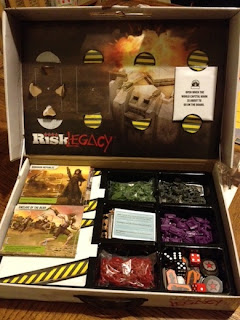
Risk Legacy What is in the box
What's in the box
Finally, because of the abbreviated timeframe in Risk: Legacy, I think that a player who is close to being knocked out (the difference between "knocked out" and "eliminated" is that if all of your armies are destroyed, you start your next turn with half of your initial armies on any valid starting territory; "eliminated" means there are no starting territories) has very little chance to come back in the game. Not only have you probably lost your own headquarters, but it is incredibly difficult to ever accumulate enough armies to actually challenge the other players that are still doing well - especially since they are collecting more armies than you each turn. Your only chance is to somehow stay alive (if you are knocked out, then they get to take all of your resource cards), gather enough resource cards to get a large amount of reinforcements, and hope that your opponents fight a lot in the meantime. And, if they see you gathering resource cards, they will probably only leave you alone if one of them is close to winning the game (since they will know that they can steal your cards, which will help them win).

Overall, I give Risk: Legacy an 8.0/10. I absolutely love the ever-changing game. However, the ever-changing game is all centered around Risk. I wish that they had started with Risk 2210 and had then added the changing board to it - having a combination of new gameplay and new outside the game effects. Either way, I love that Risk: Legacy has introduced an entirely new idea into board games - one that I am very excited to see if people will incorporate into future games!

If you like war games, you might also check out Summoner Wars, Test of Fire: Bull Run 1861, and Axis and Allies: Pacific. Or, if you want another opinion, check out this Risk Legacy Review on Play Board Games.

NOTE: I have been informed since writing this review that the only packet with variance is the "Do Not Open.  Ever." packet.

Quarriors Review

Quarriors dice game in play


One of the most widely discussed games (whether positive or negative) of 2011 is Quarriors.

"Quarriors is Dominion with dice." That is how I was first told about the game, and I can't think of a better way of describing it myself.  (See here for my Dominion review - one of the first reviews I wrote on this site!) In Quarriors, each player starts with 12 basic dice. Each turn, they draw six dice from their bag (and if their bag is empty, they return the discarded dice into their bag and continue drawing). After this, they roll all of their dice, which can cast spells, provide potential creatures, or produce "Quiddity" (money). After rolling the dice, you can summon any creatures that you rolled (they each have a Quiddity cost to summon), and you can buy one new die from the common area. After this, all of your creatures attack all of your opponents - you calculate your total attack value and your opponent sacrifices creatures until he is able to absorb all of the damage. Then, your turn is over. To start your next turn, if you have any creatures still alive, they score "Glory" points. The first player to a certain amount of Glory (based on the number of players in the game) is the winner. I believe that the game can also end once a certain number of dice piles are empty, but this has never occurred in a game that I have played, so I'm not sure how many piles it is.

My absolute favorite part of Quarriors is the replayability inherent in the game because of how the dice are setup. You have sets of five dice, but then you have three different cards that represent what those dice might be. Yes, each of the cards representing a given set of dice are very similar, but they still change up the game enough to give it some extra diversity. For example, the die representing a wizard may be a wizard that will give you extra glory when scoring, or he may allow you to cull dice from your bag. He may have a special ability that lets you re-roll him and get an extra die from the bag - it all depends on which card is representing that die in any given game. And, each of these different wizards has a scaled cost based on their abilities, so it actually allows some of them to be better than others (instead of all wizards are equal, but simply slightly different).

The next thing that I like about Quarriors are the Spells and Creatures. It is really hard to put words together to explain why I enjoy them, but I think that some of the Spells and Creatures are interesting, and add depth to the game. You can at least somewhat envision yourself actually bringing this giant dragon into the realm - and you feel like you should be suddenly winning since you managed to summon him! (Though you probably won't win based on a single creature, not even a sweet dragon.)

However, though Quarriors definitely has some positive aspects, there are some things you should be aware of. First of all, the game is incredibly random. Did you think that Dominion wasn't random enough through all of your shuffling and drawing cards? You also wished that there was a chance that your card didn't work as you wanted it to any given time that you play it? Then you would like Quarriors. The game can be incredibly fun or incredibly frustrating, all depending on how you roll. For example, that sweet dragon that I mentioned can be incredibly powerful if you roll the correct side of the die... or it can miss completely and give you Quiddity. This can be good, since there is a chance that all of the dice you draw are creatures, and you will need at least some Quiddity to play them; but it's normally frustrating. This element of the game isn't really a pro or con - it is really just the crux of the game, and you need to determine if that is something that you would enjoy.

My first con with Quarriors is that I don't feel like you are ever able to make a good "deck" (bag of dice). In most <whatever> building games, you have ways of getting rid of the start cards/dice, thus making your deck better. This isn't really the case with Quarriors. Yes, there is at least one creature that allows you to cull dice, but most games you will simply be attempting to make your die bag better by adding more powerful dice to it, not by upgrading what you have. This makes early turns more boring as you may be forced to debate on whether it is even worth it to buy the die that you can afford.

The other con that I have for Quarriors was that it felt like my purchases were a bit too prescribed. For example, the creatures are all costed well enough that 9 times out of 10 the creature that costs 7 Quiddity is better than the creature that costs 6 Quiddity. Therefore, most turns consist of rolling all of your dice and then looking to see what die costs the correct amount of Quiddity for what you rolled. What's worse, most of the Creatures that cost less than 5 Quiddity are worthless (in comparison to everything else), so there is very little reason to clutter up your die bag with them. Whereas other "building games" have things that you can purchase that are mid-range in cost, but helpful long term (like the Village in Dominion), I didn't really get that impression with Quarriors. There are very few mid-range cards that actually make your die bag better, which makes you feel like you don't ever have a "good" bag of dice.

Overall, I give Quarriors a 7.0/10. I think that this game can be fun to play with the right group, but that group needs to appreciate lightweight, highly random games. If you enjoy deep strategy and having lots of control over your actions, Quarriors isn't really a game that I think you will enjoy.

If you want to explore more games, you might also check out Dixit, Hanabi, and Smash Up.

EDIT: Since originally posting this review, it has been pointed out to me that I missed a rule.  Whenever you score glory for one of your monsters, you are able to "cull" (remove) one of the dice from your used pile.  This would definitely help address my first con, but I do not believe that this rule would make a big enough impact on the game to where you would ever feel like you had a "good" bag of dice.  Specifically, in 4 player, you very infrequently score monsters (because everyone else kills them), and will probably only score a few monsters before winning (only the big monsters are likely to live long enough to score).  In 2-player, I can see this being a much more important addition.  Thank you to those of you who pointed this out to me, so that I can play it correctly from now on!

Martian Dice Review

Martian Dice game

A simple dice rolling game that I scored a copy of at GenCon 2011 is Martian Dice. And so it seems like a good candidate for my first post-GenCon review.

You, Mr. Martian Man, are tasked with a mission. You are in charge of kidnapping members of the three strongest races on Earth: Humans, Chickens, and Cows (in no particular order). Of course, there may be some opposition in the form of tanks, but our giant green death rays will crush them - after all, we outnumber them two to one! What this actually means in gameplay terms is that you have 13 dice. Each die has one chicken, one cow, one human, one tank, and two death rays on it. You roll all of your dice, set aside all of the tanks, and then you choose one of the other types (humans, chickens, cows, and death rays) to set aside. You can always set aside death rays, but if you have previously set aside humans, chickens or cows, then you can't set them aside again until your next turn. After setting aside your chosen type of dice, you may choose to score, or you may continue rolling - unless you do not have any dice which you can set aside, at which time you must go to scoring. During scoring, if you have at least as many death rays as tanks, then you successfully score points - one per human, chicken, and cow set aside, and three bonus points if you have at least one die of each type. Continue like this until you have reached the designated number of points (suggested to be 25).

The first thing that I like about Martian Dice is the tank versus death ray interaction. This is really the crux of the strategy of the game. (Did I say "strategy" when talking about a Press Your Luck dice rolling game? Indeed, I did; thank you Martian Dice!) Because of the tanks, it is important to have several death rays each turn. However, if you set aside too many death rays early in your turn, then you won't have very many dice for actually scoring. And so, an initial roll of seven death rays can quickly guarantee that you might score points, but an initial roll with seven humans allows you the opportunity to score significantly more points (and setting them aside reduces the odds of rolling a large number of tanks; but really, one tank too many can kill you just as easily as five). I like the fact that there are decisions to be made while playing the game, instead of simply "should I keep rolling" like in Zombie Dice.

Now, with that pro stated, the tanks can also be a con. As with all Press Your Luck games, there is always the chance that you immediately lose. If you roll seven tanks to start your turn, then there's no luck to press - apparently all of your luck is bad luck. To a lesser extent, if you roll four tanks on your first turn, you still have the opportunity to score points, but you have to commit a significant amount of your turn trying to collect death rays; to the detriment of collecting any dice that actually score points.

With those two points made, I suppose it's time for me to stop writing - after all, it's never a good thing to write a review that is longer than the instructions to the game.

Overall, I give Martian Dice a 7.0/10. I prefer it over the Catan Dice Game or Zombie Dice. If you enjoy Press Your Luck dice games, then this would be a good fit. Plus, with the fun, cartoony art, it could make a good, cheap present that you could give to a friend that is looking for something to fidget with while watching TV (which is what I use dice games for).

If you feel like this was too short and want to read more - check out the Board Game Family's Martian Dice Review. Or, you could read my reviews of Jab: Real Time Boxing, Liar's Dice, and Code 777.

I would like to thank Tasty Minstrel Games for providing me with a review copy of Martian Dice.

Catan Dice Game Review

Settlers of Catan dice game in play
 
An inexpensive game that I decided to try recently was the Catan Dice Game.

For all of you that were complaining that The Settlers of Catan didn't have nearly enough dice rolling (oh, wait, I haven't ever heard that), Mayfair games has finally fixed that problem. In the Catan dice game (which can be played either solo or with friends all competing for the highest score), each round consists of players rolling the dice trying to build various items. The things that can be built include settlements, cities, roads, and knights. And, like in the original Settlers game, each of the settlements, cities and knights must be connected via roads. On each turn, you have three total rolls, and you can keep any number of dice from one roll to the next. At the end of 15 turns, whoever has the highest score wins (or in solo play, you attempt to defeat your previous high scores).

The Catan Dice Game is essentially a theme based Yahtzee. The only difference is that instead of having certain things that you could only use once, you have several different things that you need to roll repeatedly (like the combination for roads). In fact, you will be building tons and tons of roads - if you don't build the roads, then you won't be able to build any of the other items (because you won't have them connected, just like in the original Catan).

With that said, there are a couple of useful changes to the Catan Dice Game that distinguish it from Yahtzee.   First of all, the knights act as a "resource joker" which allows a one-time per game resource change - this gives the player some decision making as to whether they should build the knights, and when they should use the resources.  The other change is that there are "gold" resources - if you roll two gold, then you can trade that in for any resource of your choosing.  Those are really the only useful differences from any other die rolling game.

It is hard for me to write a pro and con section for this game, because it is such a simple game. How much can you say about rolling dice? It is useful for when you have a few minutes to spend and not much else to do. It is also useful that it requires very little concentration, and thus can be played while watching television, or during most anything else, but aside from that, there's not much else to say.

Overall, I give the Catan Dice Game a 6.0/10. I didn't expect to like the game very much, but it was more fun than I expected (I didn't expect much). I think it's about on par with Zombie Dice (which for some reason I gave a 6.5 to. Who knows what I was thinking that day - I told you that I might change my mind about my reviews) or Yahtzee. When you're in the mood to throw dice, most any of them will work - pick your favorite theme, and go with from there.

If you like dice games, you might also check out Liar's Dice, Martian Dice, and Cookie Fu.

Alien Frontiers Review

Alien Frontiers board game in play


Another game that I've looked forward to playing for quite a while is Alien Frontiers.

In Alien Frontiers, each player takes on a fleet of ships (dice) trying to successfully colonize a distant planet. On each turn, the player rolls the dice representing ships and, depending on what he rolls, can perform different actions. Some actions reward you for having numbers that match, some reward sequential numbers, some are useful when rolling high, others low, and some don't care at all. What affects this even more is that what you can do is dependent on what your opponents have done before you - if the spots on the board are already occupied, then you cannot place your ships there (unless you shoot them off with a Plasma Cannon). Anyway, each turn, after rolling, you decide where each of your dice are placed; but with the ultimate goal of placing colonies on the planet (there are three actions that directly help you with that goal). The game continues like this until one player has successfully placed all of their colonies - at which point the player with the most points (from colonies and Alien Technologies) is the winner.

The first thing that I love about Alien Frontiers is how the dice are used (which is good, because this is how the entire game flows). I have heard that Kingsburg has dice mechanics that work similarly, but I've not played it, so I can't really say too much here (except that I like this mechanic enough in Alien Frontiers that I'm motivated to go try Kingsburg, too). What is brilliant about Alien Frontiers is that the dice add an element of random to the game, and yet there isn't a "bad roll." Obviously, on some turns you really need to roll a certain way, and if you don't then you will be frustrated but, in general, you always have options available to you; it is simply a matter of making the best of your options. (Plus, there are certain Alien Technologies that allow you to change the numbers on the dice, which adds yet another strategic element to the game.)

The next thing that I like about Alien Frontiers is the bonuses - both from having Alien Technologies and from controlling certain areas on the planet. These bonuses are valuable enough in the game that they are worth pursuing; and yet, they are not so powerful that the person with the most will win (with Alien Techs at least - you do win by having tons of colony bonuses because that means you've placed tons of colonies). Because of this, each player must decide carefully between how many Techs he needs and how often you should use your dice to pursue other interests - such as getting a colony closer to launch.

The final pro that I will note about Alien Frontiers is how player interaction works. Granted, I (to this point) have been too nice during the game and have not attempted to destroy my enemies' fleets yet, but I like the different ways that players have of interacting. You can never affect another player when it is not your turn, but you can really wreak some havoc when it is. Specifically, one of the locations allows you to rob other players of resources and/or Alien Tech cards (if you roll three sequential numbers). This can be quite useful. Another way that you can affect other players is with Alien Tech cards. However, to keep this in check, you normally have to lose your Alien Tech to drastically impact another player - and this is a very steep price! Therefore, the game is setup so that you can definitely interact with ("attack") each other (and get rewarded for doing so), but has also implemented measures to keep the game from becoming an all-out war game, which I appreciate (after all, I play stuff like Risk 2210 A.D. when I want to do that).

The only real con that I have for Alien Frontiers is that the last few turns can really turn into quite a bit of "Analysis Paralysis". After the first game or two, turns will really go fairly quickly since players will know where their dice can be placed and have a general strategy... until the end. The last couple rounds of the game can lead to significant over-analyzing from normally quick players. This is really a situation that occurs in a ton of very good games (Power Grid comes to mind), but is still fairly annoying when it happens.

Overall, I give Alien Frontiers a 9.0/10. I really enjoyed my time with this game, and, as hard as it is to live up to several months' worth of hype, Alien Frontiers did not disappoint my expectations.  I can see myself continuing to play this dozens more times!

Value diversity of opinion? You can also see an Alien Frontiers Review from the Board Game Family, or another review of Alien Frontiers by Games with Two. But you might also want to check out Steam: Rails to Riches, Stone Age, and Bootleggers.

I would like to thank Clever Mojo Games.  Whereas this is where I normally tell you that a game company has sent me a demo copy to review, that is not true of this title (though I have been promised a copy from the third printing to replace my copy that got damaged in a tornado).  I actually pre-ordered a copy of the second printing of Alien Frontiers and wrote this review based off of that.  However, after the tornado, I received immense amounts of support from the fine men that run Clever Mojo Games.  David MacKenzie sent me three boxes full of games from his personal collection to help restore my collection and to donate to the people of Joplin - and many of these were very good, sometimes rare titles, many of which were still in the packaging!  Not only did David send me games, but Fred MacKenzie followed suit by sending me several more games.  This company is truly run by very giving individuals who love the hobby of gaming, and I cannot encourage you enough to go support them by purchasing Alien Frontiers and any other games that they come out with.

Cookie Fu Review


Today's game I first heard about when Dice Hate Me interviewed it's creator Brian Kowalski. After this, one of my friends mentioned that she had seen it at GenCon, and so I investigated it further. Ladies and gentlemen.... Cookie Fu!!!!

In Cookie Fu, each player creates their young fighter and can mold them by selecting different special moves for them to perform and different dice to use throughout the duel. After the setup, players roll their dice each round to determine initiative (there is a special die for this). After initiative has been determined, players roll all of their remaining die (and I can tell you from experience, the more dice you use the more fun the game is). The result of the die rolls determine what each player can do each turn. They now alternate attacking (and defending) each turn with basic puches, kicks, and super-amazing ridiculously-powerful cookie-shattering Chi moves (this is my favorite part and the main reason the game is better with more dice). The game continues in this way until one of the players is knocked out - at which time the winner should gloat and laugh at the poor crushed victim who apparently needs to practice his Cookie Fu more (though I would encourage the trash talking to occur throughout the game and not just at the end).

So, Cookie Fu is a fun little pointless game... wait... I just called a game "fun" and "pointless" in the same sentence. I guess I should re-evaluate what I play games for; I think it actually is for fun! Therefore, Cookie Fu's first pro is that it is really fun. And, like I said earlier, the more dice you have, the more fun it can be. With 5-6 dice per person (we were splitting a single player pack), the game isn't really much fun. With 12-13 dice per person, where you are able to get enough Chi to do crazy over the top moves, the game is a huge blast!

The next pro for Cookie Fu is theme. Now, I personally don't really care anything about theme in games; if a game has a theme, great, but if it does not I'm fine with that, too (I'm just as happy playing Battlestar Galacticaas I am playing Yinsh). But, if the theme is awesomely implemented, it can be wonderful! The theme for Cookie Fu is "bad Chinese take-out spoof" (I at least hope that's the theme - otherwise, I suppose me writing that could be fairly offensive). The game comes in a Chinese takeout box, the special moves come in fortune cookies (yes, they are edible), and all of the special moves are essentially jokes about Chinese food stereotypes. There have been a lot of collectible-style fighting-ish dice games to come out, but what really sets Cookie Fu apart is the hilarity of it's theme.

Now for a quick discourse between pros and cons. How do we really determine how good a game is? Is it based on number of plays, hours of play, strategic depth, or something else entirely? I would say that one of my preferred ways of measuring this is in number of plays. Now, I realize that this will greatly favor short games, as it is much easier to find table time for them, but I accept that limitation. With that said, I can see Cookie Fu getting continued table time for several years to come since it is a very light, fast, and more importantly, fun game. I'm still not going to rank it in my top 5 games of all time or anything like that, but I can see it occasionally being in the top 5 games that I play in any given 3-month period.
Now for the cons of Cookie Fu. First, I'm not really a fan of "collectible" games. Fortunately, Cookie Fu isn't collectible in the "I need to own them all or my life is incomplete" sense (like Magic). However it is collectible in the sense that different dice are made differently and so you can customize your characters before fighting and such - but to do this, you must have enough different dice that you have these options (read "buy more dice"). Instead of customizing our characters, what we honestly found to be the most fun was to simply use all of our dice each game; maybe once we have played it more (and/or bought more dice) we will pull some of them out and focus more on the customizing aspect. The saving part of the collectible aspect of this particular game is that you can get enough to play a solid game with the 2-player with a "Battle Royal Pack". From there, if you buy a few booster packs, you should have enough dice to play a really fun game of "the 'Fu".

The other "con" (nah, we'll call this a neutral point of note) is that the game is not very deep (you know, in case you missed that earlier). Fortunately, there is at least some strategy in determining when to attack, and moreover in how to use your multi-use dice; should grabs be used on offense, or on defense? Should you use Chi dice separately or save them up for a cool move (or even use them to heal)? But if you don't have enough dice in the game, then the cool Chi moves won't be much of an option and so it can feel like just alternating punches back and forth.

Finally, this game isn't for everyone. I think that there will be tons of people that can find great joy in playing Cookie Fu. And I would enjoy playing with them as well. However, if I brought this out to try to play with some of my more strategy-focused gaming friends, they will give me the "what's wrong with you" blank stare. Oh well - to each his own.

Overall, I give Cookie Fu an 8.5/10. This is on the extreme high side of what I debated in my mind (and possibly influenced by the fact that I think I give out too many 8.0's), but ultimately, I think that Cookie Fu completely fulfilled everything that it was trying to do. It was not made to challenge Puerto Rico as one of the most strategic games of all time - it was closer to trying to challenge Fluxx as one of the most fun, quick, and lightweight games. And I think that it did an exceptional job.

Final point of note: have you not checked out Dice Hate Me yet? You really should - Chris does lots of really cool interviews; and now he even has his own podcast!

Point of note after the final point of note: Have you subscribed to my site yet?  You really should - I'm on Facebook, Twitter, and even offer a full-text RSS feed for your favorite Reader.

I would like to thank Blue Kabuto for providing me with a copy of Cookie Fu to review.