Showing posts with label drafting. Show all posts

Between Two Cities Review

Between Two Cities board game

So, as you may have noticed, I haven't really written many reviews recently.  Yet, after trying Between Two Cities, I decided that I wanted to explore the game some more - including fleshing out my thoughts in writing.  (So, here we are!)

In Between Two Cities, you create two (4x4) cities - one with the player on your left, and another with the player on your right.  The game is played in three rounds - the first and third round are drafting, and the middle round is simply picking a (larger) tile.  Each time that you select a tile, you select two tiles, and everyone reveals their tiles at the same time.  Once revealed, you can place either of your tiles in either one of your cities (but one tile must go in each city).  Each type of tile has certain ways of maximizing its score, and at the end of the game, your total score is the point value of your lower scoring city.  So, the challenge of the game is to balance your two cities so that they both do well - even if it means preventing one of your cities from becoming amazing, in order to allow them both to be great.

The first thing that I like about Between Two Cities is the partnership element of the game.  It really has a very unique feel in that you are working with other players all game.  (You don't have your own city.)  However, this is a double-edged sword.  Because, though you're working with two people, each of those players is also working with someone else, and there will be times when they will make a decision that hurts your city, because they feel like it is more important to help their other city.  This causes a very strange balance in the game - especially since you are drafting tiles and passing the remaining tiles to one of your partners.  Since you know what they are receiving, you can select and place accordingly.  But, just because they take the tile that you want them to draft does not mean that they'll actually place it in the city that you both share!

Between Two Cities second round of the game
Placement in the second round is a bit more constrained
The next pro that I've found for Between Two Cities is that the simultaneous play keeps the game very engaging.  Many games scale linearly in time with the number of players - which often translates into sitting around waiting while other players take their turns.  However, in Between Two Cities, you are selecting and placing your tiles at the same time.  Yes, there will be times when one player takes longer than the others, but ultimately, there is very little down time in the game.  You truly feel like you're participating the entire time.

The third thing that I really enjoyed about Between Two Cities was eluded to earlier - I like that when drafting, you are passing your unselected tiles to one of your partners.  This knowledge (and foreknowledge) of what tiles are available and can be selected really makes the decision of what to select a bit more intriguing.  Obviously, this is still only limited knowledge, in that you don't know what you will draw in future rounds, or what tiles will be passed to you.  Yet, this small bit of additional knowledge makes the game feel more strategic.

One thing that I will point out about Between Two Cities that's a bit different from other drafting games is that there isn't really any "hate drafting."  What I mean is that there aren't really opportunities to select tiles simply to prevent other people from getting them.  There are a couple reasons for this.  First, everything that you draft has to go in your city; so if you draft something that's not useful, you're hurting yourself more than your opponent.  Secondly, you only select three times in each of the drafting rounds, so the tiles simply don't go that far around the table.  It is drafting, but is a much more abbreviated draft than in a game like 7 Wonders.

Completed city in Between Two Cities
Factories make you want more factories!
The main "con" that I have for Between Two Cities I go back and forth with my feelings on.  What's the con?  It's really annoying when I can't draw what I want!  As an example, one tile type, factories, is worth a lot of points if you have the most of them - and worth far less if you don't have the most.  So, if you're drafting factories, you want to draft a lot of factories.  If you draft a bunch of factories in round one and then don't draw any factories in round three, it can be quite annoying, and make the game feel a bit luck oriented.  Yet, I've never seen a "perfect" city be built (I calculated up that I think 69 is the top possible score).  What instead tends to happen is that each city has one specific type of tile that it scores most of its points with.  And so, what you are able to do with your backup tiles tends to be the difference between winning and losing in the game.  So, with all that said, it is still frustrating to not draw what you want - and there is admittedly an element of luck in the tiles drawn; yet there is still strategy involved in how to handle these situations (as with all drafting games).

Overall, I give Between Two Cities a 9.0/10.  I have enjoyed the games of it that I've played so far, and I expect that I'll be playing it many more times.  With the speed of setup, explanation, and play - along with the nice 3-7 player count - I see it being easy to get to the table.

I would like to thank Stonemaier Games for providing me with a review copy of Between Two Cities.


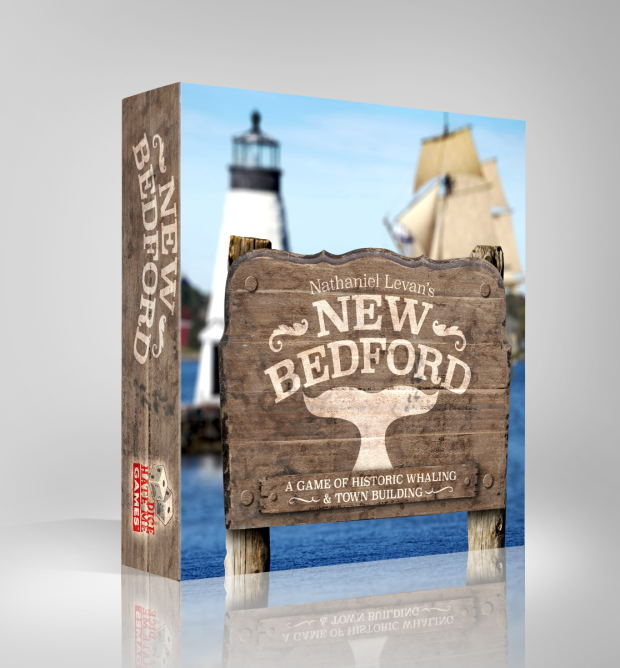
New Bedford Kickstarter Preview

NewBedfordBoxFirstLook
This post is not a review, but a preview for a game that is currently seeking funding on Kickstarter. Final art, components, and rules are subject to change.

Dice Hate Me Games was one of the first board game publishers to get their start on Kickstarter. They have done quite well for themselves and have a very strong reputation as a great company that puts out consistently great games.

Five of the Town action spaces
Next up from Chris and company is New Bedford. Designed by Nathaniel Levan at Oakleaf Games, New Bedford is a worker placement game set in the titular Massachusetts city during the time of whaling. Players will use their workers to collect resources, build buildings, and go on whaling expeditions.

Play takes place in phases. The first is the Action Phase, where players will take turns placing workers onto the seven starting action spaces, as well as any built buildings, and resolving their effects immediately. Town spaces are not blocked once workers are placed on them, but the player who places on each space first will get a bonus.

Light colored buildings can be used for actions,
while dark colored buildings are worth points at the end of the game.

Players will also be able to build their own buildings. Unlike Town spaces, buildings can only be used once per round. Additionally, the player who builds a building owns it, and can use it on future turns for free, while other players who use the building will have to pay the owner $1. There are also buildings which cannot be used as action spaces, but rather score the owning player points at the end of the game

After all players have place their workers, the Movement Phase will begin. All ships at sea will move 1 space up the whaling track towards the Return space. Then, the Whaling phase begins. Whaling tokens are drawn from the bag equal to the number of ships on the board. These tokens are then drafted by the players, with players who have ship farther out to sea choosing first. Whale tokens chosen this way are placed on the player's board, next to the corresponding ship. Any whale or open sea tokens that are leftover will be returned to the bag at the start of next round's whaling phase.

When a player's ship returns to port during the Movement phase, players will have to pay a "lay." Each whale token paid for, will earn the player points indicated on the token. Players can also choose to (or they may have to if they can't afford lays for all their whales) sell any whales tokens that return to port. When a player sells a whale token, she receives half of the cost of each sold token from the bank. Then, moving in clockwise order from the seller, each player will have the opportunity to purchase the sold tokens for the full cost. Any amount paid goes to the bank, and if a player cannot or chooses not to purchase whale tokens, the next player clockwise will have the opportunity, and so on.


The game continues in this way for 12 rounds. At the end of the game, players receive points for any whale tokens in their possession, any buildings which score points, and for leftover money ($5=1 point).

That's New Bedford! It is a very enjoyable game, with a refreshing mix of familiar mechanisms. The worker placement aspect is fun, since it both removes the tension of being locked out of spots, but retains the tension of having to prioritize placement because the bonuses for being first at a Town space are pretty good. The whaling mechanism is always very exciting, especially as the game goes on and the bag really only has a few whales mingling with a mess of worthless open sea tiles. I especially like the choice of having to either pay for your whales or sell a few for some much needed money. Should I sell for some quick cash, but then risk giving my opponent's the opportunity to score points? And once you've gone through that decision, the next time you're at sea you'll think twice before automatically taking the big 4 point whale (which costs $8 to bring back)! Or maybe you'll spend most of your time in Town, building up a bustling economy, and then waiting at the docks to buy the leftover whales from your overeager opponents with too many whales!

New Bedford does a lot of things right - but the best thing about the game is that it is one of those games that is easy to both learn and teach, but will surprise you with its depth after you dive in for subsequent plays.

If you think New Bedford sounds great, go pledge your support for the game on Kickstarter today!

Argent: The Consortium Review


Argent: The Consortium is the newest game from Level 99 Games. It was wildly successful on Kickstarter back in January, funding over 450%. In Argent, players use their wizards to earn enough votes from the consortium of a university in order to become the new chancellor.


Argent is primarily a worker placement game, but there are elements of card drafting, set collection, and special player powers also integrated as well. 


One of the best things about Argent is that there are 5 different kinds or workers (wizards) that each have a different ability either before or after they are placed. The red wizards, for instance, have the ability to knock other wizards off of placement spots, take the spot for themselves, and send the injured wizard to the infirmary.

Players' turns consist of taking a single action, which can consist of placing a wizard, playing a card, casting a spell, or passing. Worker spaces don't trigger until the end of the round. Once the round ends, the tiles that comprise the board trigger one after the other. All tiles have several spaces for wizards, and while the best ones are at the top of the tile and trigger first at the end of each round, these spots also require a badge - of which players only start with one.

There are three types of cards in the game. Spell cards, which players will acquire and then be able to activate once per round for a special ability, supporter cards, which will sometimes grant a special ability, and vault cards, which are a mix - treasures stay in play and can be activated once per round and consumables are played and discarded.

As I mentioned above, the goal of the game is to attract the most votes from the members of the consortium. The trick here is that the members of the consortium all start the game face down and secret. Players have to use their wizards to earn marks in order to gain information about what each voter is looking for - some will vote for the player with the most supporters from a certain school of magic or the player with the most money at the end of the game, etc.

The game ends after 5 rounds. End the end of the fifth round, the consortium cards are revealed, and rewarded to whoever meets the voters criteria. 

Argent: The Consortium does a lot of things differently from many worker placement games. First is the fact that players' turns do not always involve placing a worker. Adding card play into the mix changes the normal prioritization of worker placement games - not only do players need to decide which spots they need to take first, they also need to time snatching up those spots with resources or abilities they might need by taking an entire turn to play a card.


One thing that fell a little short for me is the hidden scoring conditions. Before my first couple plays, I was really excited about this concept. I really liked acquired marks so that I could get information about final scoring that my opponents didn't have and give me a direction to go in. The problem I have with this part of the game is two fold. First, there are 12 consortium votes available each round - but it was very rare in any of my playthroughs to see any players who had not placed out all or nearly all of their marks. The problem is that there are so many voters available that the variation of which voters are available each game is not very big. For the most part, players will want to try to get the most of everything, and need to find the consortium voters who are looking for specific color spells and supporters. I guess since my expectations for this mechanism were so high, I got to be a little let down after the fifth time I marked the "most gold" voter - not super exciting.

Another thing that I didn't love about Argent is the feeling that, even though the game adds a lot of really interesting twists to the worker placement genre, at its core, Argent's basic gameplay of "place a wizard, get resources," is still pretty stock worker placement. The different wizard's special powers didn't come into play nearly as often as I would have liked, and their abilities are not super exciting anyway.

Although those two factors didn't hit for me, I did have a great time playing Argent. The theme is great, and the twists the gameplay does offer are fun to play around with.


In addition, one of my favorite mechanical twists Argent throws in is the end of round trigger. In each game, there are a number of Bell Tower cards which grant a one-time bonus. Players can take one of these as their entire turn, but once the last card is taken, the round ends immediately. So players also share control over how long each round will last. Do you take the Bell Tower card with the resource you really need before the resolution phase? It's the second-to-last one there...will you have enough turns before the last one is taken to get everything done you need to get done?

Argent: The Consortium isn't going to set the worker placement genre on fire, but it is a very solid game, and one that I would recommend checking out! 7.5/10.

Jim would like to thank Level 99 Games for providing him with a review copy of Argent: The Consortium.

Sushi Go! Review


Sushi Go card game in play


An interesting little drafting game that Gamewright sent my way is called Sushi Go!

In Sushi Go!, each player is attempting to make the best overall Sushi dishes to serve their patrons, in order to become the best sushi restaurant in town!  This consists of three rounds of drafting cards.  The different cards that are taken are worth points, but only if they are played correctly.  For example, Tempura only score points for each pair of them that you have, Sashimi requires sets of three, and Wasabi is only valuable if you draft a Nigiri after you've already played it.  After three rounds of drafting, whichever player has the most points is the winner!

My first pro for Sushi Go! is that I really enjoy the concept of Chopsticks.  Chopsticks are the only card in the game that cannot be worth points.  However, what they allow you to do is break the rules of drafting.  If I have a Chopsticks card in front of me, then whenever I choose which card to keep, I can choose to play my Chopsticks, and keep two cards.  In place of the second card, I pass the Chopsticks card.  Which means that the next player can draft it and get this same ability.  Whereas I initially thought that this was the best card in the game (I no longer think that), it is at least the best new addition to the drafting genre that Sushi Go! incorporates - in my opinion, of course.

Sushi Go card examples
Helpful information on each card
The next pro that I have for Sushi Go! is how easy it is to teach - to anybody. The prototypical drafting game, 7 Wonders, is not terribly complicated, but because of the number of icons and how different cards interact, it can be fairly overwhelming to someone when they are just learning it.  Especially if they haven't had much exposure to drafting games or strategy board games.  Sushi Go!, on the other hand, is really easy to teach to anybody.  One of the people that I played with has only dabbled in board games and had never heard of "drafting."  (Drafting is when you have a hand full of cards, and you select one while passing the rest of them.  You continue doing this until you have a pile of cards that you have selected, which consists of cards from each of the original piles on the table.)  Yet, she was able to learn Sushi Go! within a few minutes, and if she ever had a question, then the cards themselves were generally able to answer it, as all of the scoring information is printed on the cards.

One thing to be aware of when considering Sushi Go! is that it is a bit more tactical than strategic.  What I mean is this - you deal cards off the top of a single deck to make the players' hands, instead of having set cards that are dealt out.  This means that you do not know the available cards.  Therefore, when choosing a Sashimi card (which requires three copies in order to score), you are not even guaranteed that there are three copies of Sashimi available in that round.  Ultimately, this makes the drafting much more similar to a Magic: The Gathering booster draft (where you open packs and have random cards to draft from) than it is to 7 Wonders (in which there are specific cards that are always available each Age).  This isn't really a good thing or a bad thing - some people will prefer it, and some people will prefer to know what is available.

Wasabi example in Sushi Go
Salmon Nigiri on Wasabi!
The next thing that you should be aware of is that in Sushi Go!, the game doesn't really build upon itself.  What I mean is that the cards that you build in the first round do not really affect any decisions that you make in the second or third round.  This is not strictly true, as there is a card, Pudding, that only scores at the very end of the game.  (The person with the most Pudding gets points, and the player with the least Pudding loses points.)  However, there aren't prerequisites, cards don't get better, and you see the same options in round three as you did in round one.  Ultimately, if you dealt out all of the cards for each of the three rounds before starting, it doesn't matter if you grab the cards for "round one" or "round three."  There is no difference.  Whereas some people will want a deeper strategic experience where they can be planning ahead, this is the trade-off for how easy the game is to teach.

The only con that I have for Sushi Go! is that I dislike that you play every card - specifically the last card.  I prefer 7 Wonders' rule in which you discard the very last card every round.  One of the reasons that I don't like being forced to play the last card is that sometimes you can guarantee that the person you pass to will score no points (by playing your Chopsticks).  Ultimately, though, whether the last card is helpful or not feels much more like blind luck than strategic gameplay, so I'd prefer that you simply stopped at the next to last card each round.  (Granted, this con isn't a big deal, since if it really bothers you, you can easily just play how you want.)

Overall, I like Sushi Go! a lot, and I give it an 8.0/10.  It hasn't revolutionized anything for me, but I like the addition of Chopsticks, and the ease of teaching the game should help me to be able to keep getting it played.

If Sushi Go! sounds interesting, you should also check out 7 Wonders (obviously), as well as Biblios and Scallywags.

I would like to thank Gamewright for providing me with a review copy of Sushi Go!

Notre Dame Review

Notre Dame game in play


A great little game that I bought by fluke last year is Notre Dame.

In Notre Dame, each player controls a section of the city, and they are attempting to help build the cathedral of Notre Dame - while avoiding being overrun by rats!  The game consists of thee rounds, with each round having three turns.  Each turn, a player will draw three of his nine cards and select one - passing the others to the player on his left.  Then, from what is passed to him, he selects another one and passes.  Finally, he accepts a third card.  These cards represent actions that a player can perform, but he will only perform two of the three.  These actions can allow you to remove rats, gain victory points, earn money, move your carriage, unlock more of your influence markers, and build Notre Dame.  At the end of each turn, each player has the opportunity to hire a special helper, who can assist in moving your influence markers, gaining victory points, and dealing with rats.  After this, rats frantically charge at the players, avoiding clubs, boots and gunfire on the way to bite your ankles, and anyone that is overrun with rats loses two victory points and an influence (perhaps I made that sound a bit more exciting than it really is).  Finally, if the round is over (not just the turn), then players score victory points based on who assisted in Notre Dame and get their starting action cards back.  At the end of the third round, the game is over!

The first thing that I enjoy about Notre Dame is the action card drafting.  I have played a few games with a drafting mechanic in them, but I believe that Notre Dame does it at least as well as any other game I've played (including 7 Wonders).  I really enjoy the fact that what actions you are able to perform are based on both what you draw and what other players pass to you.  This forces you to adjust your strategy based on other players.  For example, if you are passed a lot of carriage cards (I generally pass these), then it might be a good idea to go ahead and start implementing a carriage strategy.  At the same time, you can look and see what the opponents on your left are doing, and you can decide to keep cards simply to prevent them from having them.  (Though, this strategy obviously does not focus on earning your own victory points, and so it is less than ideal.)

Notre Dame draft cards
The available action cards - and the Hunchback
But, do you know why it might be important to adjust your strategy based on what you draw?  Well, it's because of this part of the game that I didn't tell you about before - as you continue performing the same action, you become better at it.  Which I also think is brilliant.  If you perform the action to gain victory points, then you gain a point.  That's less than impressive.  However, if you do it again, then you gain two points.  If you do it again you gain three points (assuming that you have left your previous influence markers on it).  In fact, each of the action spaces gives you a reward that is related to the number of influence that you have on that space.  And so, the game rewards you for having a strategy and sticking with it.  I'm ok with games rewarding you for performing a single action repeatedly - but I think that it works amazingly well in Notre Dame because you really have no control over whether you will be able to perform an action repeatedly.  It all depends on what cards are passed to you.  And so, if you get to perform the victory point action nine times (throughout the game), you can point and laugh at your opponents who passed you those cards!

And, though your actions improve by doing them repeatedly, Notre Dame also forces you to do multiple different actions.  How?  Well, there are nine cards in each round, none of which repeat.  And, you will be performing six actions each round.  Even if you draft every copy of a given action, you will only be able to perform it three times - and so, you have to do something else, too.  (Which is good, because I really don't think that you would have a chance at winning if you did any of the actions 18 times.  Except for maybe the victory point action; but you would run out of influence that you could place on it!)

board setup for Notre Dame
The board configuration changes based on number of players
My final pro for Notre Dame is that I like the rat mechanic.  You gain no points from killing rats.  None.  Instead, you don't lose points.  Two of the actions deal specifically with killing rats - but as a bonus, one lets you kill rats as you earn them, and the other lets you gain extra victory points.  The space that lets you kill rats as you earn them can be incredibly useful at preventing rats from overrunning your board - but if you focus on this, then you're not earning points.  And, you've been stacking all of your influence on a place that won't help you earn points in the future, either.  But, being overrun by rats is bad.  Not bad enough that it will cost you the game, but bad enough to make you try to avoid it.  I think that Notre Dame has found the magic balance between having rats be important enough to force you to pay attention, yet trivial enough that you don't have to spend the whole game obsessing about them.

If I had to name a con for Notre Dame, it would be that there are not many special helpers (the cards that you hire at the end of the round).  Each game, you will see all of them, and you will see six of them repeatedly in the same game.  More of these would allow the game to have more variety from one play to the next.  Yet, with that said, I think that the special helpers are well balanced, and the game gets a different feel based on who you play with and how they choose to draft cards each time, so this con is really very minor.  (Also, the Notre Dame mini-expansion provides you with more of these.)

Overall, I give Notre Dame a 9.5/10.  I love this game.  It is easily one of my surprise favorite games, and has quickly jumped up to be one of my favorite "euro-style" games, on the same level as games like Puerto Rico.

If you like Notre Dame, you may also be interested in Biblios, Pillars of the Earth, and Le Havre.

7 Wonders Review

7 Wonders game mid play


A game that has been hyped to ridiculous proportions (and so I desperately needed to play it) was 7 Wonders.

In 7 Wonders, each player (very loosely) represents a civilization that is trying to build their trademark Wonder (such as the pyramids of Giza, Colossus of Rhodes, etc... though you're not penalized in the game if you choose not to build your wonder). The game actually plays out through 3 "ages". Each age consists of the players starting with 7 cards. From these cards, they must select a card to play and pass the rest to the person next to them. This continues until they only have 2 cards left, at which time they play one and discard the other. After each age the players compare military might against their neighbors (thus gaining or losing points). This continues until the end of the third age, at which time players count up points for military conquests and different kinds of buildings built, with the player having the highest score winning (I know you're shocked by this outcome).

The first (and most obvious) pro that I have for 7 Wonders is the draft mechanic. I have seen this mechanic before (in Magic booster drafts), but I have never seen it in an actual game. Therefore, I find it very innovative that 7 Wonders was able to take this mechanic and build a high quality, strategic game around it. I appreciate any time a game introduces a new mechanic, and this one worked especially well.

The next pro that 7 Wonders does better than most games on the market relates to flexibility with regard to number of players. 7 Wonders claims that it can be played with 2-7 players (though the 2 player game is a variant), so the main game can be played with 3-7. More importantly, the game can be played well with 3-7, without really feeling like it is too long (players make decisions at the same time) or unbalanced (you primarily interact with the people next to you) if you add or subtract players. This means that I can carry 7 Wonders around with me and play it without having to worry about whether that week 3 people will show up, or whether there will be 7 - definite pro!

The next pro that I will mention is in the different paths to victory that 7 Wonders allows. With that said, I don't believe that any player will be able to win by focusing only on one aspect of the game. However, between military conquest, science, religious buildings, and constructing your wonder, there are enough varying elements to the game that different strategies can be applied, each of which will have a legitimate chance at winning.

The final pro that I will mention here is how you are able to borrow resources from other players. To build certain cards, you must have certain resources available. Since no player will have all of the resources they need all of the time, the game has been designed so that you can trade with your immediate neighbors. Knowing that you may be fickle with whether you want to trade with your neighbors, the designers of the game didn't give you the option - you can't say no (though, as a good businessman, you do get paid when they use your resources). This and all of the other rules related to trading work very well and help the game to flow smoothly (as well as allowing for more strategic options such as whether you want to build resources or just rely on borrowing from the people next to you).  (Just as a note before moving on, I also liked the concept of a predecessor building - where you don't have to pay the resource cost for a building if you have built the correct "predecessor" building already.  This also added more options on how to pay for construction costs.)

Now with all of the glowing part of the review out of the way, it is time to mention some of the things that I didn't like as much. First, 7 Wonders takes us tons of space! Ignoring the fact that the cards are all oversized, each player will wind up with about 10-18 cards in front of him by the end of the game! Yes, several of the cards will be stacked on top of each other, or hidden under your wonder, but this still winds up being about 1-2 square feet of play area per player (maybe more). I have not been able to play a full 7 player game yet, but I am not entirely sure whether it would fit on a standard sized table - I'm almost completely positive that it will not fit on my dining room table.

The next, less cosmetic, con is the depth level of the game. After a few plays where I tried out several different strategies, I began realizing how few options are actually available in the game. Most of the decisions you are making are: 1) how am I going to pay for buildings? (through predecessor buildings which let you build later ones for free, through my own resources, or by using other people's resources), 2) do I care about science, or am I just trying to keep other people from getting it? and 3) how much military am I going to build? With this said, mixing up the number of players and the seating position will help with some of the replayability of 7 Wonders, but overall these are the basic decisions that will be made each game. After all the hype going into it, I was really hoping for more choices out of 7 Wonders.

One neutral aspect of 7 Wonders that I would be remiss for not mentioning is the amount of iconography in the game.  What each card does is depicted only in images.  Because of this, the game can take up less room (it doesn't actually take up less room, but it theoretically could).  More specifically, it means you can quickly see what you have in play.  This works very well once you know what all the images mean; however, you should expect to look up what different images mean repeatedly through your first play or two of the game.  On the bright side, since you know that you will be passing these cards to the next player, you can go ahead and hand them the cheat sheet on the back of the instructions to look it up when you pass the cards - because they'll have no idea what it means, either.

Overall, I give 7 Wonders an 8.5/10. It is a very good game, but it took a little while to grow on me (I think part of this is that it didn't live up to my heightened expectations). Whereas I think I will continue playing the game repeatedly, I don't see myself getting together with people for the sole purpose of playing it - it will probably serve more as a high-end filler game than a "main entre."

Want a second opinion? Check out Play Board Games' review of 7 Wonders or I Slay the Dragon's 7 Wonders review.  Or, to discover more games, check out Glory to Rome, Innovation, and Smash Up.

51st State Review

51st State during play


One of the newest titles to come out that looked fascinating was 51st State. When my Friendly Local Game Store had an open copy for me try, I jumped at the opportunity.

In 51st State, each player takes on a certain faction trying to survive in a post-apocalyptic world. Every turn, the players will start by adding new cards to their hand (this is done by drafting the first 2 cards, and drawing the 3rd from the deck). Next, they will take turns placing cards and/or performing actions; when placing cards, they can either play them as red cards (one time use), blue cards (occur every turn), or as white cards (worth a victory point and a bonus, but might be usable by other players). At the end of the round, players each total their current number of victory points - and once a player has 30 points, the game is over with the player having the most points winning.

The first really neat aspect to the game (which is also the most innovative and truly the heart of the game itself) is the different ways that a card can be played. This is especially awesome because the different factions have different strengths and weaknesses. Specifically, each faction will start the game being able to play cards one way more easily than the others. Therefore, which faction you have affects how you play the game (another plus,but I won't get into that one). As stated in the intro, each card can be played 3 different ways. If a card is played as "red", then this means at the start of any turn you have the option of discarding that card and gaining the benefit that it shows. If it is played as "blue", it will be much less powerful, but it will give it's owner a benefit at the start of every turn. Finally, a card can be played as "white", which both scores a victory point, and also serves a variety of functions; it can give the player more resources, it may or may not be usable by opponents, it may generate victory points automatically, it may score victory points when it is triggered, or it may do something else. Overall, the different aspects of the card gives each player a lot of choices during the game.  As I said to start, this is the heart of the game, and it's heart is golden.

The next pro is the draft mechanic of the game. I like the fact that players have the ability to influence what cards they acquire (as well as what cards their opponents do or do not gain). The draft is not a huge aspect of the game, but it is especially important because of the difference in factions. For example, one of the factions is best at playing white cards to start off, but they can only play smaller white cards - the draft allows that player to gain cards that he can play instead of cards that he won't be able to play until later.

The final pro that I will mention about the game is that you are able to build on your previous actions/turns. Now, I realize that a normal concern with this type of mechanic is when the player in the lead is able to run away with the game. In 51st State, the game is short enough that this isn't really a major concern (normally around 6-8 turns). With that said, I really enjoy the fact that what I chose to play in an earlier turn greatly affects what I can play in later turns. For example, several of the cards, when played as "blue", generate victory points every turn. This is very nice, because it helps you win the game. However, if all I have played are victory point "blue" cards, I will have significantly less options than if I played resource "blue" cards. This really allows players to develop strategies throughout the game and decide how they want their upcoming turns to play out.

Though I really enjoyed 51st State, I would be remiss if I didn't mention some cons. First, 51st State definitely lends itself to "Analysis Paralysis" (thinking through so many decisions that you never bother to play). Since each card has three different ways that it can be played, and you can play off of many cards owned by both you and your opponent, there will be a large number of options during each action phase. This number of options can cause players who are normally fast to have noticeable pauses when determining the next action; I would hate to play this game with the people from my gaming group that are over-thinkers to start with.

The next con for 51st State is that I would absolutely hate to teach it to new players (which is unfortunate, since I am often the one teaching new games). Not only are there the different ways of playing cards, but there are also a ton of symbols on every card and many rules that just have to be remembered (a victory point building can only generate points three times; to replace a leader you must play a new leader and a gun resource; a leader can only have five victory points on him, etc). Essentially, the first game of 51st State, even more than most games, must be viewed as a "learning game". Actually, your first several games may be like this (I don't think we got everything right until my 4th game, and I'm still not certain).  This is a game that would really frustrate gamers that insist on understanding all of the rules going into the first game - that's just not going to happen.

Overall, I give 51st State an 8.5/10. I really enjoyed the game, considering it on par with Race for the Galaxy when it comes to gameplay (and thus I almost gave it a 9.0). Unfortunately, the difficulty in teaching 51st State keeps it (barely) out of my upper echelon of games. If you're willing to persevere through learning it, the game will be well worth your time - I look forward to playing it more!

If you like sci-fi games, you might also want to read about Glory to Rome, Cosmic Encounter, Battlestar Galactica, and Stargate SG-1 (so you know why you should never play it).