Showing posts with label AEG. Show all posts

Valley of the Kings

Guys, just because its Egyptian themed doesn't mean triangles become pyramids. Its a triangle.

Valley of the Kings is a small box game from AEG's Pocket line of games that includes Cheaty Mages and Sail to India. It is a deck building game set in ancient Egypt. A mechanism and theme that the board game hobby has certainly seen a lot of. Does Valley of the Kings deserve your attention anyway?

One of the starting cards - unlike "copper" it remains useful until the end of the game.

Valley of the Kings does a lot of things that we're seen in previous deck builders. Players buy cards from a pool of available cards, and put them into a discard pile, which will be shuffled into their personal deck later in the game. The available cards in Valley of the Kings are set up in a triangle, and are cycled in a way that is reminiscent of Ascension, but here only half of the cards that are face up are available for purchase, which adds a bit to that formula.

The game also adds two bigger innovations to deck building. First, each card can be used to execute 1 of 3 actions.
     1. The card can be played for money in order to buy cards in the center.
     2. The card can be played for its action.
     3. The card can be buried (permanently removed from their deck) in a player's tomb, for its victory point value.

In Valley of the Kings, any cards left in a player's deck are worthless at the end of the game. Only those cards which have been purged from each player's deck and placed into their tombs are counted as points. This is the essence of what Valley of the Kings brings to the genre - and the main reason the game is so much fun.

As one might expect, cards which have strong abilities are also worth a lot of points. So just like in Dominion - where there is a point where players have to decide to stop buying action cards and start buying point cards - players in Valley of the Kings have to choose how long they want to keep playing that valuable action card, and when they want to bury it in their tomb to ensure it gets counted as points at game end.

One of my favorite things about any deck building game is trying to thin out my deck to make it as efficient as possible. Valley of the Kings really lets me play around with this idea because players are allowed to get rid of any card in their hand once per turn. I like this both because it gives me a lot of control over my deck, and also because there isn't a safety net. I think it would be possible in this game to buy the wrong cards, thin too much, and simply be out of the game. I'm not saying this is likely, or that this game is especially punishing, but I like being treated like I know what I'm doing by a game and its designer.

Valley of the Kings also plays with deck composition by having a fair number of cards in the deck whose actions involved getting cards out of one's own deck, and putting them into the deck of another player. This action would be interesting in any deck building game - but is even more interesting here, as even the weakest/least exciting cards in the game (your starting deck) are worth victory points. So yes, by using one of these cards and then burying another card a player could potentially thin 2 cards from her deck in a single turn, but will the other player bury the card I just sent? Is making my deck a few cards stronger worth the victory point cost? In a two-player game, even a card that is just worth a single victory point could result in a 2 point swing if the shunned card ends up in the other player's tomb.

Deck building is one of my favorite mechanisms in games. Despite this, there aren't many deck building games that I have fallen in love with. Ascension, Trains, and Star Realms are some of my favorites - but with so many mediocre deck builders out there, its hard to keep playing all of them and being disappointed over and over again. That is part of why I think Valley of the Kings has been such a hit for me. The game keeps enough about the genre the same, while putting its own interesting twists on the formula.

I would definitely recommend Valley of the Kings to fans of deck building, and even to those who might feel like deck building doesn't have anything new or fun to explore. I'd rate it a solid 8.0.

Istanbul Review


Istanbul is the Kennerspiel des Jahres nominated (2014) game from famed and accomplished designer Rudiger Dorn. It has players assuming the role of a merchant and his assistants moving through a bazaar, interacting with the various vendors and meeting up with other merchants, family members, and even the governor!


Istanbul's "board" is made up of several separate tiles, which are laid out in a 4x4 grid. This can be done randomly, but the rules do suggest specific layouts for beginner and advanced games. The goal of the game is to gather goods and money in order to acquire gems. The first player to acquire 5 gems (6 in a two player game) will be the winner!

On a player's turn, she must move her merchant and her stack of assistants either 1 or 2 spaces (not diagonally) and do 1 of 3 things:


  1. If none of her assistants are already on the tile, she drops one off, and performs the tile's action.
  2. If one of her assistants is on the tile already, she picks that assistant up (places it on the bottom of her stack) and performs the tile's action.
  3. If none of her assistants are already on the tile and she also has none in her stack, her turn ends. 
Here, the yellow player need to decide if she will go back to a tile where she had previously dropped off an assistant, or go to the fountain (the only tile that can be used without an assistant) to call back all of her assistants.

A lot of the strategy of Istanbul is planning out a couples turns ahead, so that you don't have to deal with option 3, and do basically nothing on your turn. 

The tiles that make up the board allow players to do a variety of things. Some are Warehouses that allow players to load as many of a certain kind of good as they can carry in their carts. Some are Markets that allow players to sell sets of goods for money. Others are Mosques that reward players with upgrade tiles for having a certain number of goods.

Two of the more important tiles are the Sultan's Palace and the Gem Market. These are the two main ways to acquire gems. At the Sultan's Palace, players can trade in goods for a gem, which makes the next gem more expensive for the next player. The Gem Market lets players buy gems, with each successive gem purchased more expensive than the last, just like the Sultan's Palace. 

The first available gem at the Sultan's Palace (in a 2 player game) costs 1 jewelry,  1 fabric, 1 spice, and 1 fruit. Once that gem is taken, the space it was previously covering is added to the next gem's cost.

Istanbul is a game that hit me right in my wheelhouse. It has a lot things that I love about board games, like variable setup, player powers (though you don't start with them), advanced planning, upgrades/engine building, and even some dice rolling! 

From left to right: The blue upgrade tile adds another assistant to a player's stack, the yellow upgrade tile (my favorite) allows a player to pay $2 to retrieve an assistant from anywhere on the board and place it in her stack, the red upgrade tile allows a player to set a die to a 4 or reroll whenever rolling dice, and the green upgrade tile allows a player to purchase 1 of any good when visiting a warehouse.

Speaking of upgrades and dice rolling, let me talk about the upgrade tiles. There are four total, and just like the Sultan's Palace and Gem Market, they become more expensive as they become purchased. They are also pretty important to doing well in Istanbul. Once players are more familiar with the game, an interesting race happens in the beginning of the game where the players will rush to grab either their favorite upgrade tiles or a cart expansion.

(Left) At the beginning of the game, each player can only have 2 of each good. 
(Right) By visiting the Wainwright tile, players can purchase cart upgrades for $7. 

Players have to visit the Wainwright during the game as early as possible, because the additional capacity will allow them to purchase upgrade tiles they may have been priced out of, it makes it easier to make money at the market tiles, and it makes it much easier to acquire gems from the Sultan's Palace. 

There is so much to like about Istanbul. Mr. Dorn has not only reimplemented a version of his Goa auction mechanism, but he has finely crafted a fantastic medium weight strategy game. Istanbul has so many options for players to explore, with many interesting decisions to be made each turn, and planning ahead is very much rewarded. The act of planning out your actions in just the right order so that you can not only do everything you need to do, in the order that you need to do it in, and also end up with all of your assistants back in your stack is just so satisfying. 
One thing I don't always love about the game is the luck of the cards and the dice. Some of the cards are just better than others, especially if they are drawn at exactly the right/wrong time. The dice can really hurt a player who doesn't have the applicable upgrade tile, and can result in several wasted actions. The interesting aspect that arises from the randomness of the dice, however, is that the value of the dice manipulation upgrade tile is a bit more fuzzy than the values of the other 3 upgrade tiles.

After I got Istanbul, I played it 5 times in 4 days. It is absolutely one of my favorite games from this year. It plays well with all player counts, does not overstay its welcome, and despite having a fair amount of complexity, I feel like I could teach this game to almost anyone. Istanbul deserves all the hype around it, and despite being up against two very strong contenders for this year's Kennerspiel des Jahres (Concordia and Rococo), I believe it should (and will) win the very prestigious German "expert game of the year" award. I give Istanbul a 9.0/10.

Sail to India Review


Sail to India is a new release in the US from AEG's Big in Japan line. The designer, Hisashi Hayashi, is no stranger to having his games imported to the US from Japan. His game Trains was a big hit at Essen in 2012, and was brought here by AEG in 2013 to critical and commercial success. Sail to India was released overseas last year and caused a lot of excitement.

Pretty much everything you get in the box.

Unlike Trains, Sail to India takes a minimalist approach to its design. Upon opening the small box, players will only find 28 cards, 52 cubes, and a 20 page rulebook. Does Sail to India rise above this meager component list to become more than the sum of its parts?

As you might expect, game play in Sail to India is fairly simple. As you might not expect, there are some novel ideas in the box that take a few turns to fully understand. The cubes in Sail to India are used to represent several different things. If they are placed beneath the location cards the cubes are ships, if placed on the cards they are either buildings or goods, if placed on a player's historian card they represent a player's victory points.

Those cubes sure are multitaskers!

On a turn, a player has two actions. The possible actions are:
  • Employ a marker - pay $1 to move a cube from out of play onto the Lisboa card (into play and available to perform other actions)
  • Move ships - move each ship cube up to your movement value, reveal any facedown location cards adjacent to any of your ships, and (optionally) convert ships to trade goods by moving those cubes onto an adjacent location card on the good pictured
  • Sell trade goods - sell as many goods as you wish and gain money and VPs based on the number of different goods sold
  • Build a building - pay $2 to place a ship cube onto a building space on an adjacent card - immediately gain that building's benefits
  • Acquire technology - pay the indicated amount to move a scientist cube from your Domain card onto an unoccupied technology
  • Increase ship speed - pay the indicated amount to increase your ship speed
One of the most interesting aspects of the game is that because cubes have many uses, but each player's supply is limited (especially in the beginning of the game), players need to balance what they are using their resources on. If a player would ever gain more than $5 on her wealth track, she would have to place an additional cube from Lisboa onto the wealth track to mark the money she has over the first cube's $5. But if she does not have a cube available in Lisboa, she will have to take it from elsewhere - maybe a ship, a building, or a trade good - but she cannot use any of her cubes that have not been employed yet and are still out of play. 

This simple constriction is the source of almost all of the interesting decisions in the game. Players need to manage the growth of their companies. Since the game puts limits on how broadly each company can effectively be, players have to decide things like, "Will having $6 in wealth be worth it, or could that cube which is only tracking $1 be better used elsewhere? Should I sacrifice that $1 to build a building I need, or should I discover a new location card and make that $1 cube a VP cube?"

While these types of decisions were very interesting to me, the game still fell a little flat. One thing I didn't care for in the game is that since everything is public, the game felt a little calculable. And with only two actions per turn, doing anything competent opponents don't see coming a few rounds away is almost impossible. While this is likely part of the design rather than an oversight, it is a part that I didn't particularly care for. 

Sail to India is certainly an easy game to recommend for board game enthusiasts who are interested in design and like seeing where the current trend of minimalism in design is going. It does a lot of interesting things with very few components or rules. The game will also appeal to those euro gamers who enjoy being able to "math-out" the very best strategy and know what the best move is for them each turn - and want to do so in a smaller, easier to digest package.

I have used the word "interesting" several times in this review, but I haven't used the word "fun" once. For me, that's where this game falls short. I think there is a lot to explore here, but for me, doing so was not especially enjoyable. Maybe I'm a victim of the hype or maybe I'm just done with micro-games - either way, I would give Sail to India a 6.5/10 - an innovative game that impressed me with its mechanisms, but left me feeling cold.

Cheaty Mages Review


Cheaty Mages is a recent card game release from AEG and that Seiji Kanai guy. You might recognize that name from another recent Japanese import of his that had a modicum of success, Love Letter. 

Cheaty Mages is a fairly simple almost area control type card game with some wagering, hand management, and "take that" thrown in. The premise of the game is that the players are all mages, watching an arena battle and betting on the outcome. And, as referenced by the title of the game, the players are not just spectators, but use their magic to take an active role in the battle. 

During each round of the game, 5 fighter cards are dealt to the table to participate in the current battle. The top judge card is also drawn - this is the judge who will impose rules on the current round.


The first thing a player does, is choose 1, 2, or 3 bet cards from her hand to play face down in front her. If a player bets on 1 fighter, and it wins, the player will receive double the prize money printed on the fighter card. If a player bets on 2 fighters, she gets the printed amount, and betting on 3 fighters will net the player half the printed value on the fighter. After 3 rounds, whoever has the most money is the Cheatiest Mage!

Enchant Cards                      Direct Cards                   Support Cards

During a turn, players cast spells on the fighters. There are 3 types of cards - Enchant (face down spells), Direct (face up spells), and Support (event cards that will usually affect the other mages instead of the fighters). 

In turn order, players will either play one card, discard a card to look at all the face down cards that are affecting a fighter, or pass. Once a player has passed, she is out for the remainder of the round, which will end once all players have passed. 


At the end of the round, all cards are flipped face up, the winner of the battle is determined, and any successful bets are paid out to those mages. To begin the second and third rounds, players are dealt (in a 3-4 player game) 4 new cards from the deck, but not more than the hand limit of 8.

That's basically the game! The judge for a round can affect a lot, as each spell card comes with a mana value, and if a judge's mana limit is exceeded on any one fighter, the judge will usually either disqualify that fighter or discard all spells played on him. The judge for a round may also not allow certain card types to be played at all during a round.

Cheaty Mages is loads of fun. If you've ever played Reiner Knizia's Colossal Arena, the gameplay should sound pretty familiar to you - and it is very reminiscent of the good doctor's now 15 year old game. But Cheaty Mages adds a lot to that game.

First, a few things that I didn't love about the game. I like the idea of the judges, but I don't like when they disallow certain card types. If a player has a hand full of Direct cards, and the judge that gets flipped for the round doesn't allow any Direct cards to be played, how is that fun? I also wish there were more fighters in the deck. There are 10, and only 5 are needed for each round, but I think it would be more fun to have a bigger variety. 

One of my favorite things about Cheaty Mages is the hand management aspect. Knowing you are going to get 4 cards to start the next round, give a huge incentive to only play 4, so that you can have your hand completely replenished for rounds 2 and 3. But when it comes down to your turn, and you have 4 cards left, and no one else has passed yet, what do you do? This goes to another point I like about the game - Cheaty Mages is chaotic, but there is definitely some strategic play to be found here. A good deal of it comes from seeing the odds, and the fighters, and how certain card combinations will play out, but most of the strategy in the game comes from playing the other players. Working out temporary alliances with the other players - that may be based on either lies or incorrect assumptions about shared bets - is where a lot of the fun comes from in this game. 

I also love the hidden betting mechanism. I like hidden roles in general, but I really like that in this game, players not only have hidden agendas, but they also get to choose those agendas, AND have to decide how much risk they are willing to take, in terms of betting on 1, 2, or 3 fighters.

Something I generally despise in games is "take that." But another thing I like about Cheaty Mages' hidden roles is that the "take that" aspect of the game is somewhat blunted in the game, because any attacks are not against any player in particular, but against a fighter...that your opponents are hopefully supporting.

I would rate Cheaty Mages 8.5/10. It is a short, simple game, with a lot of subtlety and delicious backstabbery. During my first game of Cheaty Mages with a group of close friends, and after playing a 10 mana card on a fighter (thus disqualifying him from the round), my best friend stood up from the table and shouted, "I friggin hate you!" That moment was so laugh-out-loud funny, and the whole game was just so much fun, I knew immediately that this was my kind of game. 

Jim would like to thank AEG for providing him a review copy of Cheaty Mages.

Trains Review

Trains board game in play

One of the newest deck building games that has been generating buzz is Trains.

Trains, simply put, is "Dominion with a board."  (If you haven't heard that phrase yet, then you probably haven't heard much about the game at all.)  Each player starts with a train track in a single city on the board, as well as a very basic starting deck (consisting of "Normal Trains" which are money, and a few cards that allow you to interact with the board).  On each player's turn, he is allowed to buy, play actions, lay tracks and build station improvements as many times as his cards allow (based on icons and available money).  When buying cards, they simply go into the player's discard pile.  When performing board related actions, the active player will also collect "Waste."  Play continues in this manner with players attempting to lay tracks to connect different cities while also building stations in those cities until one player has exhausted their supply of track, all of the stations are built, or four piles of cards are exhausted.  At that point, whichever player has the most points based on what they have built, what they have bought, and what they have played is the winner!

The first pro that I have for Trains are the Waste cards.  Every time you do anything beneficial, you gain a Waste.  Want to lay track?  That's a Waste.  Want to improve a station?  Waste.  Buy victory point cards?  Waste.  Go where another player already is?  Extra Waste.  Granted, the Waste cards slow down the game by causing each player's deck to be suboptimal, but Waste management is also a nice addition to the genre.  In previous deck building games, there have been bad cards that clutter up your deck, but in Trains, dealing with these cards is a central facet of the game.  Additionally, there is a rule built just for this - a player has the option of passing his entire turn and simply trashing all of the Waste in their hand.  (Seems fitting to trash waste, doesn't it?)

Trains board closeup showing cities and track
Building multiple stations can be valuable
The next pro that I have for Trains is that there is quite a bit of replayability to the game.  The board is double sided, and there are 30 different piles of cards to choose from each game.  (These are called "kingdom cards" in Dominion, but do not appear to have a specific name in Trains.)  Of these 30 options, you only use eight piles per game.  Thus with the double sided board and 30 different options for available cards, there are a large number of different setup choices.  This will allow people who fall in love with the game to play it repeatedly without worrying about it growing stale.

The game also plays smoothly.  But, instead of spending time fleshing out that, let's move on to an element that I haven't decided about.  There has been a strong tendency in the games that I have played to ignore the board.  How does this work?  Well, instead of gaining points by connecting cities and building stations, you can also gain victory points by purchasing certain cards.  The crux of this strategy lies in Waste management.  Whereas improving a city multiple times and connecting different cities on the board may gain a player 5-10 Waste cards, buying a victory point card only nets a single Waste.  Therefore, it is much easier to build a deck that can buy a lot of victory point cards than it is to build a deck that can utilize the board efficiently.  In the games that I have played, I have not seen anyone win while completely neglecting the board, but there does seem to be a strong strategy around ignoring the board for the first half of the game.

This leads to my first con.  If you have improved several cities and built your infrastructure, it is far too easy for other players to connect to your cities and earn the same points - and this can be very frustrating, as there is nothing that you can do to stop them.  At the end of the game, cities score full points for each player that has built a track in them.  To build where another player already has track costs some extra money and gains extra Waste, and building in a city that has been upgraded also costs extra money.  However, there are cards that allow you to ignore each of these extra costs.  So, it will happen that one player will improve several cities, and another player can swoop in and claim equal credit - and do so much more quickly (and inexpensively)!  I wish that there were at least an occasional option (possibly one of the card piles) that allowed a player who was already in a city to prevent other players from being able to build in it.  I would imagine that something like this would be coming in future expansions.

basic setup cards for Trains
Here are your basic currency: worth 1/2/3 money
My second con for Trains is that it feels a bit too similar to Dominion.  Essentially, it feels a bit like a re-themed expansion to me: "Dominion, the Board Expansion!"  Whereas I think that Dominion is a brilliant game, the similarities cause Trains to conjure up thoughts about Dominion throughout the game.  Then, Trains can start to feel a bit incomplete as it has not had the time to build the vast array of expansions that Dominion has.  I will freely admit that not everyone will share this con, and many people will like Trains much more than Dominion as they will feel like they are doing something with their deck, instead of building a deck just for the sake of having a deck. Yet for me, I don't know that I can play Trains without thinking of Dominion.

My final con is simple.  I cannot shuffle the cards in Trains (which is really annoying in a deck building game).  I have actually played on two different physical copies, and when I shuffle the cards, they clump together.  Now, when I say this, please keep in mind that I have been shuffling cards for 20 years or longer, as I have been playing games of some sort my entire life.  Each of the individual piles of cards seems to be the same height, but I think that some of the cards are a fraction of an inch different than others - which causes this problem.  And, now that I've said this, also be fully aware that many people that I have played with think that this is all in my head.  I'd be curious to see if other people have experienced what I'm talking about here - please leave a comment and let me know if you have noticed this, or if you can shuffle the cards with no problems.

Overall, I give Trains an 8.0/10.  I think that it is a very well made game, but (as you're tired of hearing), it is so similar to Dominion, that I don't see myself pulling it out instead of Dominion, except for with friends that really didn't like Dominion.

If Trains sounds interesting, you might also check out these deck building games: Nightfall, Puzzle Strike (which is actually "chip building"), and Quarriors (which is "dice building").

I would like to thank AEG for providing me with a review copy of Trains.

Love Letter Review

Love Letter card game in play

So, after Essen last year, it seemed like everyone was talking about the little game Love Letter. And, since I often succumb to peer pressure when it comes to trying the new, "hot" game, I decided to give it a whirl.

In Love Letter, you start with a card in your hand.  On each turn, you draw a card, discard a card, and you obey the text of the discarded card.  Once the deck (of 16 cards minus a random one that you toss out each round) is exhausted, then the person with the highest card wins.  You can also win a round by eliminating all of the other players.  You play until a person wins a certain number of rounds, or you decide that you've played it enough.  That's it.  No more rules; the rest of the game is simply what the different cards do.  

So, with all of that, Love Letter's greatest strength is this - it knows what it is, and it does that very well.  Love Letter is a "micro game."  It has barely any components, can be played in very little time, takes about a minute to teach, and basically has no setup.  Yet, even with all of the factors that I just named, it is still an enjoyable experience (and many would argue that this is an "experience" more than a game).  The game has a lot of luck, people might be eliminated before they even take a turn in any given round, and has a fairly low amount of strategy.  Yet, we get back to this - it is fun to play.

Love Letter by AEG
It comes in fancy packaging, too
The second pro that I have for Love Letter expands on the "fun to play" element that I just mentioned.  There are various things that will occur during the game that are incredibly amusing - or at least were amusing in the games that we played.  One of the cards (the Guard) allows you to name a role and pick a player - if they have that role in their hand, then they are eliminated.  If you play a Guard as the first action of the game, you're blindly guessing at what another player has (though some roles are slightly less statistically likely than others).  When this blind guess pays off, most people at the table generally get a chuckle out of it - even the player eliminated (since he knows that each round only takes a minute or two).  Another thing that can occur is when one player plays a "Baron."  The Baron allows two players to compare cards, and the player with the lower card is eliminated.  What will inevitably happen at some point is that someone will play the Baron, and the highest two cards will be compared.  This allows all of the other players to see who has the top card (the Princess).  The Princess' special text is that she is eliminated if her card is discarded.  So, suddenly this Baron has eliminated the second highest card in the game, and has also made it glaringly obvious how to eliminate another player.  These were some of the situations that my group found amusing in the games that I played - I'm sure that your group will find others.  The important thing is to worry more about enjoying the game than winning the game, since there are a lot of ways outside of your control to lose the game - but you can still have fun in the midst of those situations.

I could continue rehashing very similar sentiments about what is good about the game, but I think that you are beginning to understand the crux of the pros.  The first con is this - some people will hate this game.  I mentioned earlier that some will view this more as an experience than a game.  Those people (or any other people that really only enjoy strategic games) may hate this.  There are too many ways to lose the game and so you don't have a feeling of controlling your own destiny.  In theory, when you play a strategic game, the player with the best strategy will win more consistently than players with lesser strategies.  I doubt that is the case with Love Letter.

cards from Love Letter game
You'll probably want sleeves - and check out that rule book!
My other con for Love Letter is incredibly nitpicky.  Here it is: the rules are 24 pages long!  24!!  Granted, the pages are small (the height of a card), and the font is large (about 14 point), but still - 24 pages!  Did you read the paragraph at the top where I taught you all of the rules?  Yeah; that's all of them.  The rules include a backstory, a full FAQ of the different cards, and the rules for different numbers of players... but I still find it ridiculous that there are more pages of rules than there are cards in the deck (there are 16).

Overall, I give Love Letter an 8.5/10.  I enjoy the game and will probably continue playing it as a filler in between other games - after all, when I can play a couple of rounds of Love Letter in the time that it takes my friends to clean up after their game, then I think we have found a great "filler" game.

If you're looking for light, quick games, then you might also check out For Sale, Monopoly Deal, and Tsuro.

I would like to thank AEG for providing me with a review copy of Love Letter.

Smash Up Review

Smash Up what's in the box

One of the games that I've been eagerly wanting to get my hands on this year is Smash Up.

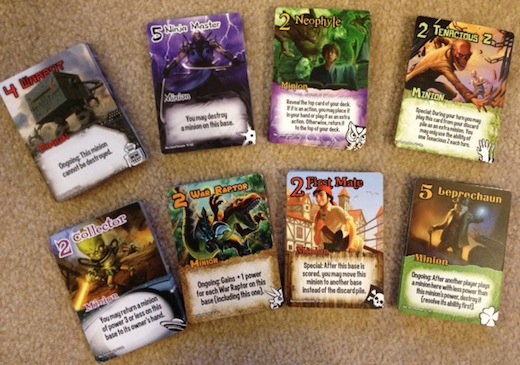
Smash Up is a "shufflebuilding"game.  What this means is that you select two factions at the start of the game, and then you build your deck by shuffling them together.  During the game, you will be using the minions and actions of your new deck to attempt to break different "bases".  Each turn, you are allowed to play one action and one minion (in either order).  The minions are played on bases, and at the end of a turn, if a base has a certain amount of power (from minions) around it, the base "breaks", and players score points based on if they were first, second, or third in power.  Then, all of these minions and the base are discarded, a new base is drawn, and the next player takes their turn.  Oh - you also draw two cards at the end of your turn.  That's basically all of the rules.  You play until someone gets 15 points.

The first, and most obvious, pro for Smash Up is the theme.  This is a game about Aliens, Dinosaurs, Ninjas, Pirates, Robots, Wizards, Tricksters (Fairies and such), and Zombies.  When you play this game in public, people want to play it without knowing anything about the game.  The theme is cool.  The only thing that instantly comes to mind that is missing is Dragons.  (I consider them different from Dinosaurs - after all, everyone knows that Dragons breathe fire, and Dinosaurs don't.  Maybe if Dinosaurs could breathe fire, they would still be around.  And really, stinkin' scary!)  I also think it would be amusing if Chuck Norris was given his own faction.  But that would probably cost a lot of licensing fees.  You could also do a professional wrestlers faction (and probably use made up people).  Either way, there are a lot of new factions that they could add to Smash Up to make it fresh and add replayability.  Yet, one of the other things that I like about the factions that they already have is that they all play differently.  Instead of simply going for theme and making eight decks that work exactly the same but have different art, they made a game where each faction has definite abilities that you need to capitalize on in order to win.

different factions you can play with in Smash Up
All of the different factions!
The second pro really surprised me.  And, mainly, it is because I had this game taught to me.  The rulebook is actually really amusing.  After playing a couple of games, I was teaching the game to others.  I had a rules question (who wins on ties, or something else minor that hadn't come up in a previous game).  So, I started flipping through the rules.  And seeing things like a section with the header "Cheater!  Y U Action Twice?"  Or, in the tie breaker rules, "If there is a tie for the most, keep playing turns until there isn't.  No sharing!  Except for your two factions.  You guys are BFFs."  Plus, every question that I've had has been quickly and easily answered in the rules.  Very rarely do I mention the instructions as a pro for a game, but Smash Up has one of the best rulebooks that I've ever dealt with.

My third pro to Smash Up is that the actual game is fun.  Why did this not make it until third?  Well, because the other two pros are really, really strong!  But, there is quite a bit of depth to figuring out which base to attack, when to attack it, whether it's better to kill your opponents minions (or leave them there to help break the base), when to play action cards that help you instead of ones that hurt your opponent.  There are really a lot of strategic choices to the game.  And, each combination of factions will give you a variation of these choices.  For example, with the Aliens, I played the game completely opposite of how my wife played them.  When I played as the Aliens, I played one of my minions that gave me a Victory Point when it entered play.  Then, I regularly used my other cards to beam him back into my hand so that I could play him over and over and keep scoring more victory points.  When she played the Aliens, she beamed up everyone else's minions whenever they came and threatened the bases that she was attempting to break.  Two completely opposite ways of playing the exact same cards - and both work well!

But, with all that Smash Up does right, there are some cons that need to be mentioned.  First, the game is very text heavy.  Or, more specifically, it is very text heavy for what kind of game it is.  Smash Up is (I believe) a non-gamer friendly, easy to learn, fast and easy to play game.  It can appeal to people beyond just gamers because of it's theme, and it is an easy way for them to play games and have fun.  Yet, with this, most every card that they will draw will do something different that they will have to read (and understand).  So will every base.  And every card that everyone else plays.  Once you have played the game a few times, this really won't be an issue anymore.  However, every time that you teach the game to someone new, you will immediately see what I am talking about - the game begins with a lot of sitting there and reading.  It just seems that the amount of text just doesn't fit the style of game.

mid play of Smash Up - calculating bases
Now how much power is at each base??
The next con for Smash Up is in the same vein.  There is a lot of math going on in the game.  By "math", I mean simple arithmetic.  You will constantly be adding and re-adding how much power each person has at a base, how much total power is at the base, and how much more power you need at the base.  Then, for strategic purposes, you will be adding how much power the cards you play will give you, and how close you will be at that point.  And, some minions gain extra power when it's not their owner's turn.  So, you have to remember that and add it in.  Another minion gains extra power based on the number of minions its owner has in play.  So, you have to add all of that in, too.  None of this is difficult, but it does serve to slow down the game, whether you've played it once, or you've played it dozens of times.

Finally - there's no score markers.  Really?  Do you think that I have dice just laying around that I can use for this purpose?  (Ok, stupid question - but that doesn't mean I remember to bring them with me.)

Overall, I give Smash Up an 8.5/10.  I enjoy the game, and I intend to continue playing it.  I am also eager to see what new factions they release in the upcoming months and years.  And, whereas I won't be playing Smash Up on a weekly basis, I look forward to getting to pull it out and teach it to new people and watch as they enjoy getting to throw Ninjas and Dinosaurs together to see what happens.

If you like Smash Up, then you might also want to check out 7 Wonders, Flash Duel, and Revolver. Or, if you want to check out some more opinions on Smash Up, I'd recommend checking out this Smash Up Review on I Slay the Dragon, or another Smash Up Review by Games With Two.

I would like to thank AEG Games for providing me with a review copy of Smash Up.

Nightfall: The Coldest War Review


Hello, friends, and welcome to Nightfall review #4.  This one is of.... well.... the 4th set - Nightfall: The Coldest War.

As with most of my expansion reviews, I will assume that you are already familiar with the base game.  If you're not, I highly recommend checking out my review of Nightfall, so that you'll have a context to frame this discussion, as I only plan on writing about the changes that Coldest War has introduced.

One of the phases of the moon
The first, and most widely advertised, thing that Coldest War introduces is the "Moon Phase."  Essentially, there is a new deck of about 6-8 cards that represent different phases of the moon.  Based on which phase of the moon is currently active, a different global effect will occur.  Some of these will make lycanthropes stronger, others will help vampires, one causes all kickers to resolve.  But, for the most part, these phases target a specific race of monsters and make that race stronger in some way.  And, if that isn't a race that you have a lot of in your deck, then at the end of your turn you have the option of changing the phase to be something else.  Honestly, I found this element of the game to be fiddly and unnecessary.  Since most of the phases only worked based on the class of your monster, it generally seemed to be an afterthought to get the bonus.  You definitely couldn't plan a strategy around the moon, because it changes too often, and it's possible for the phase that you want to never come back up.  More than anything, this element felt like something they tacked on just to have something "new" in the game.  Fortunately, it is optional, and I will probably opt out of using it 98% of the time.

The next new addition in Coldest War are Combat effects.  Combat effects are cards that you can play during any combat phase, and they give you a bonus.  This is nice, since inevitably you will not be able to chain every card in your hand every turn.  Most of these bonuses aren't large enough to be overpowering (give a minion +1 strength, heal a minion, etc), but it is nice to have an alternative way of playing cards.  My favorite Combat effect is the minion that is able to be put into play from your hand, but with only one health.  He then becomes a nice surprise attack to your opponents.  Whereas I was a bit torn, because it almost felt like cheating to be able to gain effects from your cards without successfully chaining them (chaining is the crux of the game!), I do like the new Combat effects, and they help the Coldest War expansion to have a different feel than the previous sets.  This is a nice addition.

The third thing that I will mention isn't really a new addition, but is really awesome.  I love the new wound cards.  It's worth mentioning - Coldest War is a standalone set.  Yet, instead of giving you all "new" wounds, Coldest War gives you wounds of each of the existing types.  This can be a bit confusing when you first look through the set and see "Martial Law" written on some of your wounds, but it really makes sense when you think about it.  Anyway (drumroll....) the new wound effect is: "This card chains to and from any card.  This does not count toward your 1 wound effect per turn limit."  That is amazing!  Suddenly, I want to get hit a few times, because I'll be able to chain on any card on any turn (assuming that other players start a chain).  However, because of the final part (not counting towards your 1 wound effect limit) it makes sense to include the other kinds of wounds - otherwise the Coldest War set woundn't make sense without being mixed with the other sets (and, after all, it is supposed to be a standalone expansion).  So, yes, I love the new wound effect.  I like it more than any of the actual archive cards I've seen in the set!

Bone Cruncher!
The final thing that Coldest War mixed up on us was the starting decks.  Nightfall and Martial Law each had the same starting decks.  Because of those starting decks, the first few turns always felt a bit too prescribed (you start off by playing Yuri, because he gets you extra influence).  This is no longer true, and the starting turns feel a bit more fluid - though, that might simply because I'm not as familiar with these new minions, so I haven't found a "go to" strategy.  Honestly, in some colors I like the original starting cards, whereas in other colors I like the new ones.  The most interesting one is "Snowstorm", whose strength is dependent on how many minions the defending player has (if you play this early when nobody else has any minions, you completely wasted your card).  Though none of these new starting cards are incredibly unique or special, I like that they were included, as it provides more flexibility with the starting game.  Now, you can use the old set, the new set, let each person pick which set to use, or even let each person mix and match from the different sets.  I hope that they continue providing different starting decks in the future!

Now, just because it's fun, here's my (current) favorite card from this set: "Bone Cruncher."  He is a Lycanthrope (this actually matters now, but still not much) with 4 hitpoints, and he deals 5 damage!  Plus, he has a Combat effect that lets you make a target minion's damage unblockable.  Awesome!  Can you just imagine having a handful of these in your deck?  You play one on the table, then discard another copy from your hand to make the first one unblockable - all 5 damage!

Overall, I give Nightfall: The Coldest War  an 8.5/10.  Whereas I still like the base game significantly more than this one, because of the new wounds and starting cards I think that The Coldest War is at the top of my list of Nightfall expansions.

If you like expansions, you might also check out (of course) Nightfall: Blood Country, but also Bang! Dodge City, and Thunderstone: Dragonspire.

I would like to thank AEG for providing me with a review copy of Nightfall: The Coldest War.

Nightfall: Blood Country Mini Review


Since I love Nightfall, I am glad that I was able to try out Nightfall: Blood Country. In this review, I will assume that you are familiar with Nightfall - if not, I recommend checking out my review of it.

Here is the extent of the changes in Blood Country - when drafting, all of the extra cards that will be shared by the players are revealed before players select the cards for their private archives.  That's it.  This is a nice change, as you can actually draft knowing whether or not your cards will work with some of the center cards.  However, it's obviously not a huge change.

The first thing that I will talk about with Blood Country is that the packaging is very small.  Because of this, some people might balk at the MSRP being $35.  However, the box comes with 24 new archive cards.  Considering that the "promo" archives that they offer wind up being $5 per archive, $35 for 24 archives really isn't very expensive.  Secondly, if you decide to combine all of your cards into a single box (for ease of carrying), then why would you want a large empty box?  All of the cards from Nightfall, Martial Law, and Blood Country easily fit into the original or Martial Law box.  Plus, if you want to carry around just Blood Country (or a different subset of cards), the box is large enough to hold all of the new cards as well as the starter decks and wounds from the other sets (as well as a few favorite archives), and takes up much less space.  So, overall, I think that the packaging (though initially causing the expansion to look way overpriced) is ideal for what you receive, and the product itself seems priced appropriately.

Those are really the only additions and controversial issues with Blood Country.  So, now I'll just mention a few of my favorite cards.

The first one is called "Pipe Bomb."  Pipe Bomb lets you shuffle the bottom two wounds from the wound stack (the extra wounds), and shuffles them into one of the archive piles.  This card really seems very unique, and can also be very powerful at slowing down (or at least punishing) a player that is buying lots of cards from single archives - especially if they are coming from his private archive.

Another one of my favorite cards is "Harley Doberman."  Harley forces all players to discard a card from their hand each time they put a minion in play - and if they can't discard a card (or choose not to), then they receive a wound.  I love playing a couple copies of this card at the end of a really long chain. Because of how the chain resolves, Harley will be in play before the other minions, and so your opponents will either have to discard all of their cards, or (more likely) will wind up receiving a lot of wounds for the minions that they have in the chain.

Overall, I give Nightfall: Blood Country an 8.0/10.  If you are a Nightfall fan, I think that this is a great option for adding a lot of extra minions in a fairly inexpensive way.  Plus, several of the minions add new strategies to the game aside from just gaining minions and dealing direct damage.

If you like the darker theme of the Nightfall games, you might also check out Mob Ties, Gloom, and Betrayal at House on the Hill.

I would like to thank AEG for providing me with a review copy of Nightfall: Blood Country.

Thunderstone Advance: Towers of Ruin Review

playing Thunderstone Advance


The latest and greatest (literally) version of Thunderstone has broken onto the gaming scene - Thunderstone Advance: Towers of Ruin.

In case you're new to my site - hi! I hope that you keep coming back (and note, that you can follow me with RSS, Twitter, or Facebook). But, you should also know that Thunderstone Advance is definitely not my first Thunderstone review. So far I've reviewed Thunderstone, Thunderstone: Wrath of the Elements, and Thunderstone: Dragonspire. So, I'm going to assume that you're familiar with Thunderstone, and I'm only going to cover the new elements introduced in Advance. If you aren't familiar with the game, you should definitely check out the basic Thunderstone Review - and maybe the Dragonspire one, too (though Wrath of the Elements introduced some new concepts, too).

The first new addition that Advance introduces is that Monster groups now have "Levels". This is small, but is by far my favorite new feature! Yet, not when I play the game by the "official" rules. I think that one of the biggest problems with Thunderstone is that the dungeon often fills up with gigantic monsters, and so nobody will ever go fight them - thus the game gets really boring. (One of the expansions, I believe Wrath of the Elements, introduced a variant of "advancing monsters" that also helped address this problem.) So, in Advance, the official rule is that you select a random monster group from each of the three levels. And, that is the extent of their role - you shuffle them together and play the game. However, it is easy to come up with a slight variant that helps keep the game flowing - either stack all the Level 1 monsters on top, followed by Level 2 then Level 3. You could also shuffle the Level 1 monsters with half of the Level 2 monsters, and the Level 3 monsters with the other half of Level 2. Or, any other combination that you like. No matter what, you actually have the freedom to setup the dungeon hall to prevent this stalling!

familiar from Thunderstone Advance
One of the more awesome Familiars
The next new feature introduced in Thunderstone Advance may seem a bit "familiar" to you (hehe - I love puns). You can now gain a Familiar. The first time that you defeat a monster in the dungeon, you gain a Familiar. This card goes in front of you and gives you extra abilities that you can perform. Some of the abilities require you to own Experience Points (though you don't spend it). The Familiar stays in front of you every turn until you use it - at which point it goes in your discard pile. But, once you play him again, he will again stay in front of you. This is a neat concept, but I dislike that your Familiar is random and that you have no ability to change it. They all seem to be fairly balanced, but I still think that in a game where one of the main objectives is to tune the cards you play with, it doesn't make sense that you get a card at random with no ability to decide which one to get - though you can prevent yourself from having to draw it by never using it (thus never discarding it). But, if you do this, then the other players with Familiars that are helping them have a slight advantage.  Overall, Familiars are a nice addition, but they won't change gameplay very much.

The third major change (do you like how I've now upgraded that first change to "major"?) is that you now have a fourth option on your turn - you can "Prepare". When Preparing, you simply discard what you want from your hand and keep the rest. Then you draw back up to six cards. This is a very small action, and yet it can be incredibly helpful. When you draw all weapons and no heroes, you can keep a few and hope to draw heroes. When you draw three amazing heroes and three cards that only help in the village, you can keep what you need for next turn. When you get a bunch of useless trophies, you can keep the useful cards. This action will really be used much more than you would originally think, and it mitigates some of the inherent luck involved in trying to draw the "perfect" hand.

There are a ton of other changes that Thunderstone Advance makes to the brand, but I won't cover them all. I will say that I think they all improve the game. Here are a few more (without discussion about how useful they are):
Guardian from Thunderstone Advance
One of the new Guardians
  • The game end condition is based on a Guardian instead of a Thunderstone (thus, no free points to whoever ends the game unless they kill a huge monster)
  • "Militia" have been turned into "Regulars" and have been improved slightly
  • "Iron Rations" has been replaced with "Thunderstone Shards" which are worth actually using
  • The game comes with a board that helps you in setup by preventing you from overloading a single card type (Weapon, Spell, Villager, Item)
  • You can play in a Dungeon (light penalty of 2) or a Forest (light penalty of 1)
  • The packaging is better than the original Thunderstone but not as good as in Wrath of the Elements (yet the cards stayed in place when I carried it vertically in a backpack - kudos!)
  • Diseases are replaced with Curses, and each one has an Ability that lets you destroy it (by suffering a temporary penalty)
  • There are more cards that encourage you to go to the Dungeon even when you don't have a guaranteed victory
Overall, I give Thunderstone Advance: Towers of Ruin an 8.5/10.  If you disliked the previous Thunderstone offerings, there's not enough in Advance to pull you back in.  However, if you liked the previous games, or you were interested in trying out the game, I think that this is a good set to buy.  I think that Advance improves on the game in a large number of small areas, which add together to make a better game.

If you like games like Thunderstone, you might also check out Nightfall, Warhammer: Invasion, and Runebound. Or, if you're looking for more opinions on this set, you can check out a Thunderstone Advance Review from I Slay the Dragon, or another Thunderstone Advance Review from the Board Game Family.

I would like to thank AEG for providing me with a review copy of Thunderstone Advance: Towers of Ruin.

Nightfall: Martial Law Review


For those of you that have followed my blog for a while, you may remember that I left off my Nightfall review eager for expansions. (And if you haven't read that review, you should check it out here as I'm going to assume that you're familiar with the base game throughout this review and focus on the differences introduced in Martial Law, even though Martial Law is actually a fully playable game without the base set.)  Well, AEG has finally created the first expansion: Nightfall Martial Law!

There isn't really much that Martial Law introduces that is <i>completely</i> new to the Nightfall franchise. The one thing that is introduced is "Feed." Feed allows a player to have an effect continue occurring as long as they can pay the penalty (such as discarding two cards). Aside from this, Martial Law adds depth to a few ideas that were introduced in Nightfall but not all very fleshed out in the base game. For example, in Martial Law there are more minions that are not discarded every combat phase (like what "Bad Smoke" from the base game) , there are new color chains, and there is a new wound effect (in Nightfall, there was only the single wound effect). Now that I've told you the gist of what makes Martial Law unique, lets get to the pros and cons.

The first pro that I have for Martial Law is that some of the minions have effects that occur when they attack. For example, "Lone Hound" causes you to exile a card from your hand whenever he attacks. Another one, "Mad Jake" allows you to inflict a wound directly on another player whenever he attacks. I think that these extra things that occur while attacking add some strategy to the game. For example, with "Lone Hound", he can be incredibly helpful by allowing you to exile wounds from your hand late in the game, but early in the game, he might actually harm you by forcing you to exile useful cards (after all, you have to attack each turn). With "Mad Jake," you have the ability to attack two different players at the same time, since he can attack one player and cause the direct damage to go to someone else.

The next thing that I like is how more of the new Minions stay in play after combat. One particular minion, "Brynna & Taylor" allows you to draw extra cards during your cleanup phase. Therefore, if you can get several copies of them into play, you can get a significant advantage by drawing more cards than your opponents. This also adds strategy in forcing players to decide between whether they want to defend with these characters, and also causes other players to pay more attention when dealing direct damage to a minion. (Of course, these new minions are completely worthless when playing someone using a lot of "Furious Melee" from the first set which deals two damage to each of Target Player's minions. But maybe that just means that Furious Melee is overpowered.)

My next item is really a neutral more than a pro, and that is Feed. Feed can be useful, but the conditions under which Feed is powerful seem to rarely be met. For example, one card allows you to discard two cards to "Feed" an effect to inflict one point of direct damage (how often do you really have a handful of extra cards?). Another problem that I had with Feed was that the payoff for Feed was often minimal. For example, one card lets you Feed by discarding two cards in order to draw one (which can be useful if you are looking for a certain card but normally not very beneficial), and another lets you Feed by discarding two cards to gain three influence (useful, but not really a major gain). Overall, Feed is a concept that I think will become more useful in future expansions, and will occasionally be pretty impressive now (such as with "Bleak Resurrection" which allows you to Feed by discarding a card to bring a target minion from the discard pile into play - which can be really useful if you have a hand full of minions (and worthless if you don't have a discard pile)!)

However, though there are some neat new elements to Martial Law, I felt like there were a few areas that could have been better. First off, the starting cards are the exact same as those from the base set. Whereas this isn't "bad", it is an area that I thought could have been better. There could have been at a minimum new art on the cards (like they did with Thunderstone: Dragonspire), or, better yet, they could have come out with new starting decks that players could have used to mix up the game. Then, players would have had the option of playing with the old starting decks, the new starting decks, or a combination deck made of one of each card from the old and new.  This could have helped with my biggest con from the base game, which is that the first several turns are all the same - everybody waits until his turn and plays Yuri to gain influence.

The next con that I had with the game was that a lot of the cards seemed somewhat bland to me. One example is a card that allows the player to draw one card (with a kicker that each player must destroy a minion). This card really seems to be a filler card that you would only use to continue a chain. Other cards seemed to have very specialized situations in which they are helpful, but for the bulk of the game they would be fairly useless. For example, "Target player discards down to 5 cards and receives 1 wound per card discarded." When is this card useful? When someone has a ton of cards in their hand. When does that normally happen? When they've discarded a ton of wound cards to draw new cards. Which means - this card is really good at picking on the guy that already has a ton of wounds! Several others seem to target vampires or lyncanthropes. Whereas, I knew this would probably occur at some point (why else put the race on the cards in the first place), overall these cards don't seem to be nearly as good as cards that target minions, because they have very similar effects, but are much harder to use (and, to be fair, their effects normally are much greater if they are able to be pulled off).

Overall, I give Nightfall: Martial Law an 8.0/10. I was honestly a bit disappointed with the set. That's not to say that it is bad - it is just that the base set is phenomenal, and this set is "only" good. I would recommend picking up the base set first, and once you've played it enough that you need to mix it up a bit, pick this one up and mix them together.

I would like to thank AEG for providing a copy of Nightfall: Martial Law for me to review.

Thunderstone: Dragonspire Review

Thunderstone Dragonspire game in play

Now that I've had the privilege of playing Thunderstone: Dragonspire, it is time to post my review.

So, this is the part of the review where I normally summarize the game. I'm going to assume that you have already played the base game, and if not, you should probably read my review of Thunderstone. Instead, I'll try to focus on the differences that set Dragonspire apart from the other iterations of Thunderstone that I've played. In all honesty, I skipped Thunderstone: Doomgate Legions, so I'm not 100% sure what was introduced there instead of in Dragonspire, but after doing my due diligence on Board Game Geek, I think I have a pretty good handle on what aspects were introduced in each set.

Dragonspire really doesn't introduce very much in the way of new mechanics to Thunderstone. The only two things that I saw that seemed to be new were Settings and a new cooperative way of playing the game. However, it did include everything necessary to play the game (it is a fully playable standalone game), and also expanded upon all of the features that were added in previous expansions (new Thunderstones, Treasures, Traps, Mercenaries, and Guardians). Therefore, whereas the game isn't especially innovative, it does allow a new player to jump into the fully developed Thunderstone game.

Now for the pros, cons and something in between. We'll start with the in between, which is the packaging. If you have read each of my previous Thunderstone reviews, I thought that the packaging for Thunderstone was absolutely atrocious. However, I thought the Wrath of the Elements packaging was amazing. I personally think that Dragonspire is somewhere in between those two. Instead of the sleek, spartan packaging of Wrath of the Elements, AEG went back to the ridged plastic dividers, but with the ridges meant to keep the cards from sliding instead of to separate cards.  They have also continued providing nice, labeled dividers. I'm not completely sold on this being "better" than what was in Wrath of the Elements, but it is definitely better than what was in the original game. Along with the new packaging design, they also included plastic experience tokens and a dungeon board (to help keep track of light, guardians, etc). These are (though unnecessary in my opinion) nice little additions to the game that make you feel more like you get your money's worth. Regardless of which packaging I prefer, I have converted all of my cards to be in the Dragonspire box, because it is big enough to actually hold the board and the instructions (which annoyed my about the Wrath of the Elements box because it wasn't big enough to hold the instructions from the original game).

Now that I've had the obligatory discussion about packaging, time to get more into the actual game. I'll do one quick note about Settings, and then I'll go on to the cooperative play. So far I like the Settings mechanic. What the Settings do is change the actual overall game. They add rules like "every time you defeat a monster you gain a disease" or something similar that makes one game of Thunderstone different from the next. This is a plus, in my eyes - especially since they are optional, and if certain players find them annoying they are easy enough to leave out.

The innovation that I found in Dragonspire was around the cooperative play. My wife refused to play this game competitively with me after our first game (I have lots of deckbuilding experience and she has very little, and so she found the experience quite frustrating). With a new cooperative game, I was excited that I felt like I could convince her to try again (and in fact, I was successful at this). The cooperative game works very similarly to the advancing monsters game variant that was introduced in Wrath of the Elements, where the monsters attack and cost the players points every certain number of turns. There were a few big differences, though. In the cooperative version of the game you have a shared experience pool, you can trade cards (to a limited amount) when resting, and you can turn in monsters when visiting the village to gain experience (and remove them from your deck). This mode of play worked fairly well, and I would be willing to continue playing it. I really appreciate the fact that each release I have played has added a new game play option.

Another quick pro is that in Dragonspire, the heroes have diverged from the standard setup. Whereas in the previous versions all the heroes had levels 1-3 and the same number of cards (from one hero to the next) for level 1, 2, and 3. This is no longer the case. In Dragonspire, some heroes have 4 levels, some have 2, and therefore the heroes are actually becoming more unique. This helps the game not feel like it is the same every time through.

The next thing that I have learned to really appreciate about AEG (through my interaction with their Thunderstone brand) is that they seem to both learn from their mistakes and fix them. As an example that was stated previously, the original Thunderstone storage was horrendous. AEG realized this and setup the Wrath of the Elements box to use labeled dividers between the card sets. The problem was, these were not included in the original set. AEG, fixing their mistakes, provided labels in Wrath of the Elements for both the original game and the Wrath expansion. They have done this again in Dragonspire. They determined that it would be very convenient for the randomizer cards to have different colored backs. Therefore, they provided new randomizers for each of the previous sets. I really wish that all companies tried to fix their mistakes like AEG has done with the Thunderstone brand.

Now that I have talked about the pros, here are a few cons. First off, I noticed more than ever that you need to be careful when picking the heroes and village cards that you play with. If you randomly select them, you will often get cards that do not mix well together and so you will have several cards that are essentially unusable in your setup of available cards. Fortunately, this is pretty easy to fix - look at the cards selected and make sure they work together; ie, do not have a wizard that works well with spells and then no useful spells available (this happened to us).

Something that I have mentioned as a con previously in the Thunderstone set, but that I noticed again (and so I will mention) is that the game seems to be setup where nobody attacks the dungeon for quite a long time. It seems to be all buildup for the first half of the game, and then attacking for the second half, but not intermixed. Because of this, I will continue recommending that you play with the advancing monsters variant that was introduced in Wrath of the Elements.

There are several other pros and cons to the game, but these are the same as what can be found in the previous versions of Thunderstone, so I don't really feel the need to retype them, since you can click on those reviews from my links on this site.

A few final quick notes before wrapping this up... First, I like Treasures and Mercenaries (these were introduced in Doomgate Legions, and I will write more about them if I play and review that expansion). Second, the game seems to work best with about 3-4 players, as with 2 your deck will get too watered down with monsters, and with more than 4, you will not have the opportunity to purchase many village cards.

Overall, I give Thunderstone: Dragonspire an 8.0/10. It is not nearly as innovative as the original game (and so I seriously pondered giving it a 7.5), but it introduces some useful new aspects to the game and so I keep them on par with each other. If you really enjoy the Thunderstone brand, then you should pick it up, because it will add more replayability to your sets. If you are debating whether to try out the Thunderstone system, I would recommend getting this set before the "original" base game, as it includes everything the base game had plus more.

If you want to read about more Thunderstone, I've also reviewed Thunderstone, the Thunderstone: Wrath of the Elements expansion, and the Thunderstone Advance: Towers of Ruin franchise reboot.

I would like to thank AEG for providing me a demo copy of Thunderstone: Dragonspire to review.