Dungeon! Review

Dungeon board game in play

Recently, Wizards of the Coast decided to re-print a classic game from the 1970's - Dungeon!

In Dungeon! each player takes on the role of a different adventurer with the goal of looting the dungeon.  Each character has a certain amount of loot that they are attempting to collect before returning to the Great Hall for victory.  Each turn, you can move your adventurer up to five spaces - but you are stopped if you go into an uncleared room or chamber.  In these rooms and chambers, you must fight a monster.  After selecting the monster of the appropriate level, you find the number that your adventurer must roll.  After rolling the dice, if you have rolled high enough to defeat the monster, then you gain loot (if you are in a room or the monster had stolen loot).  If you do not defeat the monster, then you roll again to see what happens - this can range from nothing, to losing some of your loot, to being killed and having to start over.  Turns continue in this manner until one player has collected enough loot to win and successfully returns to the Great Hall (with that loot).

Dungeon monster card - Hill Giant
Find the number your character needs to roll
The first pro for Dungeon! is that it is easy to teach anybody.  Now, this pro comes with a caveat.  Though it is easy to teach anybody, that doesn't mean that adults will enjoy the game.  This should probably be considered a kid-friendly game more than a non-gamer game.  However, with that said, it seems like the kind of game that you could enjoy with young children.  The amount of luck and die rolling involved would help put both children and adults on approximately equal footing when it comes to chances of victory, which I think could add even more to the children's enjoyment.

Oh, and the next pro for Dungeon! is that it's inexpensive.  A suggested retail price of $20 for a full board game with any kind of role playing element (however small) is essentially unheard of.

Now that I have listed all of my pros for Dungeon! it's off to the cons.  There is a ridiculously overpowered strategy in the game.  Do you want to know what it is?  It is to roll the dice well.  This strategy will defeat any other strategy that players choose to implement (like not rolling well).  Basically, the entire game is dependent on luck.  The higher you roll against monsters, the better your chance of victory.  However, as opposed to games like Runebound where you defeat the smaller monsters to level up and get better weapons before continuing onto the harder monsters, you will have essentially the same chances of defeating a huge monster at the end of the game as you would at the beginning.  (The one exception is that you might be able to get a "magic sword" which can give you a +1 or +2 bonus to your rolls - normally a +1; again, unless you roll well.)  So, if you're going to go after gigantic monsters, you might as well do it right at the beginning before you have loot to drop.  But, then you might get really good loot and drop it later where someone else can go get it.

Dungeon board game close up
You better play friendly with those dice!
The next con for Dungeon! is related to the first con.  If you choose the sub-optimal strategy (you don't roll well), then you are going to be very frustrated in this game.  I played a game of Dungeon! where one of the players spent significantly more time without loot than with loot.  Each time they earned any loot, they immediately lost to another monster (of a level that they were "recommended" to be fighting), and then would have to spend the next several turns fighting that monster in order to re-gain their loot.  After all, once you've already lost all of your loot, there's not really much downside to losing to a monster.  However, it can be incredibly frustrating to play the game and constantly roll slightly too low to beat the monster - just to see your high roll get used by determining how the monster smashes you in return.  (This is the kind of frustration that makes people want to flip the table.  I'm not condoning this action - just stating that this is an example of what could possibly cause someone to want to do that.) 

That's really all there is to Dungeon!  Overall, I give it a 6.0/10.  And, honestly, I only gave it a score that high because it can be played with kids.  However, like Uno, just because your kids will enjoy it doesn't necessarily mean that you will.  If you're looking for a highly luck based game with a lot of die rolling and a slight role playing element, then you should check out Dungeon!  Otherwise, you should probably stay away.

If you are looking for games for children, you might also check out Hey, That's My Fish! or Scallywags; or, if you're looking for a role playing game, you might check out Runebound or Legend of Drizzt.

I would like to thank Wizards of the Coast for providing me with a review copy of Dungeon!

WWE Topps Slam Attax (Rumble) Review

WWE Slam Attax game setup to play
 
Hello.  My name is Josh, and I am an adult that enjoys watching professional wrestling.  Because of this, I buy wrestling games that I know will be awful.  At least I have a board game review site, so that I can at least pretend to have a reason for buying these games. Recently, this meant I bought WWE Topps Slam Attax (Rumble).

In the WWE Topps Slam Attax game, each player chooses nine wrestlers and sets them face-down in front of them.  Now, after determining who goes first, the active player will select one of their wrestlers and decide if they will attack or defend - and, optionally, can specify a sub-category of this (such as reverse or block for defense).  Their opponent must select one of their wrestlers and do the opposite - defend an attack or attack a defender.  Both players flip over their cards, and whichever one has the highest number wins.  The person who wins five of these matchups first wins the game.  (There is also a weapon card that you can use once per game to increase your number by the number of stars showing on the weapon - but as far as I know, you can both do this at the same time and cancel each other out.)

WWE Big Boss Man card for Slam Attax Rumble
Some cool classic wrestlers are included
There's really one pro for this game - it has cool, collectible WWE cards.  And some of them are pretty and shiny.  And (at least where I bought them), they're cheaper than other collectible WWE cards.  Granted, I don't really buy a whole lot of WWE collectible cards, so this pro is only somewhat useful.  That's it - I'm done covering pros.  And, now that we've covered the pros, are you ready for the cons?

First of all, the rules are absolutely awful.  Awful!  There are supposedly three different ways to play - standard, Rumble, and Match play (if I remember the names correctly).  But, do you want to know the differences between the three?  Yeah - so do I!  I bought the standard starter pack, and it told me basic rules.  Then I searched online to see the different versions - nothing.  I searched harder - still nothing.  I have no idea how to play the versions that aren't explained on the back of the package.  Also, the different cards have various icons on the back of them - such as which part of WWE they are affiliated with (Raw, Smackdown, Divas, etc) and a star rating.  As far as I know, these don't mean anything.

WWE Slam Attax Rumble cards
Know what these do?  Nothing!
And, speaking of not meaning anything, my second con is that there are a lot of completely worthless cards in this game.  I don't mean that John Cena is stronger than some random guy you've not heard of, and so taht guy seems worthless.  I mean that there are a lot of cards that have absolutely no gameplay element whatsoever.  Such as the pay-per-view cards (Wrestlemania, No Way Out, etc) and the match cards (Ambulance Match, Steel Cage Match, etc).  You know what you do with these?  You set them off to the side and pretend that this is the setting of your game.  To the best of my knowledge, that is all you do.

But, I briefly mentioned that John Cena is better than a lot of the other people.  Do you know why this is important?  It's because the strategy in this game is to have all of the good wrestlers.  If my nine cards all consists of the major superstars such as John Cena and the Rock, then I don't have to have any strategy whatsoever to win - I'm going to flip a card better than yours.  Because you didn't obsessively collect the best ones.  (And, by the way, what were you thinking??)  I've played a lot of collectible card games where it's important to have all of the good cards.  But, in those, you have to use the cards in the right way.  In this game, if you have better cards than your opponent, you're going to win - it's like if you were playing the card game "war" and one person had Aces and the other had 2's, and you were playing to see who could win the first four matchups.  Doesn't that sound exciting?  (Short answer - no.)

Overall, I give WWE Topps Slam Attax (Rumble) a 2.0/10.  This game is awful.  You really shouldn't play it.  However - if you want to collect shiny WWE cards, it might be something to look into.

Whereas WWE Slam Attax isn't one of the better games I've played, I would recommend checking out Gloom, Dixit (which is a storytelling game), and Glory to Rome.

Glory to Rome (Black Box Edition) Review

Glory to Rome card game in play

One Kickstarter game that has brought forth some very strong opinions is Glory to Rome: Black Box Edition.

In Glory to Rome, each player is attempting to help rebuild Rome after the great fire of 64 AD.  To do this, you will need the assistance of clientele.   Each turn, you will select a role from your hand to play (the roles are Patron, Merchant, Craftsman, Architect, Laborer, and Legionary).  After you select your role, each other player has the option to follow you or to "think" (draw cards).  When performing the action associated with the role, you may boost the action if you have any more "clients" in your clientele.  In order to initially gain these clients, you must perform a Patron action.  However, you are limited to your number of clients based on your influence.  You gain influence by building buildings - with the Craftsman and Architect roles.  Briefly, the Legionary helps steal from your neighbors, the Laborer prepares you for other actions (by putting cards in your stockpile), and the Merchant helps you earn victory points.  The game is played until one of the end game conditions is met - either the deck of cards is exhausted, all of the "in town" building sites have been used, or one of the end of game buildings is built (Forum or Catacombs).  At that point, whoever has the most victory points wins - unless the game ended because of a Forum, in which case, the person who has the Forum wins!

Glory to Rome is designed by Carly Chudyk.  He is also the designer of Innovation.  I like to classify his games as "balanced by being broken."  Essentially, what I mean by this is that there are cards in Glory to Rome (similarly to Innovation) that are ridiculously powerful.  For example, there is a building that doubles the number of clients that you may have, and also lets you add an extra client from your hand during every Patron action.  This card is amazing, as it quickly lets you get exorbitant numbers of clients, which then lets you have large bonuses every time any player performs an action.  However, there are other ridiculous cards that can come back and stop it.  Such as the Colosseum, which allows you to use the Legionary to steal clients from your opponents (instead of cards in their hand) and put them in your vault (this is where you get victory points, and normally putting cards here is a much longer process that requires the Merchant action).  So, you are now hurting your opponents and gaining victory points!  There are other cards that suddenly allow all of your clients to count twice.  Others allow you to take all Jacks (wild cards that you normally get in the "think" action) that your opponents play into your hand.  So, there are amazing combinations in the game.  But, building one certain building generally doesn't guarantee anyone the victory.  Especially (and this is the final one I'll mention) because there is a card that allows you to steal any of your opponent's constructed buildings!

playmat for Glory to Rome Black Box
Typical player board with clients, stockpile and vault
One of the other things that I think is really interesting about Glory to Rome is that you can both think and follow in the same turn.  I initially did not believe the people that taught the game to me.  In fact, when teaching other player later, I verified this rule.  If the active player decides to perform an action - Craftsman, for example - you may think and draw cards.  Yet, if you have the corresponding client(s) in your clientele, when the action comes to you, you may still use your clients to follow the chosen role.  This is a really interesting and powerful dynamic.  And it also makes clients significantly more useful.  Instead of having to have the correct card in your hand in order to follow (thus causing your clients to only be helpful if you have drawn well), they are always available.  And, what's more, you can wind up doing quite a bit more on an opponent's turn than on your own.  Thinking to draw cards and then also getting the benefit of the actions is, simply, amazing.

The next thing that I like about Glory to Rome is that there are meaningful (and tough) choices to make.  Every card that you play can be used as an action, as a building, or as material for a building.  But, it is very important to decide which way you are going to use any given card.  Is it more important to start building a building that gives you an amazing bonus, but that you know you won't complete this turn, or is it more valuable to follow the action being performed by the active player?  Would you be better off using that incredibly powerful building to complete the "under construction" structure that you have, or should you keep it so that you can build it next?  What makes some of these choices even harder is that keeping a card for later clutters up your hand.  When performing a "think" action, you are allowed to draw cards back up to your hand size (generally five), draw a jack, or draw a single card.  If you are keeping a card in your hand, then that is one less card that you will be drawing whenever drawing back up to your hand size.

Glory to Rome artwork
Very bland artwork
The final pro that I will mention for Glory to Rome is that I enjoy how the different elements of the game work together and keep each other in balance.  For example, you are limited in your clientele and your vault by the amount of influence you have.  You gain influence by completing buildings.  Yet, it would be really helpful to have a lot of Craftsman and Architects in your clientele to help build these buildings.  Also, in order to utilize your Architects and Merchants, you have to have cards in your "stockpile."  To get cards in your stockpile, you have to use Laborers and Legionaries.  But, you often don't see the immediate benefit by playing these two roles.  However, ignoring them winds up making your other roles useless.  The different elements of the game really flow together well to make a beautiful experience.

My only real con for Glory to Rome is that I dislike the artwork.  Really, I've played (and owned) both this version of Glory to Rome and the previous IV version, and my complaint has been related to production both times.  In the old version, I disliked the box - it was a plastic clamshell container.  The art was very cartoonish, and many people disliked it.  I really had no problems with it.  However, in the Black Box, I felt like the art was all very cheap Clip Art styled images.  This con obviously doesn't affect gameplay, but it makes the overall experience of Glory to Rome a bit worse.

Overall, I give Glory to Rome a 9.0/10 (in either edition).  I think that the gameplay is wonderful, and I look forward to playing it more and more!

If you want another opinion, check out this Glory to Rome Review on I Slay the Dragon. Some other games somewhat like Glory to Rome, also include Eminent Domain, Puerto Rico, and Race for the Galaxy.

I would like to thank Cambridge Games Factory for providing me with a review copy of Glory to Rome: Black Box Edition.

Smash Up Review

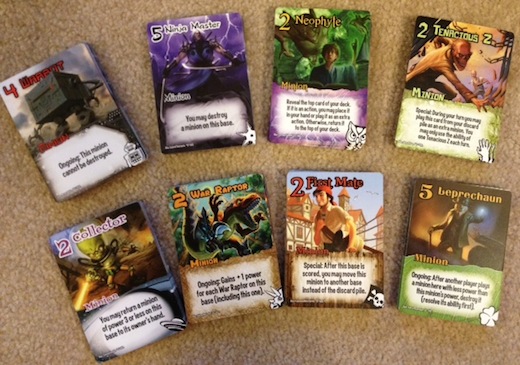
Smash Up what's in the box

One of the games that I've been eagerly wanting to get my hands on this year is Smash Up.

Smash Up is a "shufflebuilding"game.  What this means is that you select two factions at the start of the game, and then you build your deck by shuffling them together.  During the game, you will be using the minions and actions of your new deck to attempt to break different "bases".  Each turn, you are allowed to play one action and one minion (in either order).  The minions are played on bases, and at the end of a turn, if a base has a certain amount of power (from minions) around it, the base "breaks", and players score points based on if they were first, second, or third in power.  Then, all of these minions and the base are discarded, a new base is drawn, and the next player takes their turn.  Oh - you also draw two cards at the end of your turn.  That's basically all of the rules.  You play until someone gets 15 points.

The first, and most obvious, pro for Smash Up is the theme.  This is a game about Aliens, Dinosaurs, Ninjas, Pirates, Robots, Wizards, Tricksters (Fairies and such), and Zombies.  When you play this game in public, people want to play it without knowing anything about the game.  The theme is cool.  The only thing that instantly comes to mind that is missing is Dragons.  (I consider them different from Dinosaurs - after all, everyone knows that Dragons breathe fire, and Dinosaurs don't.  Maybe if Dinosaurs could breathe fire, they would still be around.  And really, stinkin' scary!)  I also think it would be amusing if Chuck Norris was given his own faction.  But that would probably cost a lot of licensing fees.  You could also do a professional wrestlers faction (and probably use made up people).  Either way, there are a lot of new factions that they could add to Smash Up to make it fresh and add replayability.  Yet, one of the other things that I like about the factions that they already have is that they all play differently.  Instead of simply going for theme and making eight decks that work exactly the same but have different art, they made a game where each faction has definite abilities that you need to capitalize on in order to win.

different factions you can play with in Smash Up
All of the different factions!
The second pro really surprised me.  And, mainly, it is because I had this game taught to me.  The rulebook is actually really amusing.  After playing a couple of games, I was teaching the game to others.  I had a rules question (who wins on ties, or something else minor that hadn't come up in a previous game).  So, I started flipping through the rules.  And seeing things like a section with the header "Cheater!  Y U Action Twice?"  Or, in the tie breaker rules, "If there is a tie for the most, keep playing turns until there isn't.  No sharing!  Except for your two factions.  You guys are BFFs."  Plus, every question that I've had has been quickly and easily answered in the rules.  Very rarely do I mention the instructions as a pro for a game, but Smash Up has one of the best rulebooks that I've ever dealt with.

My third pro to Smash Up is that the actual game is fun.  Why did this not make it until third?  Well, because the other two pros are really, really strong!  But, there is quite a bit of depth to figuring out which base to attack, when to attack it, whether it's better to kill your opponents minions (or leave them there to help break the base), when to play action cards that help you instead of ones that hurt your opponent.  There are really a lot of strategic choices to the game.  And, each combination of factions will give you a variation of these choices.  For example, with the Aliens, I played the game completely opposite of how my wife played them.  When I played as the Aliens, I played one of my minions that gave me a Victory Point when it entered play.  Then, I regularly used my other cards to beam him back into my hand so that I could play him over and over and keep scoring more victory points.  When she played the Aliens, she beamed up everyone else's minions whenever they came and threatened the bases that she was attempting to break.  Two completely opposite ways of playing the exact same cards - and both work well!

But, with all that Smash Up does right, there are some cons that need to be mentioned.  First, the game is very text heavy.  Or, more specifically, it is very text heavy for what kind of game it is.  Smash Up is (I believe) a non-gamer friendly, easy to learn, fast and easy to play game.  It can appeal to people beyond just gamers because of it's theme, and it is an easy way for them to play games and have fun.  Yet, with this, most every card that they will draw will do something different that they will have to read (and understand).  So will every base.  And every card that everyone else plays.  Once you have played the game a few times, this really won't be an issue anymore.  However, every time that you teach the game to someone new, you will immediately see what I am talking about - the game begins with a lot of sitting there and reading.  It just seems that the amount of text just doesn't fit the style of game.

mid play of Smash Up - calculating bases
Now how much power is at each base??
The next con for Smash Up is in the same vein.  There is a lot of math going on in the game.  By "math", I mean simple arithmetic.  You will constantly be adding and re-adding how much power each person has at a base, how much total power is at the base, and how much more power you need at the base.  Then, for strategic purposes, you will be adding how much power the cards you play will give you, and how close you will be at that point.  And, some minions gain extra power when it's not their owner's turn.  So, you have to remember that and add it in.  Another minion gains extra power based on the number of minions its owner has in play.  So, you have to add all of that in, too.  None of this is difficult, but it does serve to slow down the game, whether you've played it once, or you've played it dozens of times.

Finally - there's no score markers.  Really?  Do you think that I have dice just laying around that I can use for this purpose?  (Ok, stupid question - but that doesn't mean I remember to bring them with me.)

Overall, I give Smash Up an 8.5/10.  I enjoy the game, and I intend to continue playing it.  I am also eager to see what new factions they release in the upcoming months and years.  And, whereas I won't be playing Smash Up on a weekly basis, I look forward to getting to pull it out and teach it to new people and watch as they enjoy getting to throw Ninjas and Dinosaurs together to see what happens.

If you like Smash Up, then you might also want to check out 7 Wonders, Flash Duel, and Revolver. Or, if you want to check out some more opinions on Smash Up, I'd recommend checking out this Smash Up Review on I Slay the Dragon, or another Smash Up Review by Games With Two.

I would like to thank AEG Games for providing me with a review copy of Smash Up.