The Speicherstadt Review


Check it out, I'm famous!  You can see my review of The Speicherstadt at Dice Hate Me.  Thanks to Chris for the opportunity to share this review with all of his fabulous fans!

If you're looking for more euro-style games, you might also check out my reviews of Caylus, Le Havre, and Tigris and Euphrates.

Carcassonne Review


When a game truly defines a genre, I think it is only appropriate that I give it a try. And so, I wound up buying Carcassonne.

Carcassonne is the tile placing game. In Carcassonne, players take turns drawing and playing a tile. When playing a tile, it must be be placed in a "valid" position (which means that whatever is on the tile matches up with what is on the tiles next to it - no dead-ending roads, castles without walls, etc). After placing the tile, a player has the option of placing a meeple (yes, I believe Carcassonne also brought us meeples - wooden people shaped pieces) on the newly placed tile. Placing meeples is where much of the strategy of the game takes place, as it is what drives the scoring of the game. Meeples can be placed on roads, farms, cloisters, and castles. Whenever one of these things (other than a farm) is "completed" (the castle is completed, the road becomes a circle, etc) then the meeple scores points and becomes available for the user to re-place. Play continues like this until all of the tiles are placed. At this point, farmers score points, and so do all of the meeples on incomplete roads, cloisters and castles. Then, gasp, the player with the most points wins.

What's good and innovative about Carcassonne? Well, we will start with innovative - the whole game is innovative (to me). I had never seen a game where the actual playing of the game is based on placing tiles. Yes, there is a possibility of games before Carcassonne being based on tile placing (feel free to tell me about them in comments), but Carcassonne still managed to define the genre, as it brought it to the gaming market in a big way.

Now that I've told you that it's innovative - is it good? Well, I think that the best aspect of Carcassonne is that it is a nice, simple game. When you want to play a game but don't want to obsess about every move and debate whether it is the best strategy, Carcassonne is your game. It is easy to teach people (though I recommend not beating the snot out of them like what happened to me the first time I played), and can be played by almost anybody - gaming background or not. It is long enough to be engaging, without being so long that you get bored with it (though if you play too many expansions, you might argue that it gets too long).

However, though Carcassonne is very innovative and simple... it didn't click for me. I like to say that I don't care what genre a game belongs to, as long as it does that genre very well. Tile placement may be my exception. I have tried several tile placement games including Carcassonne, Alhambra, Architekton, and a few others. I haven't found any that I think of more highly than "they're ok." Carcassonne falls into this range for me. I can play it, but it's not really one of my preferred games - I would play it when friends want to play it.

Now, for a more objective con, I dislike the reactive nature of Carcassonne. Each turn you must draw a tile, assess the current state of the game, and then place it. There is very little that you can do to form a continuing strategy throughout the game. No matter how well you place things, if you don't draw the correct tiles to allow you to score, there is very little that you can do. I think that this does add to the lightheartedness of the game, and indeed many people will like this. However, this isn't an aspect of games that I am particularly fond of.

Overall, I give Carcassonne a 7.0/10. It is a respectable game that I understand why people enjoy. However, with that said, it appears to have defined a genre that I have discovered that I dislike.

So, admittedly, I'm not a huge fan of tile laying. So, instead of only reading my biased opinion, you might also check out Board Game Family's Carcassonne review, or another Carcassonne review on Games With Two. Or, if you're looking for other gateway games, you might want to check out Tsuro, Cargo Noir, Shadows Over Camelot, or 7 Wonders.

Fastrack Review

Fastrack board game in play


So, sometimes I play incredibly complicated games, and sometimes I just relax and play something quick and easy.  Something like Fastrack.

In Fastrack, you and your opponent sit on opposite sides of the board, and you each start with 5 disks on your side.  You also have an elastic band attached to your side of the board.  Here are the complicated rules: using the elastic band, be the first player to flick all of the disks to your opponent's side of the board.  Now, it's not as easy as it initially sounds - after all, there is only a small opening in the middle of the board to shoot the disks through.  If you're able to shoot the disks over the middle divider, that's legal as well.  Finally, if a disk shoots off the board entirely, it is out of play until the end of the round.  That's it - now you know how to play.

Here's the first thing that I like about Fastrack - it's incredibly kid friendly.  Now, I don't have children, so I'm not always the best judge of this.  However, when I went over to a friend's house, his kid was playing Slithering-Jumping-Hissing Snake (oh, you don't know the rules to that one?  They're fairly simple - you have to wriggle yourself across the floor... or jump... or even walk if you're not motivated.  Oh, and you can hiss at people - and you definitely want to earn style points!  But, really, there's no score keeping, so those style points just make you feel better.)  Anyway, where was I - ah, yes, Fastrack.  So, after I arrived and the very intense Snake game ended, I asked if he wanted to play Fastrack with me - the answer was yes, and we both enjoyed playing several rounds of it until I was ready to move on to the next game; he then played with the next person... and would have continued playing except that he had to go to bed.  So, yes, I would say that I have tested this and that "kid friendly" is a very valid descriptor for this game.

Next, I really have enjoyed dexterity games recently.  I realize that they're not for everyone, but if you're looking for something fast-paced that requires dexterity, Fastrack is a good choice.  Most other dexterity games (like PitchCar) allow you to prepare for your turn and take your time, Fastrack is not like that. You have to be ready to go full speed the whole time.

Now for something interesting that I hadn't thought of when I first heard about the game.  How hard is it to shoot your piece through the middle?  Well, not too terribly hard.  However, you have to be careful with this - keep in mind, you both have elastic bands.  So, if your opponent is grabbing a piece and not covering his band while you shoot a piece at him a bit too powerfully, there's a good chance that it will bounce off of his band and come back to your side.  This happens to me much more often than I would like - I need to work on shooting a bit more softly.

The only real "con" to the game is related to the nature of it - it is a very simple dexterity game.  If you don't like dexterity games, fast-paced games, or non-strategy games, then why would you even consider playing this?  For me, I enjoy Fastrack as a diversion, but it is not the kind of game that I will spend hours at a time playing.  However, I will probably break it out and play a few games of it every now and then for a change of pace - and enjoy playing it when I do so.  After all, it is relatively small and light, so it will be easy to carry to a gaming event and play when I have a few extra minutes.

Overall, I give Fastrack an 8.0/10.  It is a fun, lightweight dexterity game that can be played just as easily with kids or adults.  (Though kids might realize that it's much more effective to shoot all of the pieces off of the board rather than to your side of the board - this is actually a brilliant strategy.  You've been warned.)

If you want to know some other opinions on Fastrack, you might check out Games With Two's Fastrack Review, or the Board Game Family's review of Fastrack (they even have kids!); or, if you want to read about other dexterity games, check out Crokinole, PitchCar, and Caveman Curling.

I would like to thank Blue Orange Games for providing me with a review copy of Fastrack.

Yomi Review

Yomi card game in play

A somewhat hotly debated board game that came out recently is Yomi.

Yomi is a fairly simple fighting game. Each player takes on a character and attempts to knock out his opponent. This consists of a series of rounds in which both players will play a card and (depending on what cards are played) one player will most likely take damage. Specifically, each player chooses a card (and a side of that card) to play each round. Both reveal at the same time, and there is a Rock/Paper/Scissors style resolution. Attacks beat Throws, Throws beat Blocks & Dodges, Blocks & Dodges beat Attacks. If both players play the same type of card, then the tie is broken based on the speed of the attacks. Once a player successfully scores a hit, depending on the Attack or Throw, they will probably be able to combo that attack to score more damage. His opponent has the opportunity to counter by playing a Joker, though - or to bluff and pretend that he is playing a Joker. If the person being attacked truly played a Joker, then all of the combo damage is deflected.  Otherwise, he takes all of the extra damage and loses the card he used to bluff!  Finally, both players have the opportunity to "Power Up" by discarding various poker hands to retrieve Aces (each character's super moves) from the discard pile and/or deck. Play continues in this manner until one of the characters is knocked out.

Now that you understand the rules of the game, it's time to discuss the crux of the game (I normally jump into pros and cons, but this is a much more topic in Yomi). The crux of the game is the Attack/Throw/Block (Rock/Paper/Scissors) mechanic. As opposed to standard Rock/Paper/Scissors, in Yomi you aren't just guessing at what the other person will play. You know enough information that you will be thinking, re-thinking, and over-thinking the situation. Each character has a different breakdown of cards in their deck (with a cheat sheet on their character card telling you this breakdown on a 0-5 scale). Therefore, you know if your opponent is more likely to have Attacks, Throws, Blocks, or Dodges. You also may know if they have a Block (if they have successfully Blocked previously). You also might know if they have some Aces, and if you paid attention, you'll know how that Ace can be played. But you also know that they know all of this. Therefore, the game of Yomi is truly a battle of wits against your opponent as you both try to stay one step ahead of each other as you try to outwit one another. If you like this type of mechanic, then you will absolutely love Yomi. If this sounds like something that you are uninterested in, then you should definitely stay away.
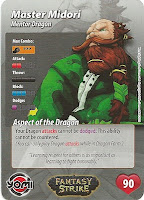
card from Yomi game
Characters add flavor
The first pro that I have found in Yomi is the different characters. This game could mechanically work with a standard deck of playing cards (where you make each suit a certain type of move), but it would have no flavor. Instead, with the characters, the differences in decks, and the different breakdown of moves, you truly get the feel that each character has a unique style that you need to embrace in order to win.  Along the lines of theme, the next pro that I have for Yomi is that I really enjoy the artwork. Whereas I don't often care much about the components in games (unless they are really good or really bad), I found the art in Yomi to be a definite highlight of the game.

Next, I really liked the fact that each card was double sided. This essentially doubles the possible plays that you have available. This is critical as you are trying to stay one step ahead of your opponent. If all of your cards were one-sided, then you would be more likely to guess what your opponent is going to play based on how many cards they have in their hand. However, with the double-sided cards, you are almost guaranteed that they at least have a chance of countering whatever card you are going to play.
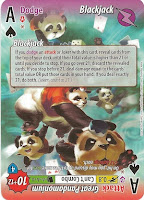
double sided Yomi card
Double-sided cards add variety
When playing Yomi, however, I found that I was often frustrated by not having my deck "flow" well. I will freely admit that I have not played Yomi to the point where I consider myself a master at the game, and so this con may go away with continued play. However, I often found myself short on cards, which makes comboing and powering up very difficult (these actions both require several cards to perform). Without being able to combo, you are not able to hit your opponent for more than a few points each turn, which in turn leads to the pace of the game being much slower. Now, Blocks allow you to draw extra cards, so if you are very good at picking the right time to play a Block, you may not suffer from this problem - but it was frustrating in the games that I played.

My other con is really just a confession - I was not in love with the Attack/Throw/Block mechanic. I think that it works, but it wasn't something that captured my imagination and made me want to keep playing it. Since this is the crux of the game, you can imagine that the game didn't really click very well for me.

Overall, I give Yomi a 7.5/10. Even without being enamored with the key mechanic, I thought that it functioned well enough to give it a respectable score. The closest comparison that I know of is BattleCON, which I also gave a 7.5 to; however, in a direct comparison, I believe that Yomi would score the victory.  At $100 for the complete Yomi set, I would highly recommend trying out a friend's copy or buying some of the smaller sets before investing in buying the complete set.

Want some more opinions? You can read a review of Yomi at Play Board Games, or another , or another Yomi review at Games With Two.

I would like to thank Sirlin Games for providing me with a review copy of Yomi.