Risk Legacy Review

Risk Legacy game


I have drooled over Risk: Legacy since I first saw that it was coming out. So, when I moved to Philadelphia and was offered a spot with a group just starting a campaign of it, I jumped at the chance to join them! Now, let me tell you that we have played 5 of the 15 games so far - so, I have a good feel for how the game is played, but have not opened every pack. However, I am also intending to write this review without spoilers: so if you're looking for spoilers, this may not be for you, but if you're looking for a good feel on how the game is played, you don't have to worry about me ruining anything - everything I tell you should be found in the rulebook or was at least known to us before we started playing our first game. (Note: I had a pretty picture of the board that we're using, but I realized that if you looked too closely, you might see a spoiler, so I removed it - I have checked all of the other pictures, and they are safe.  The Enclave of the Bear pictures shows only a starting power - which you select before your first game.) With that said, let's dig into Risk: Legacy!
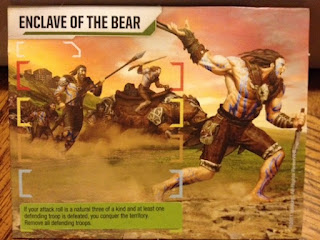
new Risk Legacy Game faction
Select your faction - with a starting power
Risk: Legacy is Risk; but with extra stuff. In Legacy, each player starts with a headquarters and a handful of troops; all of which are on the headquarters. He also starts with a faction from the game. The first time that you play, each player selects a faction, but also gets to select which of two abilities that faction will be able to use - and that faction (not necessarily that player) will use it the rest of the time that you play Legacy. Your goal is to capture four "stars." If a player has never won a game, then he starts the game with a star. Each headquarters is a star, and you can also turn in four "resource" cards to gain a star. When playing the game, you basically play with standard Risk rules. You add up your number of territories (and add population based on cities that you own - this part is new), and divide by three, rounding down. This is the number of armies that you collect each turn (minimum of three). You also get extra armies for each continent you control. From here, you can attack as many territories as you want. The attacker can roll with up to three dice, the defender with two, and the defender wins ties. If you take a contested territory on your turn (ie, you kill somebody else to do it), then at the end of the turn you get a card - when selecting a card, you can either select a card of a territory you control (territory cards can be worth anywhere from one to six resources), or you receive a standard resource card if you do not control any of the available countries. On future turns, you can trade in four cards for a star, or you can trade in cards for additional armies - if trading for armies, then the number of resources on the cards is added to determine how many you receive (with a bonus for having larger numbers). The only in-game change that I haven't mentioned are that you each will start the game with one "scar" card. These cards specify when they can be played, and to play them, you peel the sticker off of the card, place it on the appropriate territory, and then this affects that territory the rest of the time you play this copy of Risk: Legacy! Gameplay continues like this until one person has collected four stars. Then, they win the game, and sign the board (meaning they will get a "missile" instead of a star to start the next game; missiles let you change a single die roll to be a 6). After signing the board, they have the option of naming a continent (giving them a permanent one army bonus whenever they control that continent), place a major city (a city with a population of two that only they can start in), destroy a resource card (rip it in half and never use it again), or a few other things. Anyone that was still alive can either place a minor city (population of one, but nobody can start there), or add a resource icon to a territory.

Ok, that was one of my longer introductions, but now it's time to get to the pros and cons. The first pro is that Risk: Legacy is the most innovative game that I believe I have ever played. I was incredibly hesitant when I first heard that you write on the board, destroy cards, and generally make your game vastly different than when you bought it. However, this part of the game works incredibly well. You truly feel like you are in a campaign throughout the game, and in later games, you will remember what happened in the earlier ones. This will also affect how you play - for example, we had one time when a player had named Australia. He refused to play any negative scars in Australia, because he knew that it would negatively affect him if he controlled Australia in future games. This ever-changing game is an amazing concept, and I am really hoping that more games do something similar.  And, when I think about it from a financial perspective, if I pay $60 for a copy of Risk: Legacy, and I play it and enjoy it for the 15 games of the campaign, then I'm paying $4 per play - I have paid a lot more than that per play for many of my games!

Risk Legacy Do Not Open Ever
I'm ready to open this!
Next, I think that it is awesome that not each game has the same cards. When I was first reading about the game, I thought to myself, "ok, that'll be neat, but once I've played it 15 times, I'll have to move on." I now realize that I was wrong. First of all, for those of you that really enjoy the basic game of Risk, there's no real need to stop playing the game after 15 games - just because the world is no longer changing does not mean that the game itself is no longer playable. You can continue to play the game, and it will really feel like it is "your" version of Risk; because you and your friends will be the ones that caused the board to be setup how it is. However, if you constantly want the game to change, you can also figure out how to tell which copies have the same cards (I believe this is by serial number) and get a new copy of the game - one with different contents, and play through it again! Now, I don't know what all is different in the games, but I have looked at spoilers for the "Do Not Open. Ever." pack (oh, don't give me that look - we are playing on a friend's copy, and he keeps refusing to open it; you know "do not open" means "open me immediately"), and this has confirmed to me that there are different variants.

Now, those are really my only two pros to Risk: Legacy. But they are huge pros! So, instead of me trying to make something else up, let's just acknowledge that they are gigantic pros and count them both twice. So, now we're at four pros, and I can move on to the cons. Oh, I just remembered another one - the game goes much faster since you only have to get four stars instead of eliminating everyone. There you go, five pros.

The first con is that there is really very little change in the gameplay. Whereas all of Risk 2210's changes are to the gameplay itself, in Risk: Legacy I found myself playing through the game in order to get to the post-game. I was ready to customize the board, open packs, etc., and the game itself was all secondary to this. If you enjoy Risk, you will have no problem here at all! However, I do not enjoy the standard Risk, so I would often find myself bored while waiting for the game to end.

The second con is really more of the same. I don't like how easily strategy is derailed by poor dice rolling. There are some scar cards that can modify dice (make them plus one or minus one), but most of the game will be spent seeing who is better at rolling six-sided dice. I am not good at this. So, this part is incredibly frustrating.

Next, Australia is still overpowered. Whoever controls Australia will probably win the game. Fortunately, this one has a caveat - you can fix this. Since the winner of a game can make a continent bonus plus one or minus one, you can make Australia only worth one extra army instead of two. Plus, one of the scar cards (ammo shortage) makes it harder to defend a country. In addition, players cannot start on "scarred" territories, so this also can prevent players from being allowed to even start in certain territories in Australia. However, in your first few games, this might be a problem.
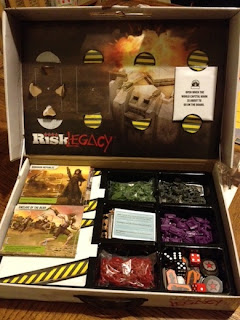
Risk Legacy What is in the box
What's in the box
Finally, because of the abbreviated timeframe in Risk: Legacy, I think that a player who is close to being knocked out (the difference between "knocked out" and "eliminated" is that if all of your armies are destroyed, you start your next turn with half of your initial armies on any valid starting territory; "eliminated" means there are no starting territories) has very little chance to come back in the game. Not only have you probably lost your own headquarters, but it is incredibly difficult to ever accumulate enough armies to actually challenge the other players that are still doing well - especially since they are collecting more armies than you each turn. Your only chance is to somehow stay alive (if you are knocked out, then they get to take all of your resource cards), gather enough resource cards to get a large amount of reinforcements, and hope that your opponents fight a lot in the meantime. And, if they see you gathering resource cards, they will probably only leave you alone if one of them is close to winning the game (since they will know that they can steal your cards, which will help them win).

Overall, I give Risk: Legacy an 8.0/10. I absolutely love the ever-changing game. However, the ever-changing game is all centered around Risk. I wish that they had started with Risk 2210 and had then added the changing board to it - having a combination of new gameplay and new outside the game effects. Either way, I love that Risk: Legacy has introduced an entirely new idea into board games - one that I am very excited to see if people will incorporate into future games!

If you like war games, you might also check out Summoner Wars, Test of Fire: Bull Run 1861, and Axis and Allies: Pacific. Or, if you want another opinion, check out this Risk Legacy Review on Play Board Games.

NOTE: I have been informed since writing this review that the only packet with variance is the "Do Not Open.  Ever." packet.

Castle Panic Review

Castle Panic game in play


A simple cooperative game that I people recommended to me is Castle Panic.

Castle Panic is like a tower defense video game - swarms of evil monsters are coming at your castle, and your job is to stay alive. (Yes, killing them is nice, but for all that is good, just stay alive, man!!!) Each turn, you start by drawing up to your hand limit. Next, discard a card (if you want) and draw a new one (if you discarded one); and then you can trade a card with another (willing) player. Now - smash the enemy!!! You can play as many cards from your hand as you would like (normally as many as possible). Primarily, this is done by playing cards that match the color and circle that an opponent is in, which inflicts a point of damage per card played (the map is built with four rings surrounded by a forest - each ring except the center one has corresponding cards in the draw deck). Finally, the bad guys do stuff - first they all move closer to your castle, and then you draw two more of them from the pile. This continues, again and again. Until the game is over - because you have either died off by allowing all of your castle towers to be destroyed, or because you have stayed alive through all of the swarms of (pile of) enemies, and have managed to kill off all of them.

The first thing that I liked about Castle Panic is that it is very simple. It's easy to learn, and also incredibly easy to teach. What's more, the game flows well and is fairly intuitive once you have learned it. This allows it to be played by just about anybody - friends that don't like "complicated" games, kids (probably starting at around 8 - though I made that number up, because I don't have children, so I really have no idea), or anyone else.  Unfortunately, the simplicity of the game comes at a cost - and the replayability suffers.

Castle Panic - now time to panic
My castle is never unscathed
The next thing that I like about Castle Panic is that it feels intense. The main thing that I heard when I asked people about this game is that "it's a bit too easy." Of the games that I have played, I never felt like I ran away with a game. Sure, I thought that at various times throughout my first game, but then the monster draw pile decided to smite my arrogance by having me draw 9 tiles on one turn! (We drew a "Draw 4 monster tiles," and the Boss that forces you to draw 3 monster tiles on the same turn. I will admit this probably isn't the normal situation, but I'd guess that other people encounter it periodically.) Even in the games I won, I felt like I was close to being annihilated, as I always had at least half of my towers destroyed.  So, I think that the people who think Castle Panic is too easy really enjoy playing masochistic games like Forbidden Island on the "you start off the game drowning" difficulty.  (Oh, there's also a variant of Castle Panic where you start the game without castle walls.  I feel that everyone who thinks the game is too easy should play with this variant and then tell me if it solves their problem.)

However, though I liked Castle Panic, I had a few cons. First off, it's somewhat disappointing that there is no difference between players. For example, you have no "roles" like in Pandemic. Really, the only difference between playing with one player versus playing with six will be how often it is your turn, and how many cards you can draw and trade. This simplicity keeps the game from having as much replayability as I would like.

The next con that I had was that it was too difficult to kill a monster that made it into your castle. Specifically, there is one card in the deck that lets you kill a monster in this situation. One! Yes, if you are playing well, it doesn't become much of an issue. Yes, monsters do lose a hitpoint each time they destroy a wall or a tower (I hadn't told you that part), so they will slowly die either way. But, there is only one card that allows you to kill a monster that makes it's way into your castle.  One!!!

Finally, I thought that the "Giant Boulder" was a bit too random. Essentially, this monster tile simulates the enemies massing together to roll a giant boulder at your castle. The boulder will destroy everything in it's path (even other monsters), and will only stop once it destroys a wall or tower. This really seems to be one of the main ways that walls and towers are destroyed (there are four Giant Boulders in the game). So, whereas I see the need for these tiles in play balancing terms, I still wish that it were a bit less random than "hey, you drew a tile and so now something is going to instantly blow up."

Overall, I give Castle Panic an 8.0/10. It's fun and easy to play - definitely worth a look. However, the game feels too similar from one play to the next for me to envision myself wearing out a copy.  Yet, it's good enough that I will occasionally pull it out and give it another game.

Want more opinions?  Check out Play Board Game's Castle Panic Review or Board Game Family's review of Castle Panic. Alternately, if you want to read about other cooperative games, you might also check out Reiner Knizia's Lord of the Rings, Shadows Over Camelot, and Sentinels of the Multiverse.

I would like to thank Fireside Games for providing me with a review copy of Castle Panic.

Fealty Review


An interesting area control game by a small publisher (Asmadi Games) is Fealty.

Fealty, at it's core, is a very simple game. The (full) game consists of eight rounds, in which players each place a single piece. Specifically, each player starts with three cards in his hand. Each player selects one of his three cards and all of the players reveal them at the same time. Whoever placed the lowest numbered card places first, followed by the other players in ascending order. Finally, each player draws back up to three cards. There are a couple of rules to note when playing pieces (your cards each correspond to one of your pieces), though. First, you cannot place on the same "duchy" (one of the boards that makes up the playing area) as another player in a single round. Also, you cannot place in the same row or column that you have placed a figure in earlier. Finally, you can't place on top of "obstacles" - mountains (apparently there are no dwarves in Fealty), other pieces, etc. At the end of eight rounds, you add up influence - again, starting with the lowest numbers claiming tiles, and continuing until all of the pieces have claimed everything that they can. Whoever has the most influence is the winner.

The first thing that I like about Fealty is it's simplicity. Essentially, the designers have been able to distill area control to it's core; and what is left is the game of Fealty. Everything you need for a quality area control game is included, but there is really very little excess. This allows you to have a game with depth, yet it can be played in around 30 minutes. You are able to have a give and take interaction with other players where you can block them from claiming influence (of course they'll do the same to you), or you can peacefully each try to claim as much as possible (well... at least theoretically you can do this - I've not seen it.  Of course, I'm normally the one doing the underhanded blocking of my opponents, so maybe I'm the wannabe warmonger in this scenario.) Due to the nature of the scoring, it is entirely possible to remove most of the value of your opponent's early placed piece by placing a piece of your own (with a slightly lower number) which will claim several of the squares around your opponent - thus cutting off his access to other tiles.

The next thing that I like about Fealty is it's replayability. The game comes with double-sided terrain, and also comes with two different sets of pieces. You can play the game where all nine of your cards are available to you from the beginning, or you can play where you draw three at a time. You could even play where you get to pick cards from each of the two sets, if you really wanted to.  These fairly minor inclusions add quite a bit of replayability. I could play it repeatedly (which is really the definition of replayability - which Blogger keeps telling me isn't even a word; stupid Blogger, it should play more board games) and not feel like I always know where the best placement of my figures should be on the board (since the board will be different every time).

The third thing that I will mention is the collapsing options throughout the game. I thought this part was very interesting. Since you can't place in the same row or column that you have previously used, the number of options you have throughout the game will decrease (and the importance of some of the pieces' powers that allow you to move will increase). This adds quite a bit to the strategy (though I'm far from having mastered it). You have to decide whether you want to use your large pieces, which can claim a lot of territory, in the middle of the board early (while you can still legally place there); thus opening yourself up to having your opponents block most of your scoring, or if you want to wait until the end to place that large piece. You have to decide if you should leave an open spot somewhere in the middle for your piece(s) to be placed towards the end of the game - and hope that your opponents don't take it from you. As the game progresses, your options become more and more limited as you eliminate a row and column each round, and if you're not the first person to place, your opponents will even be eliminating entire duchies!  By the end of the game, you may only have about 5-10 legal placements.  And these placements may be horrible if you don't plan ahead (author's note: this is from experience; my final placements in Fealty are often horrible).

However, I did have some cons with Fealty. First, I felt that the rules were unclear on some points. Fortunately, there were examples, so I was able to figure out what I think the correct rules are, but I'm still not entirely sure. I wish that they had addressed some of my issues more directly. Specifically, (I will admit that I may have missed these things in the rules) I never saw the rules explain what a "conflict marker" does (we assumed it was an obstacle). I also never saw it clearly tell me if an opponent's influence marker counts as an obstacle to prevent you from drawing a path through them to claim tiles on the other side. (An example suggests that opposing influence do count as obstacles, so we played it that way).

The other con that I have is harder to explain. Because of how the scoring works in the game (and that the person influencing any given tile might change from one round to the next until final scoring), the first game or two will be very hard to see how well each player is doing. Until the end when you place all the influence markers, you won't know if you are doing winning or getting obliterated. However, once you get past this initial blindness, you run directly into "Analysis Paralysis" (taking a long time to decide what to do on a turn because of too much information or too many choices). Since the influence is not immediately visible, you will have to continually look around the board to determine what positions might be valid. And, inevitably, once you finally find the correct position it is illegal because of your previously placed pieces (there's an alliteration for you), and so you have to start looking all over again!  This is almost begging for a computerized version of the game that allows you to highlight where each person is successfully influencing (and where you can legally place).

Overall, I give Fealty an 8.0/10. I was actually quite pleasantly surprised with the game. It's not something that I'm going to yearn to play repeatedly, but I thought that it was very intuitive and really a very solid title. This is now the second game I've played by Asmadi Games (Innovation being the first), and I am pretty impressed with this small publisher!

If you like Fealty, you might also read about Princes of Florence, Smallworld, and Alien Frontiers.

I would like to thank Asmadi Games for providing me with a review copy of Fealty via Game Salute.

Puzzle Strike Review

Puzzle Strike pink box


A game with an interesting take on the deck building mechanic is Puzzle Strike.

Specifically, you could say that Puzzle Strike is "what Quarriors was trying to do" (build a "deck building" game without cards). Instead of cards, Puzzle Strike is played with chips. And, instead of the traditional means of victory (victory points of some sort at the end of the game), it mixes in an element of classic Nintendo-style puzzle games like Tetris. Each turn you ante a gem into your pile (like having rows fall down on your screen), and the last person to have his ante pile filled up is the winner. So, to start each turn, a player takes a one point gem and puts it in his ante pile. Next, he is able to perform an action using the chips in his hand (actions can include combining chips into larger chips and "Crashing" chips to remove them from your ante pile and send them to the opponent on your left (who can counter Crash, etc)). After playing an action, you have to buy a chip from the bank. If you have no money, then you have to buy a wound chip - which does nothing, but it makes your deck worse because it keeps you from drawing something useful. Finally, you discard all of your chips and draw back up to five. And, depending on the size of your ante pile, you may draw some bonus chips (one bonus chip for every three points in your ante pile). Finally, you check to see if you have ten or more points in your ante pile - and if you do, then you lose (after all, your screen has filled up - you can sit there envisioning a TV screen with a pixelated "Game Over" label flashing).

Panda chips for Puzzle Strike
Gambling Panda
The first thing that I love about Puzzle Strike (yes, love) is that there are character specific chips. Each "deck" starts with six one-point gems, a Crash gem, and three character specific gems. I have not played enough to see if any of the characters are overpowered (I've played 4-5 times), but they at least all seem balanced. However, each character plays quite differently. Some are good at defense, some help you perform extra actions, one transforms into "Dragon Form" which causes him to ante 2's instead of 1's, but also makes his crashes un-defendable - and one (the Gambling Panda) has a chip that can only be used when he has 10 or more points in his ante pile (is about to die). I wish that more games would start doing this! Can you just imagine playing the Star Trek: Deck Building Game and getting to pick whether you're using the Klingon, Romulan, or Federation starting deck? Sure, Nightfall allows you to draft at the beginning of the game to make player-specific piles, but Puzzle Strike is the only game I've seen that allows you to actually start with different items that have different powers - and it does it well!

The next thing that I like about Puzzle Strike is the vintage puzzle game feel. I really think that this theme allows it to be played and enjoyed without feeling as competitive. Yes, I want to win (as with all games), but the theme is just relaxing and allows you to enjoy the act of playing the game - almost like it reminds me of my childhood to an extent.

Puzzle Strike Leprechaun
Dragon Form!
Next, I think that it's interesting that, essentially, the entire game is played with a countdown timer. Every turn, each player gets closer to losing. Sure, you can counteract this by playing Crash chips to send some of your pile at your opponents, but unless you actively do something to prevent it, you will lose the game simply by playing. For whatever reason, this mechanic resonated well for me.

Finally, I like that the closer you are to losing, the more chips you get to draw. This leads to more combos being played. If I am doing incredibly poorly, I am more likely to draw several Combine chips (these let you combine two gems in your ante pile and perform another action) and then Crash a larger gem at my opponent. It also gives me a better chance of drawing something that helps me to defend. It can do quite a bit to balance out the luck of having to draw the right chips at the right time.

For the most part, I really enjoyed Puzzle Strike. However, there were a few things that I should point out. First of which is that a lot of the chip piles will be left untouched in most games. Whereas, in our first game every chip seemed crucial (and, truly, I haven't seen any chips that aren't ever useful), some are simply better than others. Specifically, Crash and Combine are better than a lot of the other Action Chips - so unless there is a chip that lets you string together several Actions, you will probably find yourself mostly focusing on buying the Crash & Combine (and 2-4 of the other chip piles; especially if there are some that let you steal other people's Crashes and Combines... and then you'll be quite pesky.  And other people will have to play the "Really Annoying" chip on you.  That's right - that's what the chip's name is.  Why?  Well - because it's really annoying.). To be fair, though, this is true in any deck building game - you are trying to hone your deck as much as possible, and so you will often avoid buying good cards in an effort to get better cards. (*cough* I mean chips.  Did I say cards again?  It's like there's not really a difference or something.)

The next con is something that has already been addressed by the game company. It is very easy in Puzzle Strike (during your turn) to get your hand, in-play chips, and ante piles confused. And, if this happens, it can inadvertently change the game dramatically (by changing how many gems are in your ante pile). Fortunately, the Puzzle Strike Upgrade Pack provides you with playmats to keep track of each of these things separately.  Sweet - now if only it weren't $25.  I'd guess at some point they will combine them and sell them together for a discount.

Those are really my only two (very minor) cons. I will mention two other things briefly, though. Using chips instead of cards is unique. It doesn't really affect gameplay at all (which is why I kept referring to chips as cards), but it does reinforce the theme, so that was nice. Finally, the rule that forces you to buy a chip each turn is interesting. It forces players to pay attention to how they construct their deck to ensure that they can always afford to buy something. At the same time, it can water down a deck - which I think is intentional. This prevents the game from dragging out if several players are all able to build decks that consist of only Combines and Crashes.

Overall, I give Puzzle Strike a 9.0/10. I was quite pleasantly surprised by this game, and I'd recommend that anyone that likes vintage puzzle games or deck building games should "hit start" on this one.  (Whoa!  Vintage Game reference!!!  If only anybody else thought I was nearly as funny as I did!)

And, if you like deck building games, you might also want to read my reviews about Thunderstone or Dominion; or if you like the Fantasy Strike world that Puzzle Strike is set in, check out Yomi.  Or, for a complete change of pace, you might check out Glory to Rome.

I would like to thank Sirlin Games for providing me with a review copy of Puzzle Strike via Game Salute.