Showing posts with label euro. Show all posts

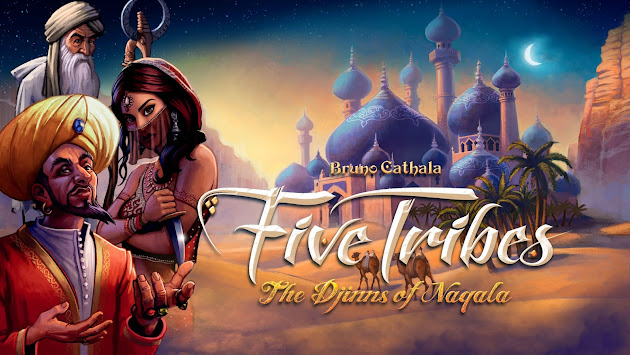
Five Tribes Review


There were a lot of great games released at Gen Con this year. Five Tribes, from Days of Wonder and Bruno Cathala, was one of the most talked about - and hardest to get.

Now that the game has finally hit distribution, does it live up to all that hype?

No "board" but still takes up a lot of space!
Looks good doing it, though.
Five Tribes is a part logistics puzzle, part action selection, part point salad game that pits players against one another, each of them trying to best maneuver the five tribes of the "Land of 1001 Nights" in order to become the next Sultan!

The game board is made up of 30 individual tiles, which are arranged randomly before each game. Meeples of 5 different colors are placed on these tiles, also randomly. Players will take turns picking up a group of meeples from any tile on the board, and dropping one off at a time, mancala-style, until they drop the last meeple they picked up. One important rule when choosing which tile to end up at - there must already be a meeple on the tile the player ends with that matches the color of the meeple she is placing on the tile.

Days of Wonder has included some large, but superb player aids.

Once the player finishes distributing the group of meeples she picked up, she performs two actions. First, she picks up all of the meeples on the tile she ended on that match the color of the meeple she placed there (always at least two because of the rule I mentioned above), and executes that tribe's action. If the player was able to pick up all of the meeples on a tile (because they were all the same color of the meeple she placed there) she gets to place one of her camels on the tile, and will score that tile's depicted points at the end of the game. Then, she also gets to perform the action of the tile she ended on.

The leftmost tile allows a player to
buy 2 goods cards for 6 gold.
The actions of the tribes and the tiles are quite varied and give players the opportunity to score points in a variety of different ways. Some allow players to get money right away, which can be used in game, or exchanged 1:1 at the end of the game for points. Some allow players to acquire powerful Djinns which can grant either in-game or end-game bonuses. And others will allow players to go to the market, and attempt to assemble sets of goods card which can be traded in for large amounts of points/money.

Gameplay continues until either one player places all of her camels or there are no legal moves left (no groups of meeples can be distributed in such a way that the final meeple to be placed will be the same color as one already on the destination tile).

The biggest potential problem for Five Tribes is how many options players are presented with, all at once. Five Tribes is not a game that starts off at a reasonable pace, and then ramps up as the game progresses. For the most part, from when the game begins, the number of choices for the players is gradually decreasing, as more meeples are removed from the board, and more tiles become owned by players. That not only can make the game intimidating and difficult to learn for new players, but it can also lead to a lot of analysis paralysis for experienced players. This can lead to awful amounts of downtime for the rest of the table. This also, however, means that player turns are almost never boring, and each point earned by players really feels like the result of proper planning and execution.


One of the most exciting parts of Five Tribes is something I haven't mentioned yet - bidding for turn order. Before each round, players will bid for turn order. There is a bidding track, like in Amun-Re or Vegas Showdown, where the values are fixed, and in turn order of the previous round, players place their bidding pawns on the amount of money they are willing to pay for turn order. This is interesting in itself and leads to a bit of bluffing and gamesmanship, but keep in mind also that at the end of the game, money is converted into points at a rate of 1:1.

The main mechanism of Five Tribes, the manacala-esque distribution of meeples is so much fun and super satisfying. Players are challenged each turn to both get as many points as they can (hopefully more than they bid for their turn order) as well as keep from setting the other players up to either take ownership or a tile or otherwise have a huge turn.

Five Tribes absolutely lives up to the hype that surrounded it during Gen Con. The game is a solid 9.0 in my book - one of my favorite releases this year.

Istanbul Review


Istanbul is the Kennerspiel des Jahres nominated (2014) game from famed and accomplished designer Rudiger Dorn. It has players assuming the role of a merchant and his assistants moving through a bazaar, interacting with the various vendors and meeting up with other merchants, family members, and even the governor!


Istanbul's "board" is made up of several separate tiles, which are laid out in a 4x4 grid. This can be done randomly, but the rules do suggest specific layouts for beginner and advanced games. The goal of the game is to gather goods and money in order to acquire gems. The first player to acquire 5 gems (6 in a two player game) will be the winner!

On a player's turn, she must move her merchant and her stack of assistants either 1 or 2 spaces (not diagonally) and do 1 of 3 things:


  1. If none of her assistants are already on the tile, she drops one off, and performs the tile's action.
  2. If one of her assistants is on the tile already, she picks that assistant up (places it on the bottom of her stack) and performs the tile's action.
  3. If none of her assistants are already on the tile and she also has none in her stack, her turn ends. 
Here, the yellow player need to decide if she will go back to a tile where she had previously dropped off an assistant, or go to the fountain (the only tile that can be used without an assistant) to call back all of her assistants.

A lot of the strategy of Istanbul is planning out a couples turns ahead, so that you don't have to deal with option 3, and do basically nothing on your turn. 

The tiles that make up the board allow players to do a variety of things. Some are Warehouses that allow players to load as many of a certain kind of good as they can carry in their carts. Some are Markets that allow players to sell sets of goods for money. Others are Mosques that reward players with upgrade tiles for having a certain number of goods.

Two of the more important tiles are the Sultan's Palace and the Gem Market. These are the two main ways to acquire gems. At the Sultan's Palace, players can trade in goods for a gem, which makes the next gem more expensive for the next player. The Gem Market lets players buy gems, with each successive gem purchased more expensive than the last, just like the Sultan's Palace. 

The first available gem at the Sultan's Palace (in a 2 player game) costs 1 jewelry,  1 fabric, 1 spice, and 1 fruit. Once that gem is taken, the space it was previously covering is added to the next gem's cost.

Istanbul is a game that hit me right in my wheelhouse. It has a lot things that I love about board games, like variable setup, player powers (though you don't start with them), advanced planning, upgrades/engine building, and even some dice rolling! 

From left to right: The blue upgrade tile adds another assistant to a player's stack, the yellow upgrade tile (my favorite) allows a player to pay $2 to retrieve an assistant from anywhere on the board and place it in her stack, the red upgrade tile allows a player to set a die to a 4 or reroll whenever rolling dice, and the green upgrade tile allows a player to purchase 1 of any good when visiting a warehouse.

Speaking of upgrades and dice rolling, let me talk about the upgrade tiles. There are four total, and just like the Sultan's Palace and Gem Market, they become more expensive as they become purchased. They are also pretty important to doing well in Istanbul. Once players are more familiar with the game, an interesting race happens in the beginning of the game where the players will rush to grab either their favorite upgrade tiles or a cart expansion.

(Left) At the beginning of the game, each player can only have 2 of each good. 
(Right) By visiting the Wainwright tile, players can purchase cart upgrades for $7. 

Players have to visit the Wainwright during the game as early as possible, because the additional capacity will allow them to purchase upgrade tiles they may have been priced out of, it makes it easier to make money at the market tiles, and it makes it much easier to acquire gems from the Sultan's Palace. 

There is so much to like about Istanbul. Mr. Dorn has not only reimplemented a version of his Goa auction mechanism, but he has finely crafted a fantastic medium weight strategy game. Istanbul has so many options for players to explore, with many interesting decisions to be made each turn, and planning ahead is very much rewarded. The act of planning out your actions in just the right order so that you can not only do everything you need to do, in the order that you need to do it in, and also end up with all of your assistants back in your stack is just so satisfying. 
One thing I don't always love about the game is the luck of the cards and the dice. Some of the cards are just better than others, especially if they are drawn at exactly the right/wrong time. The dice can really hurt a player who doesn't have the applicable upgrade tile, and can result in several wasted actions. The interesting aspect that arises from the randomness of the dice, however, is that the value of the dice manipulation upgrade tile is a bit more fuzzy than the values of the other 3 upgrade tiles.

After I got Istanbul, I played it 5 times in 4 days. It is absolutely one of my favorite games from this year. It plays well with all player counts, does not overstay its welcome, and despite having a fair amount of complexity, I feel like I could teach this game to almost anyone. Istanbul deserves all the hype around it, and despite being up against two very strong contenders for this year's Kennerspiel des Jahres (Concordia and Rococo), I believe it should (and will) win the very prestigious German "expert game of the year" award. I give Istanbul a 9.0/10.

Concordia Review


Don't worry, the game is not as boring as the awful cover might suggest.
Also: sweet Phillies bits bowls are not included. =P

Mac Gerdts has made a name for himself based on the rondel mechanism. All of his previous games have used the mechanism, for better or worse. I personally have only played Navegador, but I find the rondel in that game to be a lot of fun. It keeps turns simple and forces players into a rhythm that all players are subject to - but whoever works the most efficiently within those constraints will be victorious.

Look Ma! No rondel!

With Concordia, Mr. Gerdts ditches the rondel...sort of. Despite not having an actual rondel, Concordia still has players forced into adapting to a rhythm that Mr. Gerdts - at least at first - has designed for them. But does this alternate take on the rondel make for a fun game? Let's find out!

Introducing New Rondel! New and Improved - With more Cards!!!

As I said, Concordia has no rondel. In its place, each player is given the same deck of 7 cards. A player's turn consists simply of playing any card in her hand, and executing the card's action.

After playing this card, a player would choose either the top or bottom action.

The game consists of two basic areas the players will be competing in - the map and the card draft pool. On the map, players will be competing for colonies which grant resources. Above the map is a card draft area where players can draft new cards into their decks, which will grants players with either new actions or duplicate of one of the starting actions.

All roads lead from Rome.

Players being with two colonists in Rome, and their starting action cards. These allow players to move colonists and build, produce in a region, trade resources and money with the bank, copy the last card played by another player, or pick up all of the cards they have previously played back into their hands. 

For every VESTA card a player has in her deck at the end of the game, she will score 1 point for every 10 Sestertii she has.

As I mentioned above, a player's turn consists simply of playing a card from her hand, and taking the card's action. The game will end when the final card is purchased from the draft row. Then comes one of the most interesting parts of the game - final scoring. In Concordia, each card in a player's deck will score points based on how much or how well a player has done at a portion of the game, an interestingly, what each card gives points for is usually what the card's ability helps the player to do. So, for the example below, this player would want to have as many provinces and colonists as possible by game end.

Interestingly, these cards help a player during the game to acquire the provinces and colonists required to score at the end of the game.

Before I get to what I like about the game, let's talk about its shortcomings. The first, and I think biggest, has to do with a possible lack of variety when playing this game multiple times. Players start the game with the same cards, the game ends when all cards have been purchased (so almost every card will be played in every game), and the cards available to purchase have abilities that are either duplicates of starting cards or not-so-exciting-new-actions. So aside from a few things that are randomized during setup, not much will change from game to game. This is one of those game, especially if playing against the same opponents, where players could fall into a strategic "rut" - wherein they end up following the same VP path every game.

So many choices....delicious, delicious choices...

That being said, there is a lot to love about this game. The mechanism of playing cards until a player  wants/needs to take a turn to pickup all of her played cards is great. It feels fairly similar to another big Euro release from last year, Lewis and Clark, in that way. Doing as much as you can in between picking everything back up is beneficial, but were you able to play things in such a way that every turn between now and then is a productive turn? Or are the cards left in hand useless at this point, and picking everything up early - for less of a bonus (or more of a penalty in Lewis and Clark's case) - makes more sense this time?

In Concordia, whenever you pick up your discard pile, you have access to every card in your deck, but the longer you wait to do so, the bigger the bonus you get.

I mentioned above that the cards available for purchase are less than exciting. Well, part of the reason for that is because all of the actions players start the game with are all already pretty interesting and satisfying. Turns in Concordia are short and simple, but choosing which action to play next is always a tough decision - mostly because most of a player's choices on a turn are generally good. 

The card draft area drives much of the game's interaction.

Player interaction here is fairly minimal. Players can colonize cities near each other and gain the benefits of another player's Prefect action, but the card draft is where the most interesting player interaction takes place. A lot of the "game" in Concordia is in how well players are able to balance between drafting new cards before their opponents and how well players are able to expand their empire on the map. Because the cards players are drafting grant them new actions as well as victory points at the end of the game, the competition for cards can get intense.

Concordia is a very well designed, interesting, and (most importantly) fun board game. Part deck builder, part card draft, part hand management, and part (small part) dudes on a map, Concordia combines all of these mechanisms successfully - all in a way that keeps gameplay simple but also satisfyingly deep. With this game, Mac Gerdts has shown that he is more than just the "rondel guy." I enthusiastically rate Concordia an 8.5 - and eagerly look forward to Mr. Gerdts' next effort.